
| UNITED STATES | ||||||||||||||
| SECURITIES AND EXCHANGE COMMISSION | ||||||||||||||
| Washington, D.C. 20549 | ||||||||||||||
FORM 40-F
| REGISTRATION STATEMENT PURSUANT TO SECTION 12 OF THE SECURITIES EXCHANGE ACT OF 1934 | ||||||||||||||
| OR | ||||||||||||||
| ANNUAL REPORT PURSUANT TO SECTION 13(a) OR 15(d) OF THE SECURITIES EXCHANGE ACT OF 1934 | ||||||||||||||
For the fiscal year ended December 31 , 2022001-37400
(Exact name of Registrant as specified in its charter)
(Province or other jurisdiction of incorporation or organization)
(Primary Standard Industrial Classification Code Number (if applicable))
(I.R.S. Employer Identification Number (if applicable))
Attention: Jessica Hertz, General Counsel and Corporate Secretary
(Address and telephone number of Registrant's principal executive offices)
(302 ) 636-5400
(Name, address (including zip code) and telephone number (including area code) of agent for service in the United States)
Copies of all correspondence should be sent to:
Jessica Hertz
General Counsel and Corporate Secretary
Shopify Inc.
151 O'Connor Street, Ground Floor
Ottawa, ON K2P 2L8
Canada
Tel: (613) 241-2828
Securities registered or to be registered pursuant to Section 12(b) of the Act.
| Title of each class | Trading Symbol | Name of each exchange on which registered | ||||||
Securities registered or to be registered pursuant to Section 12(g) of the Act:
None
(Title of Class)
Securities for which there is a reporting obligation pursuant to Section 15(d) of the Act:
Class B Multiple Voting Shares
0.125% Convertible Senior Notes Due 2025
(Title of Class)
For annual reports, indicate by check mark the information filed with this Form:
Indicate the number of outstanding shares of each of the issuer's classes of capital or common stock as of the close of the period covered by the annual report.
The Registrant had 1,195,697,614 Class A Subordinate Voting Shares, 79,430,952 Class B Restricted Voting Shares and 1 Founder Share issued and outstanding as of December 31, 2022.
Indicate by check mark whether the Registrant (1) has filed all reports required to be filed by Section 13 or 15(d) of the Exchange Act during the preceding 12 months (or for such shorter period that the Registrant was required to file such reports) and (2) has been subject to such filing requirements for the past 90 days.
Indicate by check mark whether the registrant has submitted electronically every Interactive Data File required to be submitted pursuant to Rule 405 of Regulation S-T (§232.405 of this chapter) during the preceding 12 months (or for such shorter period that the Registrant was required to submit such files).
Indicate by check mark whether the registrant is an emerging growth company as defined in Rule 12b-2 of the Exchange Act.
Emerging growth company ☐
If an emerging growth company that prepares its financial statements in accordance with U.S. GAAP, indicate by check mark if the registrant has elected not to use the extended transition period for complying with any new or revised financial accounting standards† provided pursuant to Section 13(a) of the Exchange Act. ☐
† The term “new or revised financial accounting standard” refers to any update issued by the Financial Accounting Standards Board to its Accounting Standards Codification after April 5, 2012.
Indicate by check mark whether the registrant has filed a report on and attestation to its management's assessment of the effectiveness of its internal control over financial reporting under Section 404(b) of the Sarbanes-Oxley Act (15 U.S.C. 7262(b)) by the registered public accounting firm that prepared or issued its audit report: ☒
If securities are registered pursuant to Section 12(b) of the Act, indicate by check mark whether the financial statements of the registrant included in the filing reflect the correction of an error to previously issued financial statements. ☐
Indicate by check mark whether any of those error corrections are restatements that required a recovery analysis of incentive-based compensation received by any of the registrant's executive officers during the relevant recovery period pursuant to §240.10D-1(b). ☐
PRIOR FILINGS MODIFIED AND SUPERSEDED
This Annual Report on Form 40-F of Shopify Inc. ("Shopify", "we", "our", the "Company" or the "Registrant") for the year ended December 31, 2022, at the time of filing with the U.S. Securities and Exchange Commission (the "SEC" or the "Commission"), modifies and supersedes all prior documents filed pursuant to Sections 13, 14 and 15(d) of the U.S. Securities Exchange Act of 1934 (as amended, the "Exchange Act") for purposes of any offers or sales of any securities after the date of this filing pursuant to any registration statement or prospectus filed pursuant to the U.S. Securities Act of 1933 (as amended, the "Securities Act") which incorporates by reference this Annual Report on Form 40-F (or any of the documents filed as Exhibits to this Annual Report on Form 40-F).
FORWARD-LOOKING STATEMENTS
Shopify has made in this Annual Report on Form 40-F and the documents filed as Exhibits hereto, and from time to time may otherwise make, forward-looking statements under the provisions of the U.S. Private Securities Litigation Reform Act of 1995, Section 27A of the Securities Act, and Section 21E of the Exchange Act, and forward-looking information within the meaning of applicable Canadian securities legislation.
The Company's actual future results may be materially different from any future results expressed or implied by these forward-looking statements.
The forward-looking statements represent the Company's views as of the date of this Annual Report on Form 40-F. The Company anticipates that subsequent events and developments may cause these views to change. However, while the Company may elect to update these forward-looking statements at some point in the future, the Company has no current intention of doing so except to the extent required by applicable law. Therefore, these forward-looking statements do not represent the Company's views as of any date other than the date of this Annual Report on Form 40-F.
See Shopify's annual information form for the year ended December 31, 2022, attached as Exhibit 1.1 to this Annual Report on Form 40-F, under the heading "Forward-Looking Information" and Shopify's management's discussion and analysis for the year ended December 31, 2022, attached as Exhibit 1.3 to this Annual Report on Form 40-F (the "Shopify 2022 MD&A"), under the heading "Forward-looking Statements", for a discussion of forward-looking statements.
A. Disclosure Controls and Procedures and Internal Control Over Financial Reporting
All control systems, no matter how well designed, have inherent limitations. Accordingly, even disclosure controls and procedures and internal controls over financial reporting determined to be effective can only provide reasonable assurance of achieving their control objectives with respect to financial statement preparation and presentation.
Disclosure Controls and Procedures
Management of the Company, under the supervision of the Chief Executive Officer and Chief Financial Officer, is responsible for establishing and maintaining disclosure controls and procedures (as defined by the Commission in Rule 13a-15(e) under the Exchange Act) for the Company to ensure that material information relating to the Company, including its consolidated subsidiaries, that is required to be made known to the Chief Executive Officer and Chief Financial Officer by others within the Company and disclosed by the Company in reports filed or submitted by it under the Exchange Act is (i) recorded, processed, summarized and reported within the time periods specified in the Commission's rules and forms; and (ii) accumulated and communicated to the Company's management, including its Chief Executive Officer and Chief Financial Officer, to allow timely decisions regarding required disclosure.
We, including the Chief Executive Officer and Chief Financial Officer, have evaluated the effectiveness of the Company's disclosure controls and procedures as of December 31, 2022 and have concluded that the Company’s disclosure controls and procedures were effective as of December 31, 2022. See “Disclosure Controls and Procedures and Internal Control Over Financial Reporting” in the Shopify 2022 MD&A, filed as Exhibit 1.3 to this Annual Report on Form 40-F.
Management's Annual Report on Internal Control over Financial Reporting
Management of the Company, under the supervision of the Chief Executive Officer and the Chief Financial Officer, is responsible for establishing and maintaining adequate internal control over the Company’s financial reporting. Internal control over financial reporting is designed to provide reasonable assurance regarding the reliability of financial reporting and the preparation of financial statements in accordance with United States generally accepted accounting principles.
We, including the Chief Executive Officer and Chief Financial Officer, have assessed the effectiveness of the Company’s internal control over financial reporting in accordance with Internal Control - Integrated Framework (2013) issued by the Committee of Sponsoring Organizations of the Treadway Commission ("COSO"). Based on this assessment, we, including the Chief Executive Officer and Chief Financial Officer, have determined that the Company’s internal control over financial reporting was effective as at December 31, 2022. Additionally, based on our assessment, we determined that there were no material weaknesses in the Company's internal control over financial reporting as at December 31, 2022. See "Management's Annual Report on Internal Control Over Financial Reporting", which accompanies Shopify's audited consolidated financial statements as at December 31, 2022 and 2021 and for the years then ended (the "Shopify 2022 Financial Statements"), filed as Exhibit 1.2 to this Annual Report on Form 40-F.
We have excluded Deliverr Inc. from our assessment of internal control over financial reporting as at December 31, 2022 because they were acquired by the Company in a purchase business combination during 2022. Deliverr Inc. is a wholly-owned subsidiary whose total assets and total revenues represent 1% and 2%, respectively, of the related consolidated financial statement amounts as at and for the year ended December 31, 2022.
Attestation Report of the Independent Registered Public Accounting Firm
The effectiveness of the Company's internal control over financial reporting as at December 31, 2022 has been audited by PricewaterhouseCoopers LLP (PCAOB ID No. 271 ), an independent registered public
accounting firm, as stated in their report, which accompanies the Shopify 2022 Financial Statements, and is filed as Exhibit 1.2 to this Annual Report on Form 40-F.
Changes in Internal Control over Financial Reporting
In the year ended December 31, 2022, we migrated certain financial reporting systems and their accompanying financial information between cloud environments, which included changes to our underlying information technology infrastructure and internal controls over financial reporting.
Other than the system migration as described above, there were no changes in the Company's internal control over financial reporting that have materially affected, or are reasonably likely to materially affect, the Company's internal control over financial reporting.
B. Identification of the Audit Committee
The board of directors of the Company (the "Board") has a separately designated standing audit committee (the "Audit Committee") established in accordance with section 3(a)(58)(A) of the Exchange Act. The Board has appointed three independent directors, Colleen Johnston (Chair), Robert Ashe, and Gail Goodman, to the Audit Committee.
C. Audit Committee Financial Expert
The Board has determined that Colleen Johnston, the Chair of the Audit Committee, is qualified as an "audit committee financial expert" within the meaning of Item 407 of Regulation S-K. The Board has further determined that all members of the Audit Committee are "independent" within the meaning of applicable Commission regulations and the listing standards of the New York Stock Exchange (the "NYSE").
The Commission has indicated that the designation of a person as an audit committee financial expert does not make such person an "expert" for any purpose, or impose any duties, obligations or liability on such person that are greater than those imposed on members of the Audit Committee and the Board who do not carry this designation, or affect the duties, obligations or liability of any other member of the Audit Committee or Board.
D. Code of Ethics
The Company's code of ethics, the Shopify Code of Conduct, is applicable to all of its directors, officers and employees, including the Chief Executive Officer, Chief Financial Officer, Controller, and persons performing similar functions. The Shopify Code of Conduct, as amended, is available on the Company's website at https://investors.shopify.com/governance/governance-documents/default.aspx. Except for the Shopify Code of Conduct, and notwithstanding any reference to Shopify's website or other websites in this Annual Report on Form 40-F or in the documents incorporated by reference herein or attached as Exhibits hereto, no information contained on the Company's website or any other site shall be incorporated by reference in this Annual Report on Form 40-F or in the documents incorporated by reference herein or attached as Exhibits hereto.
E. Principal Accountant Fees and Services
The aggregate amounts paid or accrued by the Company with respect to fees payable to PricewaterhouseCoopers LLP, the independent registered public accounting firm of the Company, for audit (including separate audits of wholly-owned and non-wholly owned entities, financings, regulatory reporting requirements and SOX related services), audit-related, tax and other services in the years ended December 31, 2022 and 2021 were as follows:
| Fiscal 2022 US$ | Fiscal 2021 US$ | |||||||||||||
| (in thousands) | ||||||||||||||
| Audit Fees | 3,549 | 1,664 | ||||||||||||
| Audit-related Fees | — | — | ||||||||||||
| Tax Fees | 106 | 53 | ||||||||||||
| All Other Fees | 32 | 7 | ||||||||||||
| Total | 3,687 | 1,724 | ||||||||||||
Audit Fees
Audit fees relate to the audit of our annual consolidated financial statements, the review of our unaudited interim condensed consolidated financial statements, statutory audits of certain of our wholly-owned subsidiaries' financial statements, and services in connection with regulatory prospectus filings in Canada, and our Registration Statements on Form F-10 (related to our 2021 public offering of Class A subordinate voting shares) and Form S-8.
Audit-Related Fees
Audit-related fees consist of aggregate fees for accounting consultations and other services that were reasonably related to the performance of audits or reviews of our consolidated financial statements and were not reported above under "Audit Fees."
Tax Fees
Tax fees relate to assistance with tax compliance, expatriate tax return preparation, tax planning and various tax advisory services.
All Other Fees
Other fees are any additional amounts for products and services provided by the principal accountants, other than the services reported above under "Audit Fees,", "Audit-Related Fees" and "Tax Fees".
Audit Committee Pre-Approval Policies and Procedures
From time to time, management recommends to and requests approval from the Audit Committee for audit and non-audit services to be provided by the Company's independent registered public accounting firm. The Audit Committee considers such requests, if applicable, on a quarterly basis, and if acceptable, pre-approves such audit and non-audit services. During such deliberations, the Audit Committee assesses, among other factors, whether the services requested would be considered "prohibited services" as contemplated by the SEC, and whether the services requested and the fees related to such services could
impair the independence of the Company's registered public accounting firm.
The Audit Committee considered and agreed that the fees paid to the Company's independent registered public accounting firm in the years ended December 31, 2022 and 2021 are compatible with maintaining the independence of the Company's registered public accounting firm. The Audit Committee determined that, in order to ensure the continued independence of the registered public accounting firm, only limited non-audit services will be provided to the Company by our independent registered public accounting firm, PricewaterhouseCoopers LLP.
Since the implementation of the Audit Committee pre-approval process in November 2015, all audit and non-audit services rendered by our independent registered public accounting firm have been pre-approved by the Audit Committee.
F. Off-Balance Sheet Arrangements
We have no material off-balance sheet arrangements, other than operating leases and other unconditional purchase obligations (which have been disclosed under "Contractual Obligations" in the Shopify 2022 MD&A).
G. Tabular Disclosure of Contractual Obligations
See the Shopify 2022 MD&A, under the heading "Contractual Obligations", which section is incorporated by reference in this Annual Report on Form 40-F, for a tabular disclosure and discussion of contractual obligations.
H. NYSE Exemptions
Section 310.00 of the NYSE Listed Company Manual generally requires that a listed company's by-laws provide for a quorum for any meeting of the holders of the company's common shares that is sufficiently high to ensure a representative vote. Pursuant to the NYSE corporate governance rules we, as a foreign private issuer, have elected to comply with practices that are permitted under Canadian law in lieu of the provisions of Section 310.00. Our by-laws provide that the holders of at least 25% of the shares entitled to vote at the meeting, present in person or represented by proxy, and at least two persons entitled to vote at the meeting, present in person or represented by proxy, constitutes a quorum.
Except as stated above, we are in compliance with the rules generally applicable to U.S. domestic companies listed on the NYSE. We may in the future decide to use other foreign private issuer exemptions with respect to some of the other NYSE listing requirements. Following our home country governance practices, as opposed to the requirements that would otherwise apply to a company listed on the NYSE, may provide less protection than is accorded to investors under the NYSE listing requirements applicable to U.S. domestic issuers.
I. Undertaking
Registrant undertakes to make available, in person or by telephone, representatives to respond to inquiries made by the Commission staff, and to furnish promptly, when requested to do so by the Commission staff, information relating to: the securities registered pursuant to Form 40-F; the securities in relation to which the obligation to file an annual report on Form 40-F arises; or transactions in said securities.
EXHIBITS
The following documents are filed as Exhibits to this Annual Report on Form 40-F:
| Exhibit No. | Document | |||||||||||||
| 1.1 | Annual Information Form for the year ended December 31, 2022 | |||||||||||||
| 1.2 | Audited Consolidated Financial Statements as at and for the years ended December 31, 2022 and 2021 | |||||||||||||
| 1.3 | Management's Discussion and Analysis for the year ended December 31, 2022 | |||||||||||||
| 23.1 | Consent of PricewaterhouseCoopers LLP | |||||||||||||
| 31.1 | Certification of the Chief Executive Officer and the Chief Financial Officer pursuant to Section 302 of the Sarbanes-Oxley Act of 2002 | |||||||||||||
| 32.1 | Certification of the Chief Executive Officer and the Chief Financial Officer pursuant to 18 U.S.C. Section 1350, as adopted pursuant to Section 906 of the Sarbanes-Oxley Act of 2002 | |||||||||||||
| 101 | Interactive Data File (formatted as Inline XBRL) | |||||||||||||
| 104 | Cover Page Interactive Data File (formatted as Inline XBRL and contained in Exhibit 101) | |||||||||||||
Exhibits 1.1, 1.2 and 1.3 of this Annual Report on Form 40-F are incorporated by reference into the Registration Statement on Form F-10 of the Registrant, which was originally filed with the Commission on September 9, 2022 (File No. 333‐267353), the Registration Statement on Form S-8 of the Registrant, which was originally filed with the Securities and Exchange Commission on May 29, 2015 (File No. 333-204568), the Registration Statement on Form S-8 of the Registrant, which was originally filed with the Commission on May 12, 2016 (File No. 333-211305), the Registration Statement on Form S-8 of the Registrant, which was originally filed with the Commission on October 17, 2019 (File No. 333-234241), the Registration Statement on Form S-8 of the Registrant, which was originally filed with the Commission on July 28, 2021 (File No. 333-258230), the Registration Statement on Form S-8 of the Registrant, which was originally filed with the Commission on July 20, 2022 (File No. 333-266243) and the Registration Statement on Form S-8 of the Registrant, which was originally filed with the Commission on September 9, 2022 (File No. 333-267364) (together, the "Registration Statements"). Exhibit 23.1 is incorporated by reference as an exhibit to the Registration Statements.
____________________________________________________________________________________
SIGNATURES
Pursuant to the requirements of the Exchange Act, the Registrant certifies that it meets all of the requirements for filing on Form 40-F and has duly caused this annual report to be signed on its behalf by the undersigned, thereto duly authorized.
| Shopify Inc. | |||||||||||||||||
| (Registrant) | |||||||||||||||||
| Date: February 16, 2023 | By: | /s/ Jessica Hertz | |||||||||||||||
| Name: Jessica Hertz Title: General Counsel and Corporate Secretary | |||||||||||||||||
____________________________________________________________________________________
EXHIBIT 1.1

SHOPIFY INC.
2022 ANNUAL INFORMATION FORM
February 16, 2023
ANNUAL INFORMATION FORM
SHOPIFY INC.
TABLE OF CONTENTS
| Section | Page Number | ||||
| General Matters | |||||
| Forward-Looking Information | |||||
| Corporate Structure | |||||
| Description of the Business | |||||
| General Development of the Business | |||||
| Risk Factors | |||||
| Dividends and Distributions | |||||
| Capital Structure | |||||
| Market for Securities | |||||
| Directors and Officers | |||||
| Legal Proceedings and Regulatory Actions | |||||
| Interest of Management and Others in Material Transactions | |||||
| Transfer Agents and Registrars | |||||
| Material Contracts | |||||
| Interests of Experts | |||||
| Additional Information | |||||
| Exhibit A - Audit Committee Charter | |||||
ANNUAL INFORMATION FORM
SHOPIFY INC.
GENERAL MATTERS
Information Contained in this Annual Information Form
In this Annual Information Form ("AIF") "we", "our", "Shopify", and the "Company" refer to Shopify Inc. and its consolidated subsidiaries, unless the context requires otherwise. References to our "solutions" means the combination of products and services that we offer to merchants, and references to "our merchants" as of a particular date means the total number of unique shops that are paying for a subscription to our platform. Words importing the singular, where the context requires, include the plural and vice versa and words importing any gender include all genders.
Unless otherwise indicated, all information in this AIF is presented as at February 10, 2023, and references to specific years are references to the fiscal years of Shopify ended December 31.
This AIF should be read in conjunction with the Company's 2022 audited consolidated financial statements and notes ("2022 Financial Statements") and the Company's 2022 Management’s Discussion and Analysis ("2022 MD&A"), but which, for greater certainty, are not incorporated by reference herein.
Shopify and the associated logo are registered trademarks of Shopify Inc. or its subsidiaries. All other marks used herein are trademarks or registered trademarks belonging to their respective owners.
Presentation of Financial Information
We prepare and report our consolidated financial statements in accordance with accounting principles generally accepted in the United States of America ("U.S. GAAP"). Our reporting currency is U.S. dollars, and we express all amounts in this AIF in U.S. dollars, except where otherwise indicated. All references in this AIF to "dollars", "$" and "US$" refer to United States dollars, and all references to "CAD$" refer to Canadian dollars, unless otherwise expressly stated. On February 10, 2023, the Bank of Canada rate of exchange for the conversion of U.S. dollars into Canadian dollars was $1.00 = CAD$1.3362.
FORWARD-LOOKING INFORMATION
This AIF contains forward-looking statements under the provisions of the U.S. Private Securities Litigation Reform Act of 1995, Section 27A of the U.S. Securities Act of 1933 (as amended, the "Securities Act"), and Section 21E of the U.S. Securities Exchange Act of 1934 (as amended, the "Exchange Act"), and forward-looking information within the meaning of applicable Canadian securities legislation.
In some cases, you can identify forward-looking statements by terminology such as "may", "might", "will", "should", "could", "expects", "intends", "plans", "anticipates", "believes", "predicts", "potential", "continue", "become", "seek", "strive", or the negative of these terms or other similar words. In addition, any statements or information that refer to expectations, beliefs, plans, projections, objectives, performance or other characterizations of future events or circumstances, including any underlying
3
assumptions, are forward-looking. In particular, forward-looking statements in this AIF include, but are not limited to, statements about:
•our ability to make it easier for merchants to manage their storefronts via their mobile devices;
•our exploration of new ways to accelerate checkout;
•whether a merchant using Shopify will ever need to re-platform;
•our ability to expand our merchant base;
•our plans to localize the Shopify platform;
•our ability to offer more sales channels that can connect to our platform;
•our ability to invest in and develop new solutions to extend the functionality of our platform and catalyze merchants' sales growth;
•enhancement of our ecosystem and partner programs;
•our ability to provide a high level of merchant service and support;
•our ability to hire, retain and motivate qualified personnel;
•our ability to successfully optimize, operate and scale our Shopify Fulfillment Network and our logistics services;
•the ability of Shopify Fulfillment Network partners to increase the speed and reliability of their warehouse operations by leveraging 6 River Systems, LLC ("6 River Systems") solutions;
•our expectation that seasonality will continue to affect our quarterly results;
•our expectation that our business may become more seasonal in the future;
•the rapid evolution of multi-channel commerce and ecommerce and our ability to bring to market new and better selling and buying experiences;
•our investment in developing online and point of sale assets with a single commerce operating system;
•our ability to grow our base of merchants by offering new and better ways to market and sell their products and expanding the range of our solutions;
•the size of our addressable markets and our ability to serve those markets;
•our expectation that we will continue to invest in data analytics and machine learning;
•our ability to grow our addressable market and meet our merchants' needs;
•the intended growth of our business and making investments to drive future growth, and the impact of those investments;
•the growth of our merchants’ revenues and our ability to retain merchants as they grow;
•our intention to continue strategically investing in marketing programs that enhance the awareness of our brand;
•our belief in the importance of establishing relationships with merchants early in the business lifecycle;
•our intention to grow our merchant base by inspiring entrepreneurship through marketing programs;
•our investment in additional sales capacity;
•continued improvement of our platform to help our merchants sell more;
•expansion of our platform's capabilities;
•the growth and strengthening of our third-party ecosystem and partner program, including formation of strategic partnerships;
•our intention to optimize our cloud-based infrastructure;
•our investment in end-to-end automation and comprehensive test suites for our platform;
•our expectation of increased competition;
•our ability to continuously enhance our intellectual property;
•our expectations of legislation and government regulation;
4
•our expectation that leveraging third-party providers of infrastructure will increase engineering velocity;
•our expectation that the majority of employees will work remotely permanently;
•our intention to support Operation HOPE by providing up to $130 million in in-kind resources;
•the extent of the impact of the COVID-19 pandemic, and related impacts on our business, financial performance, revenues, and results of operations;
•the impact of strategic decisions on short-term revenue or profitability;
•the trend in our future growth;
•the need to devote additional resources to manage future growth and our ability to satisfy obligations and effectively manage such growth;
•our intention to expand our business;
•our plan to continue investing in our network infrastructure;
•our expectation that we will incur additional general and administrative expenses over time as a result of our growth;
•the expansion of our platform internationally and our ability to maintain our corporate culture as we execute in a digital-by-design, remote-first global workforce;
•our expectation regarding the continued expansion of Shopify Plus;
•an increase in cyberattacks including as attackers exploit any vulnerabilities introduced by the COVID-19 pandemic and any related changes by business operations;
•the evolution of competitive pressure as our business evolves to encompass a wider range of products;
•our plan to increase our investments in research and development and maintain our high level of merchant service and support;
•our intention to pursue additional relationships with other third parties, such as technology and content providers and implementation consultants;
•increasing expenses in connection with marketing our brand;
•our intention to issue equity awards as key components of our overall compensation and employee attraction and retention efforts;
•the evolution of laws governing internet-based platforms and the impact of such laws on our business including as we develop consumer-facing products and services;
•our intention to continue our use and development of open source software;
•potential acquisitions and investments;
•our exploration of other products, models and structures for Shopify Capital;
•changes in our pricing models;
•our transfer pricing procedures;
•requirements upon a fundamental change, conversion or maturity of our 0.125% convertible senior notes due 2025 (the "Notes");
•our expectation that we will not pay any cash dividends in the foreseeable future; and
•our intention to invest our future earnings, if any, to fund our growth.
5
The forward-looking statements contained in this AIF are based on our management’s perception of historic trends, current conditions and expected future developments, as well as other assumptions that management believes are appropriate in the circumstances, which include, but are not limited to:
•our ability to increase the functionality of our platform;
•our ability to offer more sales channels that can connect to the platform;
•our belief in the increasing importance of a multi-channel platform that is both fully integrated and easy to use;
•our belief that commerce transacted over mobile will continue to grow more rapidly than desktop transactions;
•our ability to expand our merchant base, retain revenue from existing merchants as they grow their businesses, and increase sales to both new and existing merchants;
•our ability to manage our growth effectively;
•our expectation that Shopify Fulfillment Network will scale and grow as we optimize the network;
•our ability to enhance and protect our intellectual property rights;
•our belief that our merchant solutions make it easier for merchants to start a business and grow on our platform;
•our ability to develop new solutions to extend the functionality of our platform and provide a high level of merchant service and support;
•our ability to build with a focus on long-term value;
•our ability to enhance our ecosystem and partner programs, and the assumption that this will drive growth in our merchant base, further accelerating growth of the ecosystem;
•our belief that strategic investments and acquisitions will increase our revenue base, improve the retention of this base and strengthen our ability to increase sales to our merchants and help drive our growth;
•our ability to achieve our revenue growth objectives while controlling costs and expenses, and our ability to achieve or maintain profitability;
•our belief that monthly recurring revenue is most closely correlated with the long-term value of our merchant relationships;
•our assumptions regarding the principal competitive factors in our markets;
•our ability to predict future commerce trends and technology;
•our assumptions that higher-margin solutions such as Shopify Capital and Shopify Shipping will continue to grow through increased adoption and international expansion;
•our expectation that Shopify Payments will continue to expand internationally;
•our belief that our investments in sales and marketing initiatives will continue to be effective in growing the number of merchants using our platform, in retaining revenue from existing merchants and increasing revenues from both;
•our ability to develop processes, systems and controls to enable our internal support functions to scale with the growth of our business;
•our ability to hire, retain and motivate qualified personnel and to manage our operations in a digital-by-design model;
•our belief that the near-term costs of reducing our leased footprint and transitioning our remaining spaces to their future intended purposes will yield longer-term benefits;
•the impact of legislation or governmental action on our platform;
•increasing restrictions on the ability of parties to access or use data;
•our ability to retain key personnel;
•our ability to protect against currency, interest rate, concentration of credit and inflation risks;
•our assumptions as to our future expenses and financing requirements;
6
•our assumptions as to our critical accounting policies and estimates; and
•our assumptions as to the effects of accounting pronouncements to be adopted.
Factors that may cause actual results to differ materially from current expectations may include, but are not limited to, risks and uncertainties that are discussed in greater detail in the "Risk Factors" section of this AIF.
Although we believe that the plans, intentions, expectations, assumptions and strategies reflected in our forward-looking statements are reasonable, these statements relate to future events or our future financial performance, and involve known and unknown risks, uncertainties and other factors which are, in some cases, beyond our control. If one or more of these risks or uncertainties occur, or if our underlying assumptions prove to be incorrect, actual results may vary significantly from those implied or projected by the forward-looking statements. No forward-looking statement is a guarantee of future results. You should read this AIF and the documents that we reference in this AIF completely and with the understanding that our actual future results may be materially different from any future results expressed or implied by these forward-looking statements.
The forward-looking statements in this AIF represent our views as of the date of this AIF. We anticipate that subsequent events and developments may cause our views to change. However, while we may elect to update these forward-looking statements at some point in the future, we have no current intention of doing so except to the extent required by applicable law. Therefore, these forward-looking statements do not represent our views as of any date other than the date of this AIF.
CORPORATE STRUCTURE
Name, Address and Incorporation
The Company was incorporated under the Canada Business Corporations Act (the "CBCA") on September 28, 2004 under the name 4261607 Canada Ltd. We filed articles of amendment on January 19, 2006 to change our name to Jaded Pixel Technologies Inc., and again on November 30, 2011 to change our name to Shopify Inc. On April 12, 2013, we filed articles of amendment to split all of our issued and outstanding common shares and all of our issued and outstanding Series A and Series B preferred shares on a 5-for-1 basis. On May 22, 2015, we filed articles of amendment to amend and re-designate our authorized and issued share capital in connection with our initial public offering. On May 27, 2015, we restated our amended articles of incorporation. On June 9, 2022, we filed articles of arrangement which included a Plan of Arrangement to amend our articles to create a new class of share, designated as the Founder Share. On June 28, 2022, we filed articles of amendment to split all of our issued and outstanding Class A subordinate voting shares and Class B restricted voting shares (“Class B restricted voting shares”) on a 10-for-1 basis ("Share Split"). See “Capital Structure” for more information about our current share capital.
While we consider the Company's location to be the internet, our registered office is 151 O'Connor Street, Ground Floor, Ottawa, Ontario, Canada K2P 2L8, and our telephone number is (613) 241-2828. Our website address is www.shopify.com. Information contained on, or accessible through, our website is not a part of this AIF.
7
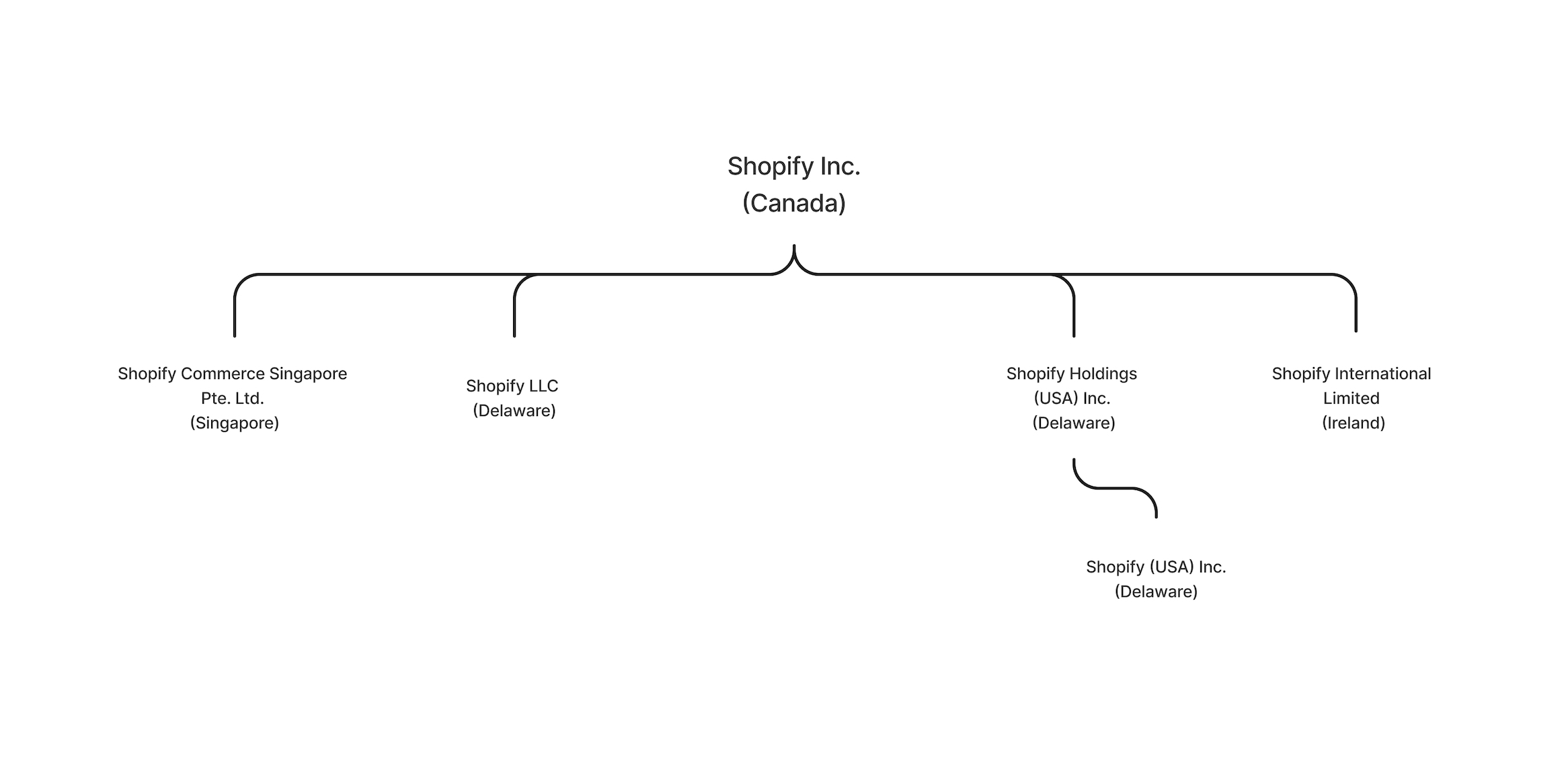
Intercorporate Relationships
The following chart shows our current material subsidiaries. These subsidiaries are, directly or indirectly, wholly owned.
DESCRIPTION OF THE BUSINESS
Overview
Shopify is a leading provider of essential internet infrastructure for commerce, offering trusted tools to start, grow, market, and manage a retail business of any size. Shopify makes commerce better for everyone with a platform and services that are engineered for simplicity and reliability, while delivering a better shopping experience for consumers everywhere.
In an era where social media, cloud computing, mobile devices, augmented reality and data analytics are creating new possibilities for commerce, Shopify provides differentiated value by offering merchants:
A multi-channel front end. Our software enables merchants to easily display, manage, market and sell their products across over a dozen different sales channels, including web and mobile storefronts, physical retail locations, pop-up shops, B2B, social media storefronts, native mobile apps, buy buttons, and marketplaces. More than 80% of our merchants have installed two or more channels. The Shopify application program interface ("API") has been developed to support custom storefronts that let merchants sell anywhere, in any language.
A single integrated back end. Our software provides one single integrated, easy-to-use back end that merchants use to manage their business and buyers across these multiple sales channels. Merchants use their Shopify dashboard, which is available in 21 languages, to manage products and inventory, process orders and payments, fulfill and ship orders, discover new buyers and build customer relationships, source products, leverage analytics and reporting, manage cash, payments and transactions, and access financing.
8
A data advantage. Our software is delivered to merchants as a service, and operates on a shared infrastructure. This cloud-based infrastructure not only relieves merchants from running and securing their own hardware, it also consolidates data generated by the interactions between buyers and a merchant's products, providing rich data to inform merchant decisions. With a highly qualified team of data science personnel, we expect to continue leveraging data for the benefit of our merchants with critical safeguards in place to ensure privacy, security and compliance.
Shopify also enables merchants to build their own brand, leverage mobile technology, sell internationally, and handle massive traffic spikes with flexible infrastructure:
Brand ownership. Shopify is designed to help our merchants own their brand, develop a direct relationship with their buyers, and make their buyer experience memorable and distinctive. We recognize that in a world where buyers have more choices than ever before, a merchant’s brand is increasingly important. The Shopify platform is designed to allow a merchant to keep their brand present in every interaction to build buyer loyalty and create competitive advantages. While our platform is designed to empower merchants first, merchants benefit when buyers are confident that their payments are secure. We believe that awareness among buyers that Shopify provides a superior and secure checkout experience is an additional advantage for our merchants in an increasingly competitive market. For merchants using Shopify Payments, buyers are already getting a superior experience, with features such as Shop Pay and Shop Pay Installments, and with our investments in additional buyer touchpoints, such as retail, shipping, fulfillment, and Shop, our all-in-one digital shopping companion app, brands that sell on Shopify can offer buyers an end-to-end, managed shopping experience that previously was only available to much larger businesses.
Mobile. As ecommerce expands as a percentage of overall retail transactions, a trend that accelerated in 2020 with the onset of the global COVID-19 pandemic buyers expect to be able to transact anywhere, anytime, on any device through an experience that is simple, seamless, and secure. As transactions over mobile devices represent the majority of transactions across online stores powered by Shopify, the mobile experience is a merchant’s primary and most important interaction with online buyers. Shopify has focused on enabling mobile commerce, and the Shopify platform includes a mobile-optimized checkout system, designed to enable merchants’ buyers to more easily purchase products over mobile websites. Our merchants are able to offer their buyers a quick and secure check-out option by using Shop Pay, Apple Pay, Meta Pay, and Google Pay on the web, and we continue to explore other new ways to offer payment flexibility and accelerated checkout. Just as Shopify's tools enable brands to sell directly to their buyers, the Shop app provides merchants that same direct sales power through a mobile experience. The Shop app is a digital shopping assistant that is available to buyers on iOS and Android mobile devices. Buyers use the Shop app to track packages, discover products from their favorite merchants, earn cash back through our rewards program, Shop Cash, and engage with brands directly, which helps merchants increase opportunities to find new customers and drive greater loyalty and lifetime value of their buyers. Shopify’s mobile capabilities are not limited to the front end: merchants who are often on-the-go find themselves managing their storefronts via their mobile devices, and Shopify continues to strive to make it easier to do so.
Global. Commerce thrives when merchants are able to build a global brand and sell beyond their own borders with little friction. Shopify offers merchants across several countries a localized experience within the country in which they are based. In addition, Shopify Markets, enables merchants to manage localized storefronts in different countries through one global store, making cross-border commerce easier for entrepreneurs. With Shopify Markets, merchants can easily set up market-specific buying experiences, enabling buyers to shop in their local currencies, languages, domains, and payment methods. Shopify
9
Markets also calculates duty and import fees. Such tailored experiences are designed to increase local buyer trust and conversion, enabling merchants to enter new geographies more easily. Shopify Markets Pro, introduced in 2022, offers merchants a native merchant-of-record tax and duty compliance solution. Shopify Markets and Shopify Markets Pro complement our partnership with Global-E, an offering for merchants who want to fully outsource their cross-border business with an approved third-party partner.
Infrastructure. We build our platform to address the growing challenges facing merchants and with the aim of making complex tasks simple. The Shopify platform is engineered to enterprise-level standards and functionality and designed for simplicity and ease of use. We also design our platform with a robust technical infrastructure able to manage large spikes in traffic that accompany events such as new product releases, holiday shopping seasons, and flash sales. We are constantly innovating and enhancing our platform, with our continuously deployed, multi-tenant architecture ensuring all of our merchants are always using the latest technology.
This combination of ease of use with enterprise-level functionality allows merchants to start with a Shopify store and grow with our platform to almost any size. Using Shopify, merchants may never need to re-platform. Our Shopify Plus subscription plan was created to accommodate larger merchants, with additional functionality, scalability and support requirements. The Shopify Plus plan also appeals to larger merchants not already on Shopify who want to migrate from their expensive and complex legacy solutions to achieve greater functionality and flexibility.
Our business model is driven by our ability to attract new merchants, retain revenue from existing merchants, and increase sales to both new and existing merchants. As such, we believe that our future success depends on many factors, including our ability to expand our merchant base; localize features for specific geographies; retain merchants as they grow their businesses on our platform and adopt more features; offer more sales channels that connect merchants with their specific target audience; develop new solutions to extend our platform’s functionality and catalyze merchants’ sales growth; enhance our ecosystem and partner programs; provide a high level of merchant support; hire, retain and motivate qualified personnel; and build with a focus on maximizing long-term value.
Sustainability
Shopify is a company that wants to see the next century, and has taken many steps to build a sustainable business, including becoming a carbon neutral company in 2019. Our commitment includes powering our global operations with renewable energy, purchasing high quality carbon credits to address travel-related emissions, and by relying on Google Cloud, which is 100% powered by renewable energy.
Because we view commerce as a powerful vehicle for positive systemic change, as part of our focus on the long term, in 2019 Shopify launched a sustainability fund with the intent to commit at least $5 million annually to fund what Shopify believes are the most promising and impactful technologies and projects to combat climate change. Since launch, we’ve partnered with 22 entrepreneurial climate companies to help them prove and scale their carbon removal solutions. In 2022, we launched Frontier, an advance market commitment, alongside Stripe, Alphabet, Meta, and McKinsey Sustainability with the objective to purchase a combined $925M of carbon removal by the end of 2030. 2022 was the third consecutive year where Shopify has tracked, calculated, and purchased enough carbon removal to counteract the impact of carbon emissions from orders placed on our platform over the Black Friday/Cyber Monday shopping weekend. Our merchants have the ability to address the carbon emissions associated with shipping their orders by adding our Planet app to their store. We also fund carbon removal through our Sustainability Fund with every order placed using Shop Pay, our checkout accelerator.
10
Our Merchants
Our mission is to make commerce better for everyone, and we believe we can help merchants of nearly all retail verticals and sizes, from aspirational entrepreneurs to companies with large-scale, direct-to-consumer or business-to-business operations, realize their potential at all stages of their business life cycle. Our marketing efforts primarily focus on selling to small and medium-sized businesses ("SMBs") and entrepreneurs while our direct sales team primarily addresses the needs of large merchants. The large majority of our merchants are on subscription plans that cost less than $50 per month, which is in line with our focus on providing cost-effective solutions for early stage businesses.
As of December 31, 2022, we had millions of merchants from more than 175 countries using our platform, geographically dispersed as follows: 55% North America, 25% Europe Middle East and Africa, 15% Asia Pacific, Australia and China and 5% in Latin America (Mexico and South America).
Our merchants represent a wide array of retail verticals and business sizes and no single merchant has ever represented more than five percent of our total revenues in a single reporting period.
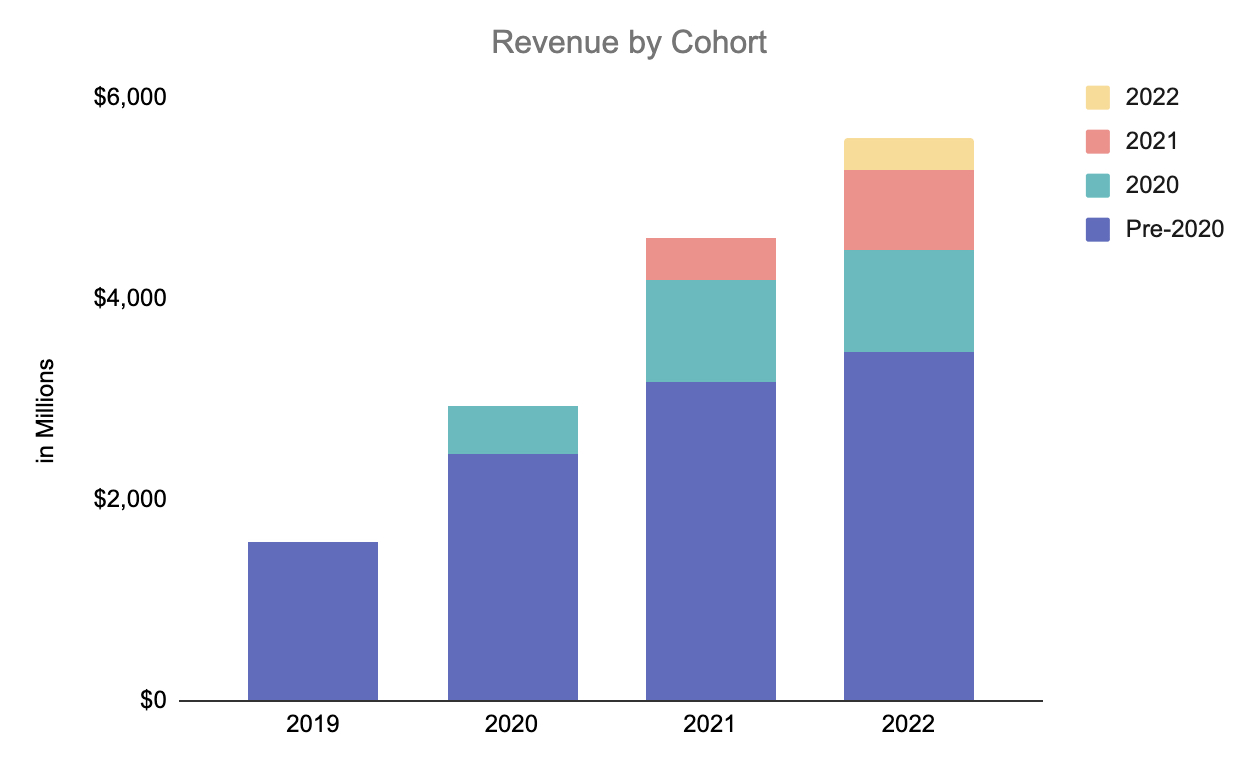
When our merchants grow their sales and become more successful, they typically consume more of our merchant solutions, upgrade to higher subscription plans, and purchase additional apps. We consider our merchants' success to be one of the most powerful drivers of our business model. The chart below displays the annual revenue for merchant cohorts that joined the Shopify platform at different times in our history. The strength of our business model lies in the consistent revenue growth coming from each cohort: the increase in revenue from remaining merchants growing within a cohort offsets the decline in revenue from merchants leaving the platform.
For example, revenue from our pre-2020 cohort expanded in 2021, as the revenue impact from merchants within the cohort leaving the platform was offset by revenue growth from remaining merchants within that cohort. In 2022, revenue from the pre-2020 cohort continued its growth as merchant retention improved, and the remaining merchants increased their gross merchandise volume ("GMV") and adopted additional solutions provided through the Shopify platform.
Moreover, the total combined revenue of all previous cohorts once they have annualized and become comparable to prior years has also grown on a consistent basis.
11
12
Merchant Acquisition
Our merchant acquisition strategy is primarily focused on marketing that builds awareness and interest in our offerings with sales and marketing efforts supported by regional resources. Our approach includes a strong emphasis on the use of data and analytics while continuously innovating and testing new ideas to drive growth.
Because our merchant base includes a wide array of retail verticals and business sizes, spanning from aspirational startups to long-established enterprises, we use a broad variety of means to attract new merchants. We actively grow our audience through digital channels, including organic search, paid search, and social media as well as offline channels like radio, television and direct mail. We also engage our merchants through events in our offline strategy. In 2022, we held in-person events, including hosting workshops and community-based events at our New York City and Los Angeles spaces.
We intend to grow our base of merchants by both inspiring entrepreneurship through marketing programs and trial experiences, and continuing to improve the ease with which merchants can get a business up and running. We invest in awareness-driven brand campaigns, authoring various Shopify blogs and podcasts, earned media and public relations campaigns, and providing thought leadership to help our merchants succeed and to build their own brand.
We offer self-serve onboarding, and employ outbound sales representatives to help drive adoption of our platform and certain solutions, such as Shopify Plus and our Point-of-Sale ("POS") Pro offering.
Additionally, we leverage relationships with third-party design agencies, developers, influencers, and freelancers around the world who actively refer merchants to us.
Ecosystem
A rich ecosystem of app developers, theme designers and other partners, such as digital and service professionals, marketers, photographers, and affiliates has evolved around the Shopify platform. We believe our partner ecosystem helps drive the growth of our merchant base by extending the functionality of the Shopify platform through the development of apps. At December 31, 2022, more than 10,000 apps were available in the Shopify App Store. The partner ecosystem helps drive the growth of our merchant base, which in turn further accelerates growth of the ecosystem.
Our Offerings
Our business model has two revenue streams: a recurring subscription component we call subscription solutions, and a merchant success-based component we call merchant solutions.
Subscription Solutions
We generate subscription solutions revenues primarily through the sale of subscriptions to our platform, including variable platform fees, as well as through the sale of subscriptions to our POS Pro offering, the sale of themes, the sale of apps, and the registration of domain names.
We offer pricing plans designed to meet the needs of our current and prospective merchants. Offering different service and pricing levels allows entrepreneurs to scale without leaving the Shopify platform: as a merchant upgrades to the higher-priced options, they receive more powerful tools and improved product
13
pricing for certain merchant solutions. We believe this ability to retain merchants as they grow is an important factor for our success in serving the SMB market. While most merchants subscribe to our Basic and Shopify plans, the majority of our GMV comes from merchants subscribing to our Shopify Plus plans. Merchant retention rates are also higher among merchants on higher-priced plans. Offered at a starting rate that is several times that of our Advanced plan, the Shopify Plus plan solves for the complexity of merchants as they grow and scale globally, offering additional functionality, and support, including features like Shopify Audiences for buyer demand, B2B features enabling merchants to sell business-to-business, and Launchpad for ecommerce automation, as well as dedicated account management where appropriate. Mattel, Gymshark, Heinz, FTD, Netflix, Kylie Cosmetics, SKIMS and Supreme are among the Shopify Plus merchants leveraging our reliable, cost-effective, and scalable commerce solution.
Our subscription plans typically have a one-month term, although merchants can elect to make an annual commitment. Those who sign on to Shopify Plus initially have annual or multi-year subscription terms. Subscription terms automatically renew unless notice of cancellation is provided in advance. Merchants purchase subscription plans directly from us. Subscription fees are paid to us at the start of the applicable subscription period, regardless of the length of the subscription period, with the exception of Shopify Plus subscription contracts, which are paid in arrears on a ratable basis. Subscription fees are non-refundable. POS Pro subscriptions fees are charged on a per month and per location basis. POS Pro enables brick and mortar merchants to seamlessly bridge online and offline commerce operations and offer their buyers a smooth shopping experience through features such as smart inventory management and buy online-pickup/return in store or curbside.
Merchant Solutions
We offer a variety of merchant solutions to augment those provided through a subscription to address the broad array of functionality merchants commonly require, including accepting payments, shipping and fulfillment, and securing working capital. We believe that offering merchant solutions creates additional value for merchants, saving them time and money by making additional functionality available within a single centralized commerce platform, and creates additional value for Shopify by increasing merchants’ use of our platform.
We principally generate merchant solutions revenues from payment processing fees and currency conversion fees from Shopify Payments, transaction fees, referral fees from partners, advertising revenue on the Shopify App Store, Shopify Capital, Shop Pay Installments, Shopify Balance, Shopify Shipping, service fees from Shopify Fulfillment Network including Deliverr, Inc. ("Deliverr"), 6 River Systems sales, non-cash consideration obtained for services rendered as part of strategic partnerships, the sale of POS hardware, Shopify Email and Shopify Markets.
Shopify Payments is a fully integrated payment processing service that allows our merchants to accept and process payment cards online and offline, and is also designed to drive higher retention among merchants. Shopify Payments eliminates the need for merchants to set up and maintain a direct relationship with a third-party payment gateway, gives merchants access to low credit card processing rates, and allows us to cross-sell additional solutions to our merchant base. We introduced Shopify Payments in the United States and Canada in 2013, and have been expanding into additional geographies in subsequent years. Today, more than two-thirds of eligible merchants have enabled Shopify Payments, which is available in 22 countries. As a result of introducing Shopify Payments, our revenues from merchant solutions and associated costs have increased. Shopify merchants that have adopted Shopify Payments also have access to Shop Pay, our accelerated checkout, Shop Pay Installments, our 'buy now, pay later' product, and
14
Shopify Audiences (for Shopify Plus merchants) aimed at helping merchants target advertising campaigns toward high-intent buyers.
For Shopify Payments transactions, processing payment fees are determined based in part on a percentage of the dollar amount processed plus a per transaction fee, where applicable. Currency conversion fees are determined based on a percentage of the dollar amount converted in a payment processing transaction, where applicable.
Transaction fees are typically charged based in part on a percentage of GMV that is not processed by Shopify Payments. We generate referral fees from partners to which we direct business and with which we have an arrangement in place. Pursuant to terms of the agreements with our partners, these revenues can be recurring or non-recurring. Where the agreement provides for recurring payments to us, we typically earn revenues so long as the merchant that we have referred to the partner continues to use the services of the partner. Non-recurring revenues generally take the form of one-time payments that we receive when we initially refer the merchant to the partner.
Advertising revenue is earned on the Shopify App Store as merchants click on the apps being advertised by our partners. We recognize advertising revenues when we are entitled to receive payment from the partner.
Shopify Capital, a merchant cash advance ("MCA") and loan program, helps eligible merchants secure financing and accelerate the growth of their business by providing access to simple, fast, and convenient working capital. In 2022, Shopify Capital was launched in Australia, bringing its availability to four countries (launched in the United States in 2016, and in the United Kingdom and Canada in 2020). We apply underwriting criteria prior to purchasing the eligible merchant's future receivables or making a loan to help ensure collectability. Under Shopify Capital, we purchase a designated amount of future receivables at a discount or make a loan. The advance, or the loan, is forwarded to the merchant at the time the related agreement is entered into, and the merchant remits a fixed percentage of their daily sales until the outstanding balance has been remitted. Certain merchant cash advances and loans are facilitated internally and originated by a bank partner, from whom we then purchase the merchant cash advances and loans obtaining all rights, title, and interest or discount for a fee calculated as a percentage of the merchant cash advance or loan's principal. For Shopify Capital MCAs, we apply a percentage of the remittances collected against the merchant's receivable balance, and a percentage, which is related to the discount, as merchant solutions revenue. For certain Shopify Capital loans, there is a fixed maximum repayment term. For certain other Shopify Capital loans, we calculate an expected repayment date. Using the merchant's contractual or expected repayment date, we calculate an effective interest rate based on the merchant's expected future payment volume to determine how much of a merchant's repayment to recognize as revenue and how much to apply against the merchant's receivable balance. We have mitigated some of the risks associated with Shopify Capital by opening insurance policies with Export Development Canada (“EDC”) to insure some of the MCAs and loans offered by Shopify Capital in the United States, United Kingdom, Canada and, Australia. In early 2023, we further enhanced our risk management and funding capabilities with the ability to sell certain Shopify Capital loans in the United States.
Shop Pay Installments, a "buy now pay later product" available to merchants and buyers in the United States, enables merchants to sell their goods to buyers on an interest-free payment plan, as well as an interest-bearing payment plan, which was introduced in 2022. Merchants receive upfront payment for a sale, net of fees, without the worry associated with collecting future payments from the buyer. We recognize revenue when a merchant sale is made through the use of the product based on a percentage of the total order value. We earn and recognize a portion of the revenue from each merchant sale, with the
15
majority of revenue earned and recognized by our third-party provider that bears the buyer underwriting and buyer credit risk associated with the product.
Shopify Balance, our money management product, rolled out to all eligible merchants in the United States in 2022. Shopify Balance offers merchants a no fee money management account, providing merchants with fast access to their cash, a card for spending online, on mobile, or in-store, and rewards featuring cash back, perks, and discounts on everyday business spending. While Shopify earns a small fee upon the use of its card, we expect to use Shopify Balance primarily as a way to introduce and centralize more financial services to simplify our merchants’ financial lives.
Shopify Shipping allows merchants doing their own fulfillment and shipping to select from available shipping partners to buy and print outbound and return shipping labels and track orders directly within the Shopify platform. Shopify Shipping was launched in France, Italy, and Spain in 2022, bringing its availability to seven countries. For Shopify Shipping, fees are determined based on the type of labels purchased or the arrangement negotiated with third parties.
In June 2019, we announced Shopify Fulfillment Network which aims to offer fast, affordable, and reliable fulfillment to independent businesses. In 2022, Shopify Fulfillment Network was offered to a subset of merchants in the United States. On July 8, 2022, Shopify completed the acquisition of Deliverr, an ecommerce fulfillment technology company, to accelerate the development of Shopify’s logistics offering.
The logistics services being built by Shopify aim to help merchants through three critical stages of their logistics journey: freight, distribution, and fulfillment. Starting with freight, in 2022, Shopify began a partnership with Flexport to help merchants more easily and cost-effectively inbound freight to the United States.
Upon arriving at U.S. ports, Shopify Fulfillment Network helps to prepare and route inventory for distribution across multiple channels including forward-positioning inventory to optimal warehouses based on predicted merchant demand. With the integration of Deliverr and by leveraging a network of Shopify-operated warehouse hubs and largely third-party owned and operated warehouse spokes, Shopify's logistics offering intends to help fulfill merchants’ orders to their buyers quickly and cost-effectively by leveraging Shopify’s scale with deep machine learning tools, including demand forecasting, predictive inventory allocation across warehouses and intelligent order routing.
In October 2019, we acquired 6 River Systems, a provider of collaborative warehouse fulfillment solutions that improves efficiency within the warehouse. Shopify partners leveraging 6 River Systems’ cloud-based software and collaborative mobile robots can increase the speed and reliability of their warehouse operations by empowering on-site associates with daily tasks, including inventory replenishment, picking, sorting, and packing. 6 River Systems also sells its collaborative warehouse fulfillment solutions to retail and third-party fulfillment customers independent of Shopify Fulfillment Network and Deliverr.
Shopify also introduced Shop Promise in 2022. Shop Promise is a buyer-facing badge that tells buyers that orders will be fulfilled and delivered in five or fewer calendar days, and is intended to help merchants build trust and customer loyalty and improve sales conversion.
Shopify POS is a sales channel that lets merchants sell their products and accept payments in person from a mobile device almost anywhere, including brick-and-mortar shops, markets, and pop-up shops.
16
Shopify POS syncs with Shopify to track merchant orders and inventory across retail locations, a merchant's online store, and other active channels.
While the majority of the POS-compatible hardware we sell has been designed and manufactured by third-party vendors, we also offer Shopify-designed hardware including POS card readers with integrated payments and a retail stand with expanded functionality to better meet the needs of our merchant base and increase the visibility of the Shopify brand. In addition to launching Tap to Pay on iPhone, which allows merchants to accept contactless credit and debit cards and digital wallets without any hardware, in 2022, we introduced POS Go, a powerful hardware that enables merchants to meet customers where they are from counter to curb, into early access in the United States.
In 2022, we expanded availability of our POS card reader with integrated payments to Belgium, Denmark, Finland, Italy, Singapore and Spain, bringing its availability to 14 countries. Merchants can purchase POS card readers from Shopify's hardware store and Shopify generates incremental Shopify Payments revenue for transactions conducted via our card readers with integrated payments.
Shopify Email, launched in 2019, is our native email marketing tool designed to enable merchants to create, run, and track email marketing campaigns from within the merchant admin, and help merchants to build direct relationships with buyers.
Shopify Markets, our end-to-end cross-border commerce product offerings launched in 2021, integrate services to centralize the platform's cross-border capabilities and enable merchants to penetrate the global commerce market. Shopify Markets leverage our existing transactional services and partnerships from which we earn referral fees to provide a tailored experience for each market.
In 2022, we introduced Shopify Markets Pro into early access, which is our native merchant-of-record solution that manages tax and duty compliance on behalf of the merchants, as well as Shopify Translate and Adapt, which helps merchants quickly and accurately localize the customer journey through language translation and adapting custom content for each market. Shopify generates revenue when duty and import taxes and currencies are converted for buyer orders, on international payment processing, and on merchant-of-record transactions. Global-E, an offering that gives merchants the option for a more full-service, outsourced solution for cross-border commerce, complements Shopify Markets and Shopify Markets Pro.
Seasonality
Our merchant solutions revenues are directionally correlated with the level of GMV that our merchants facilitated through our platform. Our merchants typically process their lowest level of GMV in the first quarter and their highest level of GMV during the fourth quarter holiday season. As a result, we have historically generated higher merchant solutions revenues in our fourth quarter than in other quarters. We believe that this seasonality has affected and will continue to affect our quarterly results. As a result of the continued growth of our merchant solutions offerings, we believe that our business may become more seasonal in the future and that historical patterns in our business may not be a reliable indicator of our future performance.
17
Research and Development
Shopify is building the internet infrastructure for commerce that enables merchants of all sizes around the world to successfully start and scale their businesses on Shopify. We are simplifying the user experience for smaller merchants, arming them with new and innovative ways to compete with larger, better-funded competitors, as well as for larger merchants seeking technology and support for higher volumes and global reach. As such, research and development at Shopify is currently focused on product management, product development, and product design to accomplish these goals. In order to best serve merchants seeking to develop a commerce presence wherever their buyers are across multiple channels, we invest in developing online and point of sale assets with a single commerce operating system, an area of the market we feel is currently underserved.
Multi-channel commerce, including ecommerce, is a relatively new industry that is rapidly evolving, as mobile device makers continue to innovate on features and functionality, media channels become more interactive and develop their commerce capabilities, and merchants continually strive to create new ways to stand out in an increasingly digital economy. Traditional brick and mortar retailers seek to join the digital revolution by leveraging their brand and physical presence in new and innovative ways. Shopify strives, on behalf of merchants, to not just keep pace in this dynamic environment, but to bring to market new and better selling and buying experiences by leveraging what technology and connectivity have made possible.
We also invest in developing the tools to make it easier for our ecosystem partners to build on and for Shopify to extend the functionality and flexibility of the platform. We believe that by deepening the capabilities of our current solution set to meet the needs of more merchants in more geographies, by offering new and better ways for merchants to market, sell, and get their products to buyers, and by expanding the range of solutions we offer, we will be able to grow our addressable market and meet the needs of merchants in years ahead. Data analytics and machine learning are increasingly informing our product development efforts and we expect to continue investing in this area.
Growth Strategy
We have focused on rapidly growing our business and plan to continue heavily investing to drive future growth. We believe that our investments will increase our revenue base, improve the retention of our global base of merchants and strengthen our ability to increase sales to our merchants. Our growth strategy is driven by our mission: make commerce better for everyone. Key elements of our strategy include:
•Grow our Base of Merchants. We believe that we have a significant opportunity to increase the size of our current merchant base. We intend to grow our base of merchants primarily by inspiring entrepreneurship through marketing programs with a dedicated focus on product marketing and awareness-driven campaigns paired with global earned media efforts and ongoing content creation and distribution with an aim to educate. We also continue to experiment with improving the merchant onboarding experience through free and paid trials aimed at reducing the barriers to enter into entrepreneurship. In addition, we are improving and expanding functionality to boost adoption of Shopify by merchants around the world. While we believe it is important to establish relationships early in the business lifecycle and grow along with our merchants, we also see opportunity with larger businesses looking for faster time-to-market and better value as they innovate to meet rapidly evolving buyer demands. As such, we are investing in self-serve and direct sales efforts focused on acquiring larger merchants as well as brick and mortar retail merchants.
18
•Grow our Merchants’ Revenue. Our goals are closely aligned with the goals of our merchants. The more a merchant sells on our platform, the longer they are likely to remain with Shopify and the more revenue we generate as they process more transactions, upgrade plans, sell through new sales channels, ship more products, and use additional solutions. We intend to continue to improve our platform to help our merchants sell more and expect to continue to use initiatives such as Shopify blogs, our digital community, our educational materials, global events and meetups, as well as exclusive learning and engagement initiatives to educate our merchants on how they can be even more successful with Shopify. Shopify’s support advisors, available 24/7, also may introduce our merchants to features of the platform at certain points in their journey that help them expand revenue. Shopify blogs continue to be localized and are available in a growing number of languages to help entrepreneurs globally build and grow a business. We are also investing in commercial efforts to help merchants unlock more of the value in Shopify's offerings by educating them about how our solutions can accelerate their businesses.
•Continuous Innovation and Expansion of our Platform. Our platform is built to support innovation and the rapid technology changes in commerce and we have consistently expanded the functionality of our platform over the last decade. In addition to the suite of merchant solutions Shopify has added over time, we are continuously advancing our technologies, tooling, and infrastructure so merchants can not only keep pace with the rapid changes in commerce, but be among the earliest adopters of commerce innovation.
•Continue to Grow and Develop our Ecosystem. We have a thriving third-party ecosystem that includes app developers, theme designers, and other partners that bolster the functionality of our platform. We offer competitive terms to our app developer partners to increase the appeal of Shopify as a platform on which to build and enable partners to reinvest in their own growth and innovation. We also host Shopify Unite to demonstrate to partners the opportunities that exist to collaborate in building the future of commerce technology. Our ecosystem has grown in part due to the platform’s functionality, which is highly extensible and can be expanded through our API. We believe that growing our ecosystem makes the Shopify platform more attractive and stickier, which further expands our merchant base, and in turn drives additional growth of our ecosystem.
•Continue to Expand our Referral Partner Programs. We have strong relationships with thousands of development, design and marketing agencies throughout the world. These agencies build merchant web and mobile shops on our platform. We intend to strengthen our existing relationships with referral partners and create new ones with the goal of expanding our overall merchant base.
•Continue to Build for the Long-term. We have a culture of iteration and experimentation with a focus on maximizing long-term value, and many of our investments are made with an eye toward what we believe merchants will require several years from now. Such longer-term initiatives include localizing the platform for international expansion, promoting our brand, expanding our existing services, introducing new solutions, and entering into strategic partnerships and acquisitions.
Technology
The Shopify platform is a multi-tenant cloud-based system that is engineered for high scalability, reliability, and performance. Open source has played a major role at Shopify from the beginning when our
19
founder was active on the core team that built Ruby on Rails, the technology that powers much of the Shopify platform. We host the Shopify platform using cloud-based servers. Maintaining the integrity and security of our technology infrastructure is critical to our business, and we plan to invest further in our infrastructure to meet our merchants’ needs and maintain their trust. Our investment plans include increasingly optimizing our cloud-based infrastructure to deliver local performance and global reach to more merchants than ever before, with consistent levels of availability, performance and resiliency. The key attributes of the Shopify platform are:
•Security. Shopify conducts regular security assessments, which include but are not limited to third-party penetration tests, a bug bounty program, and vulnerability assessments. The findings that result from these security assessments feed into Shopify's risk management process for further assessment. Credit card processing on the Shopify platform is performed by a dedicated, highly scalable, geographically redundant, high-security environment with specialized policies and procedures in place. The environment is designed to be isolated and secure and exceeds the requirements of PCI DSS. We have been certified as a PCI DSS Level 1-compliant service provider, which is the highest level of compliance available, and we undergo external audits for PCI and SOC 2 Type 2. To keep our merchants' data secure, we use technology including firewalls, advanced encryption, and intrusion detection systems, and offer two-factor authentication.
Shopify makes its Privacy Policy available on its website, which describes how we collect, use and protect personal information.
•Scalability. The cloud-based architecture of our platform has been designed to support both existing and new merchants and their sudden traffic spikes. We use multiple technologies to efficiently scale our computing resources across our platform and to load test our platform to benchmarks that exceed merchant traffic volumes.
•Reliability. Our platform includes cloud-based servers that are fault-tolerant and ensure that our platform is highly reliable. Because Shopify is at the heart of our merchants’ businesses, we employ a highly redundant, horizontally scalable, shared architecture designed to ensure resiliency and high availability.
•Performance. We believe that the faster and more accessible our merchants’ shops appear to their buyers, the more our merchants will sell. During the 2022 Black Friday Cyber Monday shopping weekend, Shopify served 75.98 million requests per minute to our commerce platform at peak leading to $7.5 billion in merchant GMV. We have a dedicated team that is constantly profiling and optimizing the performance of the Shopify platform. We leverage content delivery networks with global points of presence to ensure that content and data is delivered quickly to users across the globe. In 2022, we processed an average of 165.3 million orders per month.
•Deployment. The Shopify platform is “single branch” software, which means that all of our merchants use the latest version of Shopify at all times. The result is that we have no overhead in maintaining older versions of our platform. Our software deployment process enables us to quickly distribute new software as soon as it is ready. This is made possible by our ongoing investment in end-to-end automation and comprehensive test suites.
20
Competition
Our market is transforming, competitive, and highly fragmented, and we expect competition to increase in the future. We believe the principal competitive factors in our market are:
•vision for commerce and product strategy;
•simplicity and ease of use for merchants and their buyers;
•integration of multiple sales channels;
•embedding of commerce functionality onto more surfaces;
•cost-effective solutions;
•vast and growing app ecosystem;
•breadth and depth of functionality;
•pace of innovation;
•powerful data analytics;
•ability to scale;
•security and reliability;
•support for a merchant’s brand development; and
•brand recognition and reputation.
With respect to each of these factors, we believe that we compare favorably to our competitors.
The growth of ecommerce and of independent brands may attract new entrants or new offerings from existing competitors. Additionally, some merchants may elect to piece together technology that overlaps with our own from other providers such as:
•ecommerce software vendors;
•content management systems;
•payment processors;
•POS software providers;
•domain registrars;
•shipping label providers;
•fulfillment service providers;
•alternative lenders;
•financial services;
•cross-border services providers; and
•marketplaces.
Intellectual Property
Our intellectual property and proprietary rights are important to our business. In our efforts to safeguard them, we rely on a combination of copyright, trade secret, trade dress, domain names, trademarks, patents, and other rights in Canada, the United States, and other jurisdictions in which we conduct our business. We also have confidentiality agreements, assignment agreements, and license agreements with employees, contractors, merchants, distributors, and other third parties, which limit access to and use of our proprietary intellectual property. Although we rely, in part, upon these legal and contractual protections, we believe that factors such as the skills and ingenuity of our employees, as well as the functionality and frequent enhancements to our platform, make our intellectual property difficult to replicate.
21
We are subject to certain risks related to our intellectual property. For more information, see "Risk Factors - Risks Related to our Business and Industry."
Property
We are headquartered in Ottawa, Canada. We do not own any real property. We believe that our current facilities are adequate to meet our current needs and we expect to continue to adapt our facilities, as needed.
Culture and Talent
Culture and Talent
Culture and Employees
If you have ambitious goals, you need an equally ambitious team. Shopify is composed of highly talented, deeply caring individuals all working to make commerce better for everyone. Our culture is continuously being redefined with every person that joins our company, but, at our core, we value people who:
•are impactful;
•are merchant-obsessed;
•make great decisions quickly;
•thrive on change;
•are constant learners; and
•build for the long term.
Our values work in concert with our rules of engagement, which govern how we agree to interact with one another. We believe the more voices in entrepreneurship the better. We embrace being multicultural and celebrate the differences that occur naturally within teams, departments, and locations.
How We Work
Shopify employees began working remotely in 2020 following the onset of the COVID-19 pandemic. The effects of COVID-19 led us to reimagine the way we work, resulting in the decision to become a digital-first company. We have coined this way of working 'Digital by Design'. In 2022, we continued to reduce our leased footprint and transition remaining spaces to their future intended purpose, including use for team collaboration and events, to align with our Digital by Design principle of enabling our employees to have intentional, in-person interactions with their teams several times a year.
Shopify is also providing employees with the technology and resources to have quality remote work experiences and deliver high-impact work. We believe Digital by Design will yield longer-term benefits, including helping our employees stay healthy and safe, unlocking a diverse global talent pool, eliminating unnecessary commutes, and fast-tracking new and better ways to work together that are more productive and rewarding.
Learning and Development
Shopify values continuous learning and personal development. We are a fast-growing company that is constantly striving to get better. We expect to see similar growth from everyone on our team. We offer
22
opportunities to our employees to learn and grow so they feel engaged and are progressing in their careers, which include:
Hack Days. We deeply value innovation and experimentation. Hack Days is a multi-day event when we encourage our employees to step out of their “day jobs” to tackle a new problem or project that inspires them and adds value to Shopify. “Hack Days” is an expression of Shopify’s culture of innovation and experimentation. Coming together to solve problems outside of their day-to-day work, Shopify employees collaborate across different teams and regions, learn together, and have fun while producing something that will make Shopify better. This global, cross-discipline collaboration promotes a sense of community and belonging on the Shopify team, which is especially important as we grow globally and have more employees distributed internationally.
Own Your Own Development Program. Personal growth and constant learning are central to Shopify's culture. We encourage Shopify employees to map their personal learning journey through our "Own Your Own Development" program. Employees around the world can access courses, conferences, and workshops to build their skills and mastery, no matter where they're located.
Leading at Shopify. People leadership is critical to help employees and teams develop into their most impactful selves. Shopify offers Leading at Shopify, a leadership development program that focuses on mission-critical topics to support leadership learning for people-leads of all levels.
Coaching. Shopify employs professional coaches who fuel our mission every day by helping to grow the people and teams that make our mission a reality. We offer customized programs for individuals and teams to accelerate their development in order to generate greater impact and sustainable performance.
We are intentional in building a culture and environment that empowers care and growth in high-impact people. We offer wellness resources and programs across four pillars: financial, mental, physical, and social wellness, including an Employee Assistance Program that provides employees with confidential help for any work, health, or life concern. We measure employee engagement through regular pulse checks, including an annual survey. In a 2022 company-wide employee survey, four out of five respondents recommended Shopify as a great place to work. We consider our relationship with our employees to be excellent.
We recruit our employees through multiple avenues including internships, campus recruiting, and global outreach.
As of December 31, 2022, we had approximately 11,600 employees and contractors worldwide. Our employees are not represented by a labor organization or party to a collective bargaining arrangement, with the exception of a small number of employees in France and Spain who are covered by mandatory industry-wide collective bargaining agreements in accordance with local law.
Government Regulation
We are subject to a number of foreign and domestic laws and regulations that affect companies conducting business on the internet, many of which are still evolving and could be interpreted in ways that could harm our business. Concern about the use of software as a service ("SaaS") platforms for illegal conduct, such as money laundering or supporting terrorist activities, may in the future result in legislation or other governmental action that could require changes to our platform. Similarly, legislation or other
23
governmental action around online platforms facilitating, enabling, or hosting the distribution of illegal or otherwise harmful content, goods, or services, may require changes to our platform.
We are subject to U.S. and Canadian laws and regulations that govern or restrict our business and activities in certain countries and with certain persons, including the economic sanctions regulations administered by the U.S. Treasury Department’s Office of Foreign Assets Control, the sanctions regulations administered or enforced by the Office of the Superintendent of Financial Institutions in Canada, and the export control laws administered by the U.S. Commerce Department’s Bureau of Industry and Security, the U.S. State Department’s Directorate of Defense Trade Controls and the Canadian Export and Import Controls Bureau. We are currently subject to a variety of laws and regulations in Canada, the United States, the European Economic Area and elsewhere related to payment processing and other financial services. Depending on how Shopify Payments, Shop Pay Installments, Shopify Balance and our other merchant solutions evolve, we may be subject to additional laws in Canada, the United States, the United Kingdom, Australia, Ireland, New Zealand, Singapore, Hong Kong, Japan, Germany, Spain, Italy, Denmark, the Netherlands, Sweden, Austria, Belgium, and elsewhere.
We are also subject to federal, state, provincial, and foreign laws regarding cybersecurity, privacy, and the protection of data. Some jurisdictions have enacted laws requiring companies to notify individuals and regulators of data security breaches involving certain types of personal information and our agreements with certain merchants require us to notify them in the event of a security incident. Additionally, some jurisdictions as well as our contracts with certain merchants require us to use industry-standard or reasonable measures to safeguard personal information or confidential information, and thereby mitigate the risk of a security incident. In the coming years, we expect further regulation regarding cybersecurity, privacy, and the protection of data, both in the United States and abroad, that will likely apply to our business. These laws and other obligations create regulatory, liability, and reputational risks for Shopify.
In addition, our reputation and brand may be negatively affected by the actions of merchants or their users or partners that are deemed to be hostile, offensive, inappropriate or unlawful. While we use technology to monitor for compliance with and eligibility for certain Shopify offerings, we do not proactively and comprehensively monitor or review the appropriateness of all content on all of our merchants’ shops in connection with our services, and we do not have control over the activities in which merchants’ buyers engage. While we have adopted policies regarding illegal or offensive use of our platform, merchants or their customers could nonetheless engage in these activities without our knowledge. The safeguards we have in place may not be sufficient to avoid harm to our reputation and brand, especially if such hostile, offensive or inappropriate use was high profile, which could adversely affect our ability to expand our merchant subscription base, could attract regulatory scrutiny or litigation threats, and could harm our business and financial results.
We could also be subject to liability and/or governmental regulation related to the content of merchants’ shops, products and services sold by merchants, or other activities of our merchants in various jurisdictions around the world. In many jurisdictions, new laws, regulations or rules relating to the liability of providers of online services for activities of their customers and other third parties are currently being proposed and debated, or otherwise being tested in court. This liability could relate to a number of different types of legal claims or concerns, including concerns relating to unfair competition, unfair, deceptive and abusive practices, copyright and trademark infringement, defamation, invasion of privacy or other torts, products liability, and other theories based on the nature of the relevant goods, services, or content. Any legislation, court ruling or other governmental regulation or action that imposes liability on providers of online services in connection with the activities of their customers or their customers’ users could harm our business. In such circumstances we may also be subject to liability under applicable law,
24
which may not be fully mitigated by our terms of service. Any liability attributed to us could adversely affect our brand, reputation, ability to expand our subscriber base, and financial results.
GENERAL DEVELOPMENT OF THE BUSINESS
As of December 31, 2022, the Company operated in a single operating and reportable segment.
Three-Year History
In the fourth quarter of 2022:
Shopify launched Shopify Tax, which offers robust tax compliance tools for U.S.-based merchants that sell to customers in the United States.
In the third quarter of 2022:
Shopify acquired Deliverr, an ecommerce fulfillment technology company, for $2.1 billion, to accelerate the growth of Shopify's logistics offering.
Shopify announced the YouTube Shopping channel, which enables merchants to easily integrate their online store with one of the world’s biggest entertainment platforms.
Shopify announced a workforce reduction to recalibrate the company’s internal resources with its updated expectations of ecommerce growth levels.
Shopify launched Shopify Collabs, which gives merchants a new channel to find highly engaged consumers and powers commerce for the creator economy.
Shopify launched Shopify Capital in Australia, expanding its availability to four countries.
Shopify announced changes to its leadership team, including the appointments of Jeff Hoffmeister as the new Chief Financial Officer and Kasra Nejatian as Chief Operating Officer.
Shopify introduced Shopify Markets Pro, a cross-border merchant-of-record solution, and Shopify Translate and Adapt, which helps merchants accelerate their global expansion without adding complexity.
Shopify introduced Flex Comp, a new compensation system that gives employees agency to decide how much of their total compensation should be in the form of cash versus equity.
Shopify launched POS Go, new retail hardware that empowers merchants to meet consumers wherever they are and however they want to shop - from counter to curb.
In the second quarter of 2022:
Shopify co-founded Frontier, an advanced market commitment (AMC), with Stripe, Alphabet, Meta, and McKinsey Sustainability, to spend a combined $925 million among the participants on permanent carbon removal by the end of 2030.
Shopify launched Shopify Audiences, an advertising tool that helps merchants find high-intent buyers.
25
Shopify announced court approval of its updated governance structure, which included the creation and issuance of the Founder share to the company’s Founder and Chief Executive Officer, Tobias Lütke.
Shopify announced shareholder approval of the Share Split, a ten-for-one share split of its Class A subordinate voting shares and Class B restricted voting shares. Each shareholder of record on June 22, 2022 received nine additional Class A subordinate voting shares and Class B restricted voting shares, as applicable, for every one share held, distributed after close of trading on June 28, 2022.
Shopify introduced Shopify Editions, a semi-annual showcase that features new launches and improvements across the platform.
In the first quarter of 2022:
Shopify signed a power purchase agreement to purchase the amount of wind energy equivalent to powering 100% of employee home offices across North America.
Shopify launched Linkpop, a link in bio tool that enables creators and merchants to launch social storefronts to sell directly on the platforms they are already engaging with followers.
In the fourth quarter of 2021:
Shopify launched our integrated retail hardware with payments to retail merchants in the Netherlands.
Shopify launched the Shopify Global ERP Program, which allows select ERP partners, initially including Microsoft, Oracle NetSuite, Infor, Acumatica, and Brightpearl, to build direct integrations into the Shopify App Store.
Shopify launched the Spotify channel, enabling artist-entrepreneurs on Spotify to connect their Spotify for Artists accounts with their Shopify online stores, where they can sync their product catalogues and seamlessly showcase products directly on their Spotify profile.
In the third quarter of 2021:
Shopify launched Shopify Markets, a product that makes cross-border commerce easier for entrepreneurs by enabling merchants to enter new markets, and increase buyer trust and conversion with tailored experiences for each market.
Shopify began rolling out Shopify Balance, our money management product, to merchants in the United States.
Shopify introduced TikTok Shopping to merchants, enabling merchants with a TikTok For Business account to add products that link directly to their online store checkout.
Shopify launched our All-New POS Pro software for Android devices, and launched our integrated retail hardware with payments to retail merchants in Germany and New Zealand.
Shopify opened a brick and mortar space in New York City featuring Shopify’s products, services, and technology, and serving as a hub where merchants can receive hands-on support, inspiration, and education to help grow their business.
26
Shopify launched Shopify Shipping in the United Kingdom, enabling British merchants to easily purchase shipping labels directly from the Shopify merchant admin, saving them time and money.
Shopify eliminated its revenue share on the first million dollars made by app and theme developer partners annually in the Shopify App Store and Shopify Theme Store, respectively, extending more generous terms in order to increase our support for developers, expand what gets built on Shopify, and attract the best developers in the world to support Shopify’s mission.
In the second quarter of 2021:
Shopify introduced a new retail integrated card reader with payments using our All-New POS software in the United Kingdom, Ireland, and Australia.
Shopify made Shop Pay Installments, a ‘buy now, pay later’ product that lets merchants offer their buyers more payment choice and flexibility at checkout, generally available to all eligible merchants in the United States.
Shopify announced that Shop Pay will become available to all merchants selling in the United States on Facebook and Google, even if they don’t use Shopify’s online store.
In the first quarter of 2021:
Shopify sold 1,180,000 Class A subordinate voting shares at a price to the public of $1,315 per share for aggregate gross proceeds, before underwriting discounts and offering costs, of $1,551,700,000, to strengthen its balance sheet and provide flexibility to fund its growth strategies.
Shopify announced, on March 9, 2021, that it had purchased more Direct Air Capture carbon removal (i.e. atmospheric carbon dioxide stored underground and not for enhanced oil recovery or any other type of fossil fuel extraction) than any other company in history with our agreement to purchase 10,000 tonnes of removal from Carbon Engineering in addition to our previous commitment to purchase 5,000 tonnes from Climeworks.
In the fourth quarter of 2020:
Shopify began collecting subscription revenue for our Retail POS Pro subscription offering, which was launched in the second quarter.
Shopify announced a collaboration with Operation HOPE to support that organization’s goal to create one million new Black-owned businesses in the U.S. by 2030. Shopify intends to provide up to $130 million of in-kind resources to support Operation HOPE’s efforts to reduce systemic barriers to entry to entrepreneurship historically faced by the Black community.
Shopify launched the TikTok channel, enabling merchants to market their products using TikTok for Business. Merchants are able to create in-feed video ads that autoplay between videos while users scroll through their For You page.
Shopify partnered with the Victoria State government in Australia to participate in the Small Business Digital Adaptation Program and the New York State government to participate in Empire State Digital.
27
The aim of both programs is to more easily bring small businesses online and help them adapt to a digital economy.
In the third quarter of 2020:
Shopify launched Shopify Payments in Belgium, enabling iDEAL as a local payment method and supporting Bancontact debit payments, expanding the availability of Shopify Payments to 17 countries.
Shopify announced a partnership with the Government of Canada through the ‘Go Digital Canada’ program to bring thousands of small Canadian businesses online and help them adapt to a digital economy.
Shopify Studios debuted its first series with a major television network. ‘I Quit’, which aired on the Discovery channel, is a premium docuseries featuring real-life entrepreneurs who give up their “9-5” jobs to focus 100% on launching their own businesses.
Shopify issued $920,000,000 aggregate principal amount of 0.125% convertible senior notes due 2025 and sold 1,265,000 Class A subordinate voting shares at a price to the public of $900 per share for aggregate gross proceeds, before underwriting discounts and offering costs, of $1,138,500,000, to strengthen our balance sheet and provide flexibility to fund our growth strategies.
In the second quarter of 2020:
Shopify held its first virtual partner event, Shopify Reunite, where we announced new products and features to help our merchants adapt to the future of commerce.
Shopify made the new Shopify Plus Admin generally available to all Shopify Plus merchants, enabling them to operate their business as an organization by managing multiple stores, analytics, staff accounts, user permissions, and automation tools like Shopify Flow in one place.
Shopify introduced the Facebook Shops channel, enabling Shopify merchants to customize and merchandise their storefronts within Facebook and Instagram through Facebook Shops, while managing their products, inventory orders, and fulfillment directly within Shopify.
Shopify launched the Walmart channel, enabling Shopify merchants to sell their products on Walmart.com.
Shopify launched the all-new Shopify POS, a faster, more intuitive, and more scalable POS software designed to meet the needs of our most complex brick and mortar retailers.
Shopify launched the Shopify Tap & Chip Card Reader in Canada, bringing contactless payments hardware to Canadian retailers using Shopify POS.
Shopify launched Shop, an innovative mobile shopping app that creates a more intuitive online shopping experience, bringing together our expertise in commerce and proven features from Shop Pay, our accelerated checkout, and Arrive, an app to track online orders.
Shopify launched Shopify Capital in Canada, expanding the availability of Shopify Capital to three countries.
28
Shopify launched Shopify Shipping in Australia partnering with courier services company, Sendle.
Shopify launched Shopify Payments in Austria, expanding the availability of Shopify Payments to 16 countries.
Shopify sold 2,127,500 Class A subordinate voting shares at a price to the public of $700 per share for aggregate gross proceeds, before underwriting discounts and offering costs, of $1,489,250,000, to strengthen its balance sheet to support further growth initiatives.
In the first quarter of 2020:
Shopify introduced a number of initiatives to support our merchants and protect our stakeholders during the COVID-19 pandemic, including an extended 90-day free trial for all new standard plan signups, availability of gift card capabilities to merchants on all plans, and introduction of local in-store/curbside pickup and delivery.
Shopify launched Shopify Capital in the UK, working with a UK-based partner, expanding the availability of Shopify Capital to two countries.
Shopify opened an R&D Centre in Ottawa, Canada to trial new robotics and fulfillment technologies and initially fulfill Canadian-based orders.
Shopify joined the Libra Association, an independent not-for-profit membership association collaborating to build a simple, inclusive, and global cryptocurrency.
29
In addition to any other risks contained in this AIF, as well as our "Management’s Discussion and Analysis" and our audited financial statements and related notes, the risks described below are the principal risks that could have a material and adverse effect on our business, financial condition, results of operations, cash flows, future prospects or the trading price of our Class A subordinate voting shares. This AIF also contains forward-looking statements that involve risks and uncertainties. Our actual results could differ materially from those anticipated in the forward-looking statements as a result of a number of factors, including the risks described below. See "Forward-Looking Information."
Risks Related to Our Business and Industry
Our growth may not be sustainable and depends on our ability to attract new merchants, retain revenue from existing merchants and increase sales to both new and existing merchants.
We principally generate revenues through the sale of subscriptions to our platform and the sale of additional solutions to our merchants. Our merchants have no obligation to renew their subscriptions after their subscription term expires. As a result, even though the number of merchants using our platform has grown rapidly in recent years, there can be no assurance that we will be able to retain these merchants. Our rapid growth may also make it difficult to accurately assess our future prospects or fully discern the trends that we are subject to.
We have historically experienced merchant turnover as a result of many of our merchants being SMBs that are more susceptible than larger businesses to general economic conditions and other risks affecting their businesses. Many of these SMBs are in the entrepreneurial stage of their development and there is no guarantee that their businesses will succeed. Such merchants may be particularly susceptible to any extended impact of the COVID-19 pandemic, related restrictions, and general economic conditions. New merchants joining our platform may also decide not to continue or renew their subscription for reasons outside of our control. Our costs associated with subscription renewals are substantially lower than costs associated with generating revenue from new merchants or costs associated with generating sales of additional solutions to existing merchants. Therefore, if we are unable to retain revenue from existing merchants or if we are unable to increase revenues from existing merchants, even if such losses are offset by an increase in new merchants or an increase in other revenues, our operating results could be adversely impacted.
We may also fail to attract new merchants, retain revenue from existing merchants or increase sales to both new and existing merchants as a result of a number of other factors, including: reductions in our current or potential merchants’ spending levels; competitive factors affecting the software as a service ("SaaS") business software applications market, including the introduction of competing platforms, discount pricing and other strategies that may be implemented by our competitors; our ability to execute on our growth strategy and operating plans including initiatives such as Shopify Fulfillment Network and new solutions offerings; concerns relating to actual or perceived data incidents and security breaches; the frequency and severity of any system outages; technological changes or problems; our ability to expand into new market segments and internationally; a decline in the number of entrepreneurs; a decline in our merchants’ level of satisfaction with our platform and merchants’ usage of our platform; the difficulty and
30
cost to switch to a competitor may not be significant for many of our merchants; changes in our relationships with third parties, including our partners, app developers, theme designers, referral sources and payment processors; the timeliness and success of new products and services we may offer in the future; and our focus on long-term value over short-term results, meaning that we may make strategic decisions that may not maximize our short-term revenue or profitability if we believe that the decisions are consistent with our mission and will improve our financial performance over the long-term. Due to these factors and the continued evolution of our business, our historical revenue growth rate and operating margin may not be indicative of future performance.
In the long term, we anticipate that our growth rate will decline over time to the extent that the number of merchants using our platform increases and we achieve higher market penetration rates. If our growth rate declines, investors' perception of our business may be adversely affected and the trading price of our Class A subordinate voting shares could decline as a result. To the extent our growth rate slows, our business performance will become increasingly dependent on our ability to retain revenue from existing merchants and increase sales to existing merchants.
Our business could be harmed if we fail to manage our growth effectively.
The rapid growth we have experienced in the past few years in our business places significant demands on our operational infrastructure. The scalability and flexibility of our platform depends on the functionality of our technology and network infrastructure and its ability to handle increased traffic and demand for bandwidth. The growth in the number of merchants using our platform and the number of orders processed through our platform has increased the amount of data and requests that we process. Any problems with the transmission of increased data and requests could result in harm to our brand or reputation. Moreover, as our business grows, we will need to devote additional resources to improving our operational infrastructure and continuing to enhance its scalability in order to maintain the performance of our platform.
Our growth has placed, and will likely continue to place, a significant strain on our managerial, administrative, operational, financial and other resources. We have grown from approximately 10,000 employees and contractors at December 31, 2021 to approximately 11,600 employees and contractors at December 31, 2022. We intend to further expand our overall business with no assurance that our revenues will continue to grow. As we grow, we will be required to continue to improve our operational and financial controls and procedures, which may be challenging in the context of a remote-first, digital-by-design work model, and we may not be able to do so effectively. We are also subject to the risks of over-hiring and/or over-compensating our employees and over-expanding our operating infrastructure.
In addition, we believe that an important contributor to our success has been our corporate culture, which we believe fosters innovation, teamwork and passion for our merchants, and a focus on attractive design and technologically advanced and well-crafted software and products. Most of our employees have been with us for fewer than two years as a result of our rapid growth, and many have joined after we shifted to a remote work environment. We must effectively integrate, develop, and motivate new employees who are working remotely and based in various countries around the world, while at the same time preserving our ability to execute quickly on new features and initiatives. We may find it difficult to maintain our corporate culture in these circumstances, which could limit our ability to innovate and operate effectively. Any failure to preserve our culture could also negatively affect our ability to retain and recruit personnel, to continue to perform at current levels, or to execute on our business strategy effectively and efficiently. Additionally, while most of our operations can be performed remotely, there
31
is no guarantee that we will be as productive while working remotely over the long term or that we will be able to fully scale our operations to support effective global remote work.
Our business is highly competitive. We may not be able to compete successfully against current and future competitors.
We face competition in various aspects of our business and we expect such competition to intensify in the future, as existing and new competitors introduce new services or enhance existing services and as our business continues to evolve. We have competitors with longer operating histories, larger customer bases, greater brand recognition, greater experience and more extensive commercial relationships in certain jurisdictions, and greater financial, technical, marketing, and other resources than we do. Our potential new or existing competitors may be able to develop products and services better received by merchants or may be able to respond more quickly and effectively than we can to new or changing opportunities, technologies, regulations or merchant requirements. In addition, some of our larger competitors may be able to leverage a larger installed customer base and distribution network to adopt more aggressive pricing policies and offer more attractive sales terms, which could cause us to lose potential sales or to sell our solutions at lower prices. We also face competition from niche companies that offer particular products that attempt to address certain of the problems that our platform solves or certain merchant needs. As our business evolves, the competitive pressure to innovate will encompass a wider range of products and services including hardware devices, fulfillment solutions and consumer products. While we have invested, and expect to continue to invest in such products and services, there is no assurance that these efforts will satisfy evolving merchant and buyer demands, achieve expected returns, permit us to sustain or enhance our competitive position, or result in our ability to recoup our investments in a timely manner, or at all.
Competition may intensify as our competitors enter into business combinations or alliances or raise additional capital, or as established companies in other market segments or geographic markets expand into our market segments or geographic markets. For instance, certain competitors could use strong or dominant positions in one or more markets to gain a competitive advantage against us in areas where we operate by, among other things, integrating competing platforms, applications, or features into products they control such as search engines, web browsers, mobile device operating systems or social networks; by making acquisitions; or by making access to our platform more difficult including by changing the terms of service related to their products, which could impact any relationship we have with those competitors and adversely impact our results of operations and those of our merchants. For example, many large technology platforms have started to impose, and will likely continue to impose, restrictions on the ability of other parties to access or use data from their customers and users. Apple has implemented changes to iOS that have limited how applications and third parties can access user information, and Google has announced similar changes. These increasingly restrictive practices we believe are impacting our merchants' ability to sell or market their offerings, which has affected the demand for our platform and could lead to the loss of current or prospective merchants or other business relationships. Local competitors may also be more established in international markets with a better understanding of local customs, providing them a competitive advantage. We also expect new entrants to offer competitive services. If we cannot compete successfully against current and future competitors, our business, results of operations and financial condition could be negatively impacted.
32
We store personal information including of our merchants and their buyers and users of our apps. If the security of this information is compromised or is otherwise accessed without authorization, our reputation may be harmed and we may be exposed to liability and loss of business.
We store personal information, credit card information and other confidential information of our merchants and their buyers, our partners, and consumers with whom we have a direct relationship. Mobile applications integrated with Shopify and the third-party apps available for our platform may also store personal information, credit card information and/or other confidential information. While we use technology to monitor for compliance with and eligibility for certain Shopify offerings, we do not proactively and comprehensively monitor all content on all of our merchants’ shops, or the information provided to us through the applications integrated with Shopify, and, therefore, we do not control the substance of the content on our platform, which may include personal information. Additionally, we use dozens of third-party service providers and subprocessors to help us operate our business and deliver services to merchants and their buyers. These service providers and subprocessors may store or access personal information, credit card information and/or other confidential information.
There have been in the past, and may be in the future, successful attempts to obtain or to provide unauthorized access to the personal or confidential information of our partners, our merchants, our merchants’ buyers, and consumers with whom we have a direct relationship, including as a result of breaches of a secure network by an unauthorized party, software vulnerabilities or coding errors, human error or malfeasance, including employee, contractor or vendor theft or misuse, or other misconduct. The security measures we have integrated into our internal networks and platform, which are designed to prevent or minimize security breaches, may not function as expected or may not be sufficient to protect our internal networks and platform against certain attacks. In addition, techniques used to obtain unauthorized access to networks in which data is stored or through which data is transmitted change frequently and are becoming increasingly sophisticated. As a result, we, and third parties we work with, including service providers we use and third-party apps or other services used by our merchants, may be unable to anticipate these techniques, detect the attacks for long periods of time, or implement adequate preventative measures. The unauthorized release, unauthorized access or compromise of personal or confidential information of our partners, our merchants, our merchants’ buyers, and consumers with whom we have a direct relationship could have a material adverse effect on our business, reputation, financial condition and results of operations. Even if such a data breach did not arise out of our actions or inaction, or if it were to affect one or more of our competitors or our merchants’ competitors, rather than Shopify itself, the resulting consumer concern could negatively affect our merchants and/or our business. In general, cyberattacks and other malicious internet-based activity may increase if attackers seek to target any vulnerabilities that could be created by the ongoing impact of the COVID-19 pandemic and related changes to businesses and operating procedures and we may be the target of such attacks.
We are also subject to federal, state, provincial and foreign laws regarding cybersecurity and the protection of data. Some jurisdictions have enacted laws requiring companies to notify individuals and government regulators of security breaches involving certain types of personal information and our agreements with certain merchants and partners require us to notify them in the event of certain security incidents. Additionally, some jurisdictions, as well as our contracts with certain merchants, require us to use industry-standard or reasonable measures to safeguard personal information or confidential information. These laws, which tend to focus around individuals’ financial and payment related information, are increasingly relevant to us, as we continue to collect and store more payment information from buyers directly through services such as Shop Pay.
Our failure to comply with legal or contractual requirements around the security of personal information could lead to significant fines and penalties imposed by regulators, as well as claims by our merchants, their buyers, or other relevant stakeholders. These proceedings or violations could force us to spend
33
money in defense or settlement of these proceedings, result in the imposition of monetary liability or injunctive relief, divert management’s time and attention, increase our costs of doing business, and materially adversely affect our reputation and the demand for our solutions. In addition, if our security measures fail to protect credit card information adequately, we could be liable to our partners, our merchants, their buyers, and consumers with whom we have a direct relationship, for their losses, as well as our payments processing partners under our agreements with them. As a result, we could be subject to fines and higher transaction fees, we could face regulatory or other legal action, and our merchants could end their relationships with us. There can be no assurance that the limitations of liability in our contracts would be enforceable or adequate or would otherwise protect us from any such liabilities or damages with respect to any particular claim. We cannot be sure that our existing insurance coverage and coverage for errors and omissions will continue to be available on acceptable terms or will be available in sufficient amounts to cover one or more large claims, or that our insurers will not deny coverage as to any future claim. The successful assertion of one or more large claims against us that exceeds our available insurance coverage, or changes in our insurance policies, including premium increases or the imposition of large deductible or co-insurance requirements, could have an adverse effect on our business, financial condition and results of operations.
If we do not successfully scale, optimize and operate Shopify Fulfillment Network, our business could be harmed.
We may be unable to scale, optimize, and operate Shopify Fulfillment Network (including our recent acquisition, Deliverr) successfully to provide fast and affordable fulfillment to our merchants. Our inability to successfully optimize and operate these logistics offerings could result in excess or insufficient fulfillment capacity, increased costs, damage to our relationships with our merchants or our reputation, or harm to our business in other ways. Additionally, any scaling of Shopify Fulfillment Network, and addition of fulfillment capacity and capabilities may make operations more challenging. Our ability to manage our operations, including both those managed by Shopify directly and those operated by third parties, receive and allocate inventory efficiently and ship completed orders to our merchants’ customers also may be negatively affected by weather events, fire, flood, power loss, earthquakes, labor disputes, accidents, acts of war or terrorism, acts of God, and similar factors, including the impact of the COVID-19 pandemic and related restrictions and potential shortages. Our failure to efficiently handle such inventory, including as a result of delays in shipping, may result in unexpected costs and other harm to our business and reputation. Additionally, we may be subject to liability due to accident or injury within our logistics network or in connection with our or our customers' use of our collaborative mobile robots. Shopify Fulfillment Network and Deliverr rely on a number of critical vendors, including shipping companies, warehouse operations services, warehouse automation providers and warehouse management service providers, among others, to manage operations and ensure efficient and accurate fulfillment. The inability to negotiate acceptable terms with these companies or performance problems or other difficulties could negatively impact our operations and merchant experience.
34
Security breaches, denial of service attacks, or other hacking and phishing attacks on our systems could impact or interrupt service to our merchants, their buyers, and others who use our services, harm our reputation or subject us to significant liability, and adversely affect our business and financial results.
We operate in an industry that is prone to cyberattacks. In the past, we have been subject to system interruptions and delays including as a result of distributed denial of service ("DDoS attacks"), a technique used by hackers to take an internet service offline by overloading its servers. A DDoS attack or security breach could delay or interrupt service to our merchants and their buyers and may deter buyers from visiting our merchants’ shops. Our platform, our apps, and third-party apps may be subject to such attacks in the future. We have a defense-in-depth approach to resist such attacks and minimize our risks, but we cannot guarantee that our approach and infrastructure are or will be adequate to prevent cyberattacks, network and service interruption, system failure, or data loss. We will need to continue to harden our infrastructure to adapt to evolving tactics, techniques, and procedures to make us more resilient. In addition, computer malware, viruses, and hacking and phishing attacks by third parties are prevalent in our industry. We have experienced such attacks in the past and may experience such attacks in the future. Such attacks may result in an interruption of service on our platform or the loss or unauthorized disclosure of confidential information. As a result of our increased visibility, the size of our merchant base, and the increasing amount of confidential information we process, we believe that we are increasingly a target for such breaches and attacks, in particular because attackers tend to focus their efforts on popular offerings with a large user base. Our shift to a remote-first work environment could also impact the security of our platform and systems as well as our ability to prevent attacks or respond to them quickly. In addition, as new remote employees join our company, the risk of fraud and security breaches may also increase.
Moreover, our platform, our apps, and third-party apps available for our platform have been in the past, and in the future could be, breached if vulnerabilities in our platform or third-party apps are exploited by unauthorized third parties or due to employee, contractor or vendor error, malfeasance, or otherwise. Further, third parties may attempt to fraudulently induce employees, contractors, merchants, or partners into disclosing sensitive information such as user names, passwords or other information or otherwise compromise the security of our internal networks, electronic systems and/or physical facilities in order to gain access to our data or our merchants’ data. Because techniques used to obtain unauthorized access change frequently and the size and severity of attacks and security breaches are increasing across the industry, we may be unable to implement adequate preventative measures or stop attacks or security breaches while they are occurring.
Any actual or perceived security incident could damage our reputation and brand, expose us to a risk of litigation and possible liability and require us to expend significant capital and other resources to respond to and/or alleviate problems caused by a security incident. Many jurisdictions have enacted laws requiring companies to notify individuals or government regulators of data security breaches involving certain types of personal data and our agreements with certain merchants and partners require us to notify them in the event of a security incident. Such mandatory disclosures are costly, could lead to negative publicity, scrutiny and/or fines from regulators and may cause our merchants to lose confidence in the effectiveness of our data security measures. Moreover, if a high profile security breach occurs with respect to another SaaS provider, merchants may lose trust in the security of the SaaS business model generally, which could adversely impact our ability to retain revenue from existing merchants or attract new ones. Similarly, if a high profile security breach occurs with respect to a retailer or commerce platform, buyers may lose trust in ecommerce more generally, which could adversely impact our merchants’ businesses. Any of these
35
events could harm our reputation or subject us to significant liability, and materially and adversely affect our business and financial results.
If we fail to improve and enhance the functionality, performance, reliability, design, security and scalability of our platform and innovate and introduce new solutions in a manner that responds to our merchants’ evolving needs, our business may be adversely affected.
The markets in which we compete are characterized by constant change and innovation and we expect them to continue to evolve rapidly. Our success has been based on our ability to identify and anticipate the needs of our merchants and design and maintain a platform that provides them with the tools they need to operate their businesses. Our ability to attract new merchants, retain revenue from existing merchants, and increase sales to both new and existing merchants will depend in large part on our ability to continue to improve and enhance the functionality, performance, reliability, design, security, and scalability of our platform and to innovate and introduce new solutions. If we fail to anticipate merchants' rapidly changing needs and expectations or adapt to emerging trends, our market share and operating results and financial condition could suffer.
Furthermore, we expect that the number of merchants on our Shopify Plus plan will continue to expand and as the number of merchants with higher volume sales increases, so does the need for us to offer increased functionality, performance, reliability, scalability and support, which requires us to devote additional resources to such efforts. To the extent we are not able to enhance our platform’s functionality to satisfy these requirements, our business, operating results and financial condition could be adversely affected.
We may experience difficulties with software development that could delay or prevent the development, introduction or implementation of new solutions and enhancements. Software development involves a significant amount of time for our research and development team, as it can take our developers months to update, code and test new and upgraded solutions and integrate them into our platform. We must also continually update, test and enhance our software platform. For example, our design team spends a significant amount of time and resources incorporating various design enhancements, such as customized colors, fonts, content and other features, into our platform. The continual improvement and enhancement of our platform requires significant investment and we may not have the resources to make such investment. We may make significant investments in new solutions or enhancements that may not achieve expected returns and such solutions or enhancements may not result in our ability to recoup our investments in a timely manner, or at all. The improvement and enhancement of the functionality, performance, reliability, design, security and scalability of our platform is expensive and complex, and to the extent we are not able to execute on these efforts in a manner that responds to our merchants’ evolving needs, our business, operating results and financial condition will be adversely affected.
Our limited operating history in new and developing markets and new geographic regions makes it difficult to evaluate our current business and future prospects and may increase the risk that we will not be successful.
We operate in new and developing markets that may not develop as we expect and elements of our business strategy are new and subject to ongoing development. We have encountered and will continue to encounter risks and difficulties frequently experienced by growing companies in rapidly changing industries, including increasing and unforeseen expenses as we continue to grow our business. If we do not manage these risks successfully, our business, results of operations and prospects will be harmed.
36
Our future success will depend in part upon our ability to continue to expand into new geographic regions and solutions and we will face risks entering markets in which we have limited or no experience, which have additional complexity and in which we have limited or no brand recognition. It is costly to establish, develop and maintain international operations, and to promote our brand internationally. In addition, continuing to expand into new geographic regions including those where the main language is not English requires substantial expenditures and will take considerable time and attention, and we may not be successful enough in these new markets to recoup our investments in a timely manner, or at all. Our efforts to expand into new geographic regions may not be successful, which could limit our ability to grow our business.
Our business is susceptible to risks associated with international operations, including international sales and the use of our platform in various countries.
We currently have merchants in more than 175 countries and we expect to continue to expand our international operations and penetration in international markets in the future and to expand our workforce globally in a remote-first, digital-by-design work environment. However, our international sales and the use of our platform in various countries subject us to risks that we do not generally face with respect to domestic sales within North America. These risks include, but are not limited to:
•greater difficulty in enforcing contracts, including our universal terms of service and other agreements;
•burdens, complexity, and potential delays involved with compliance with foreign laws and regulations and laws and regulations applicable to international or cross-border operations including tariffs and customs, export controls, taxation, copyright, consumer protection, international trade, anti-money laundering, sanctions laws, and data privacy and data localization laws that may require that merchant and buyer data and data of consumers with whom we have a direct relationship be stored and processed in a designated territory;
•potentially restrictive actions by foreign governments or regulators, including actions that prevent or limit our access to our platform, services, apps, or websites and uncertainty regarding liability for services and content;
•difficulties in managing systems integrators and technology partners;
•differing technology standards and different strategic priorities for merchants in various jurisdictions and costs and difficulties associated with localizing our platform and solutions including developing products in multiple languages and tailored for local preferences including challenges supporting our merchants as we implement new products and solutions to enable them to sell internationally;
•potentially adverse tax consequences, including the complexities of foreign value-added tax (or other tax) systems and restrictions on the repatriation of earnings;
•increased financial accounting and reporting burdens and complexities;
•different employee/employer relationships and labor regulations including the existence of work councils and labor unions and statutory equity requirements and other challenges caused by distance, language, and cultural differences;
•difficulties in managing an increasingly dispersed workforce including the need to implement appropriate systems, policies, benefits and compliance programs;
•uncertain political and economic climates and increased exposure to global political, economic, and social risks that may impact our operations or our merchants' operations and/or decrease consumer spending, in particular on goods, including the impact of global health emergencies such as the COVID-19 pandemic, supply chain disruptions, terrorism, war, the invasion of Ukraine by Russia, natural disasters and foreign events;
37
•lower levels of credit card usage and increased payment risks;
•currency exchange rates and restrictions related to foreign exchange controls;
•reduced or uncertain protection for intellectual property rights in some countries and risks associated with operating in locations with higher incidence of corruption or fraudulent business practices;
•new and different sources of competition;
•lower levels of consumer spending; and
•restricted access to and/or lower levels of use of the internet.
These factors may cause our international costs of doing business to exceed our comparable domestic costs and may also require significant management attention and financial resources. Any negative outcome from our international business efforts could adversely affect our business, results of operations and financial condition. Some of our partners also have international operations and are also subject to these risks and if such partners are unable to appropriately manage these risks, our business may be harmed.
We currently rely on two suppliers to provide the technology we offer through Shopify Payments.
At present, we have payment service provider agreements with Stripe, Inc. ("Stripe") and PayPal, Inc. ("PayPal") and their respective affiliates (together, our "Payment Service Providers"). The Stripe agreement automatically renews every 12 months, unless either party terminates the agreement earlier upon 180 days' notice. The PayPal agreement, following its initial term, automatically renews every 12 months, unless either party terminates the agreement earlier upon 90 days' notice. These agreements are integral to Shopify Payments and, at this time, any disruption or problems with our Payment Service Providers or their services could have an adverse effect on our reputation, results of operations and financial results. We have the ability, under our current agreements, to integrate alternative payment service providers for Shopify Payments. However, if our Payment Service Providers were to terminate their relationships with us before an alternative payment service provider was fully integrated, we could incur substantial delays and expense, and the quality and reliability of such alternative payment service provider may not be comparable.
Our growth depends in part on the success of our strategic relationships with third parties.
We anticipate that the growth of our business will continue to depend on third-party relationships, including strategic partnerships and relationships with our app developers, theme designers, referral sources, affiliates, payment processors, providers of online sales channels and other partners. We have entered into agreements with, and intend to pursue additional relationships with, other third parties, such as content providers, technology, fulfillment and shipping partners, and implementation consultants. Identifying, negotiating and documenting relationships with third parties requires significant time and resources as does integrating third-party content and technology. Some of the third parties that sell our services have direct contractual relationships with our merchants, and therefore we risk the loss of such merchants if the third parties fail to perform their obligations. Our agreements with cloud hosting, technology, content and consulting providers are typically non-exclusive and do not prohibit such service providers from working with our competitors or from offering competing services. These third-party providers may choose to terminate their relationship with us or to make material changes to their businesses, products or services.
The success of our platform depends, in part, on our ability to integrate third-party apps, themes and other offerings into our third-party ecosystem. Third-party developers may change the features of their apps,
38
themes and other offerings or alter the terms governing the use of their offerings in a manner that is adverse to us. If third-party apps and themes change such that we do not or cannot maintain the compatibility of our platform with these apps and themes, or if we fail to ensure there are third-party apps and themes that our merchants desire to add to their shops, demand for our platform could decline. If we are unable to maintain technical inter-operation, our merchants may not be able to effectively integrate our platform with other systems and services they use. We may also be unable to maintain our relationships with certain third-party vendors if we are unable to integrate our platform with their offerings. In addition, third-party developers may refuse to partner with us or limit or restrict our access to their offerings. Partners may also impose additional restrictions on the ability of third parties like Shopify and our merchants to access or use data from their customers or users. Such changes could functionally limit or terminate our ability to use these third-party offerings with our platform, which could negatively impact our solution offerings and harm our business. If we fail to integrate our platform with new third-party offerings that our merchants want or need, or do not adapt to the data transfer requirements of such third-party offerings, we may not be able to offer the functionality that our merchants and their buyers expect, which would negatively impact our offerings and, as a result, harm our business.
Our competitors may be effective in providing incentives to third parties to favor their products or services or to prevent or reduce subscriptions to our platform. In addition, third-party service providers may not perform as expected under our agreements or under their agreements with our merchants, and we or our merchants may in the future have disagreements or disputes with such providers. If we lose access to products or services from a particular supplier, or experience a significant disruption in the supply of products or services from a current supplier, especially a single-source supplier, it could have an adverse effect on our business and operating results.
If we are unable to hire, retain and motivate qualified personnel, our business will suffer.
Our future success depends, in part, on our ability to continue to attract and retain highly skilled personnel. Our ability to identify, hire, develop, motivate and retain qualified personnel will directly affect our ability to maintain and grow our business, and such efforts will require significant time, expense and attention. Our inability to attract or retain qualified personnel or delays in hiring required personnel may seriously harm our business, financial condition and operating results. Our ability to continue to attract and retain highly skilled personnel, specifically employees with technical and engineering skills and employees with high levels of experience in designing and developing software, hardware and internet-related services, will be critical to our future success and the demand and competition for such talent is high. Our shift to a digital-by-design work model may negatively impact our ability to attract, train, and retain talent.
Decreases in the Canadian dollar relative to the U.S. dollar and other currencies could make it more difficult for us to offer compensation packages to new employees that are competitive with packages in the United States or elsewhere and could increase our costs of acquiring and retaining qualified personnel, especially as our workforce becomes increasingly global. In addition, to the extent we hire personnel from competitors, we may be subject to allegations that they have been improperly solicited or divulged proprietary or other confidential information. While we intend to issue equity awards as key components of our overall compensation and employee attraction and retention efforts, we are required under U.S. GAAP to recognize compensation expense in our operating results for employee stock-based compensation under our equity grant programs, which may increase the pressure to limit stock-based compensation. Additionally, our compensation arrangements, such as our equity award programs, may not always be successful in attracting new employees and retaining and motivating our existing employees and we may be required to grant additional awards or offer alternative forms of compensation to attract and retain highly skilled personnel.
39
In addition, in 2022, we launched a new employee compensation system, Flex Comp, which provides employees with a single total compensation amount that is to be allocated between cash, stock options and RSUs at the discretion of the employees, subject to certain restrictions. Flex Comp is a relatively novel and unproven compensation system, and while we believe it will help to attract, retain and motivate qualified personnel, there can be no assurance that this system will result in the benefits we expect. In addition, the ability of employees to choose the allocation of their compensation between cash and equity may result in variability in our cash and stock-based expenses from quarter to quarter, which may introduce some volatility in our reported financial results.
We use third-party cloud service providers to deliver our platform services. Any disruption of services from our cloud service providers could harm our business.
We currently manage our platform services and serve all of our merchants through third-party cloud computing services, such as Google Cloud Platform. If, for any reason, we are required to migrate our computing to other cloud service providers, such a transition could require significant time and expense and our business could be adversely impacted.
Our third-party cloud service providers do not guarantee that access to our platform will be uninterrupted or error-free. Any damage to, or failure of, our providers' systems could result in interruptions to our platform. Interruptions in our services would reduce our revenue, subject us to potential liability and adversely affect our ability to retain our merchants or attract new merchants and would also impact our relationships with partners and consumers using applications integrated into our platform. The performance, reliability and availability of our platform is critical to our reputation and our ability to attract and retain merchants, partners, and consumers with whom we have a direct relationship. If service interruptions occur, merchants, partners or buyers could share information about negative experiences on social media, which could result in damage to our reputation and loss of future sales. The property and business interruption insurance coverage we carry may not be adequate to compensate us fully for losses that may occur. In addition, the hosting costs for our cloud services have increased over time and may increase further if we continue to require more computing or storage capacity and such capacity may not be available on the same terms or with the same costs or at all. These costs could adversely impact our business and financial condition.
Our business is subject to complex and changing laws and regulations worldwide, which may expose us to liability, increase costs or have other adverse effects that could harm our business.
We are subject to varied and complex laws, regulations and customs, in Canada and the United States as well as internationally. These laws and regulations include but are not limited to data privacy and data localization laws, copyright or similar laws, anti-spam laws, competition laws, online platform liability, and laws related to content moderation, consumer protection, counterfeiting, financial services, cross-border and domestic money transmission, product liability, employment, taxation, anti-money laundering, sanctions, anti-corruption, securities laws and export control. Compliance with such laws is costly and can require changes to our business practices and significant management time and effort.
These laws are continuously evolving, particularly as they relate to internet and multi-channel commerce platforms as many of these laws do not address the unique issues raised by online platforms and ecommerce and those that do are often meant to target consumer-facing marketplaces that are differently situated than Shopify. New laws governing online platforms, potential amendments to existing laws, and ongoing regulatory and judicial interpretation of existing laws may be interpreted broadly or in a manner
40
that restricts the scope of applicable protections and create liability, costs or uncertainty for Shopify and our merchants. Similarly, new, amended, or re-interpreted competition laws may be interpreted in a manner that restricts our ability to operate our platform or offer some of our products, which could place us at a competitive disadvantage, subject our partners to restrictions that may impact our operations, or otherwise negatively impact our business. Finally, as we continue to develop and improve consumer-facing products and services, and as those offerings grow in popularity, the risk that additional laws and regulations will impact our business will continue to increase.
Additionally, if one of our products is found to violate applicable laws or is perceived negatively by regulatory authorities or if merchants, partners, or third parties with whom we work violate applicable laws or our policies, those violations could result in other liabilities for us and could harm our business. Such violations may also negatively impact our reputation and brand in ways that could cause additional harm to our business, for example creating a negative consumer or regulatory perception around use of our products.
We are dependent on the continued services and performance of our senior management and other key employees, the loss of any of whom could adversely affect our business, operating results and financial condition.
Our future performance depends on the continued services and contributions of our senior management, including our Chief Executive Officer, Tobias Lütke, and other key employees to execute on our business plan and to identify and pursue new opportunities and product innovations. The failure to properly manage succession plans, develop leadership talent, and/or the loss of services of senior management or other key employees could significantly delay or prevent the achievement of our strategic objectives. From time to time, there may be changes in our senior management team resulting from the hiring or departure of executives, which could disrupt our business. The loss of the services of one or more of our senior management or other key employees for any reason could adversely affect our business, financial condition, operating results and corporate culture and require significant amounts of time and resources to identify suitable replacements and integrate them within our business.
The COVID-19 pandemic could materially adversely affect our business, financial position and results of operations.
The COVID-19 pandemic has had, and may continue to have, a broad impact across industries and the economy, including impacts on our operations and our employees, suppliers, partners, merchants and their customers. We modified our business practices in response to the COVID-19 pandemic and we may take further actions as required by government authorities or that we determine are warranted. We cannot predict the future impacts of the ongoing COVID-19 pandemic or any new pandemic(s), including the extent of the impact on our employees, partners and suppliers and our merchants and their customers, and future disruptions arising from the ongoing COVID-19 pandemic and any new pandemic could have a materially adverse effect on our business, financial condition and results of operations.
Additionally, the impact of new products and initiatives launched in response to COVID-19 and other future initiatives on our operations and results is uncertain and we may be subject to additional risks in connection with such products and initiatives. The COVID-19 pandemic and related restrictions could limit our merchants’ ability to continue to operate, cause delays or disruptions in our supply chain and operations and increase vulnerability of Shopify and our partners and service providers to security breaches, denial of service attacks or other hacking or phishing attacks, or cause other unpredictable events. The COVID-19 pandemic has also caused heightened uncertainty in the global economy and if
41
economic growth slows or if a recession develops, consumers may not have the financial means to make purchases from our merchants and may delay or reduce discretionary purchases, negatively impacting our merchants (many of which are SMBs that may be more susceptible than larger businesses to general economic conditions) and our results of operations. Uncertain and adverse economic conditions may also lead to increased refunds and chargebacks or increased losses for Shopify Capital, which could adversely affect our business and may require us to recognize an impairment related to our assets in our financial statements. The effect of the COVID-19 pandemic and the related impact on the global economy may not be fully reflected in our results of operations until future periods and may negatively impact our ability to forecast our results. Further, volatility in the capital markets has been heightened during the COVID-19 pandemic and such volatility may continue, which may cause declines in the price of our Class A subordinate voting shares, increasing the risk that securities class action litigation could be instituted against us, and may also impact marketable securities held in our cash management program, which is subject to general credit, liquidity, market, foreign exchange, and interest rate risks. To the extent that the COVID-19 pandemic harms our business and results of operations, many of the other risks described in this "Risk Factors" section may be heightened.
Payments processed through Shopify Payments, Shop Pay Installments or payments processed or funds managed through Shopify Balance may subject us to regulatory requirements, additional fees, and other risks that could be costly and difficult to comply with or that could harm our business. These financial products also may increase the risk of fraud and expose Shopify or our merchants to additional costs or liabilities.
We are subject to risks related to payments processed through Shopify Payments, our integrated payment processing solution, Shop Pay Installments, our ‘buy now, pay later’ product, and Shopify Balance, our money management product. Such risks include:
•we pay interchange and other fees on these transactions, which may increase our operating expenses;
•if we are unable to maintain our chargeback rate at acceptable levels, or comply with other applicable network rules, our credit card fees may increase, we may receive fines from credit card networks, or credit card issuers may terminate their relationship with us or with particular merchants on our platform;
•increased costs and diversion of management time and effort and other resources to deal with fraudulent transactions or chargeback disputes, which may increase in an economic downturn;
•potential fraudulent or otherwise illegal activity by merchants, their buyers, developers, employees or third parties which could lead to increased fines or liabilities, in particular there is a risk of unauthorized account access and unauthorized transactions for Shopify Balance where funds cannot be recovered or reversed, which may lead to increased costs or liabilities for Shopify;
•exposure to transaction losses on Shopify Payments, Shop Pay Installments, and Shopify Balance as a result of unrecovered merchant transactions due to returns and disputes;
•restrictions on funds or required reserves related to payments; and
•additional disclosure and other requirements, including new onboarding authentication, reporting regulations and new credit card association rules.
We are required by our payment processors to comply with payment card network operating rules and we have agreed to reimburse our payment processors for any fees or fines they are assessed by payment card networks as a result of any rule violations by us or our merchants. The payment card networks have discretion to both set and interpret the card rules. In addition, we face the risk that one or more payment card networks or other processors may, at any time, assess penalties against us, against our merchants, or terminate our ability to accept credit card payments or other forms of online payments from buyers, which would have an adverse effect on our business, financial condition and operating results.
42
If we fail to comply with the payment card network rules, including the PCI DSS, we would be in breach of our contractual obligations to our payment processors, financial institutions, partners and merchants. Such failure to comply may subject us to fines, penalties, damages, higher transaction fees and civil liability, and could eventually prevent us from processing or accepting payment cards or could lead to a loss of payment processor partners, even if there is no compromise of customer information.
We are currently subject to a variety of laws and regulations in Canada and elsewhere related to payment processing, including those governing cross-border and domestic money transmission, prepaid and other payment access instruments, short-term installment loans, electronic funds transfers, foreign exchange, anti-money laundering, counter-terrorist financing, banking and import and export restrictions. Depending on how Shopify Payments, Shop Pay Installments, Shopify Balance and our other merchant solutions evolve, we may be subject to additional laws, either in existing or new jurisdictions. In some jurisdictions, the application or interpretation of these laws and regulations is not clear. Our efforts to comply with these laws and regulations could be costly and result in diversion of management time and effort and may still not guarantee compliance. In the event that we are found to be in violation of any such legal or regulatory requirements, we may be subject to monetary fines or other penalties such as a cease and desist order, or we may be required to make changes to our platform, any of which could have an adverse effect on our business, financial condition and results of operations.
Our brand is integral to our success. If we fail to effectively maintain, promote and enhance our brand, our business and competitive position may be harmed.
We believe that maintaining, promoting and enhancing the Shopify brand is critical to expanding our business. Maintaining and enhancing our brand will depend largely on our ability to continue to provide high-quality, well-designed, useful, reliable and innovative solutions, which we may not do successfully. Errors, defects, disruptions or other performance problems with our platform, including with third-party apps, or with our other products, may harm our reputation and brand. We may introduce new solutions or terms of service that our merchants and their buyers do not like, which may negatively affect our brand. Additionally, if our merchants or their buyers have a negative experience using our solutions or third-party solutions integrated with Shopify, or if our merchants do not receive a consistently high level of customer service from our support team, such experiences may affect our brand, especially as we continue attract larger merchants to our platform and expand our offerings. Our Shopify Experts marketplace enables independent designers, developers, and marketers to offer their services to merchants who engage them directly. Our reputation may be harmed if any of the services provided by these third parties does not meet our merchants’ expectations.
We receive media coverage globally. Any unfavorable media coverage or negative publicity about our industry or our company including, without limitation, the quality and reliability of our platform, our level of customer service, privacy and security practices, product changes, litigation, or regulatory activity, or regarding the actions of our partners or merchants, could seriously harm our reputation. Critics have in the past and may in the future utilize the internet, the press and other means to publish negative views of our industry, our company and our competitors, or make allegations regarding our business and operations, or the business and operations of our competitors. We may be the recipient of similar negative publicity or allegations in the future, which could adversely affect the size, demographics, engagement, and loyalty of our merchants, result in decreased revenues, divert the attention of management, cause fluctuations in the market price of our Class A subordinate voting shares, and negatively impact our business and reputation.
We believe that the importance of brand recognition will continue to increase as competition in our market increases. In addition to our ability to provide reliable and useful solutions at competitive prices,
43
successful promotion of our brand will depend on the effectiveness of our marketing efforts. While we market our platform primarily through advertisements on search engines and social networking and media sites, and paid banner advertisements on other websites, our platform is also marketed through our partner and affiliate channels and through a number of free traffic sources, including customer referrals, word-of-mouth and search engines. We use a number of offline marketing channels as well, including audio, television and direct mail to attract new merchants. Our efforts to market our brand have involved significant expenses, which we expect to increase. Additionally, the success of our brand promotion efforts is partly dependent on our visibility on third-party advertising platforms and changes in the way these platforms operate or changes in their terms or data use practices could make marketing and promotion of our platform and brand more expensive and difficult. Our marketing spend may not yield increased revenue, and even if it does, any increased revenue may not offset the expenses we incur in building and maintaining our brand.
We have incurred net losses in the past and we may be unable to maintain profitability in the future.
We incurred net losses of $3,447.2 million for the year ended December 31, 2022. While we generated net income of $2,914.7 million in 2021 and $319.5 million in 2020, we also incurred net losses of $124.8 million in 2019 and $64.6 million in 2018. In prior years, we have also had an accumulated deficit. These losses and accumulated deficit were a result of the substantial investments we made to grow our business and we expect to make significant expenditures to expand our business in the future. We expect to increase our investment in sales and marketing as we spend on commercial initiatives to expand our addressable market and more deeply penetrate existing markets. We plan to increase our investment in research and development as we continue to introduce new products and services to extend the functionality of our platform. We also intend to invest in maintaining our high level of merchant service and support, which we consider critical for our continued success. In order to support the continued growth of our business and to meet the demands of continuously changing security and operational requirements, we plan to continue investing in our network infrastructure. These increased expenditures will make it harder for us to maintain profitability and we cannot predict if we will maintain profitability in the near term or at all. Historically, our costs have increased each year due to these factors and we expect to continue to incur increasing costs to support our anticipated future growth. We also expect to incur additional general and administrative expenses over time as a result of our growth. If the costs associated with acquiring new merchants materially rise in the future, including the fees we pay to third parties to market our platform, our expenses may rise significantly. If we are unable to generate adequate revenue growth and manage our expenses, we may incur significant losses in the future and may not maintain profitability on a consistent basis and this could cause the trading price of Class A subordinate voting shares to decline.
We may make decisions that would reduce our short-term operating results if we believe those decisions will improve the experiences of our merchants and their buyers and if we believe such decisions will improve our operating results over the long term. These decisions may not be consistent with the expectations of investors and may not produce the long-term benefits that we expect, in which case our business may be materially and adversely affected.
If our software or hardware contain undetected errors or defects, our business, financial condition and results of operations could be adversely affected.
The software underlying our platform is complex and, despite internal testing, may contain errors, defects, security vulnerabilities or software bugs that are difficult to detect and correct, particularly when first introduced or when new versions or enhancements are released. Any failure to successfully correct such
44
errors, defects, security vulnerabilities or software bugs in a timely manner, or at all, could result in lost revenue, significant expenditures of capital, a delay or loss in market acceptance, litigation, and damage to our reputation and brand, any of which could have an adverse effect on our business, financial condition and results of operations. Furthermore, our platform is a multi-tenant cloud based system that allows us to deploy new versions and enhancements to all of our merchants simultaneously. To the extent we deploy new versions or enhancements that contain errors, defects, security vulnerabilities or software bugs to all of our merchants simultaneously, the consequences would be more severe than if such versions or enhancements were only deployed to a smaller number of our merchants. Additionally, our hardware products, including our collaborative mobile robots, may have defects in design, manufacture, or associated software. These defects may expose us to product liability claims, product replacements or modifications, write-offs of inventory, litigation, or regulatory action including claims due to personal injury, death, and environmental or property damage. We could incur significant expenses, lost revenue, and reputational harm as a result of recalls, safety alerts, product liability claims, or regulatory actions, particularly if we fail to prevent, detect, or address such issues through design, testing, or warranty repairs.
We may be unable to achieve or maintain data transmission capacity.
Our merchants often draw significant numbers of buyers to their shops over short periods of time, including from events such as new product releases, holiday shopping seasons and flash sales, which significantly increases the traffic and volume of transactions processed on our platform. Our servers may be unable to achieve or maintain data transmission capacity high enough to handle increased traffic or process orders in a timely manner. Our failure to achieve or maintain high data transmission capacity could significantly reduce demand for our platform and solutions and may require us to issue credits to merchants, which could negatively impact our financial position. Further, as we continue to attract larger merchants, the volume of transactions processed on our platform will increase, especially if such merchants draw significant numbers of buyers over short periods of time. In the future, we may be required to allocate resources, including spending substantial amounts of money, to build, purchase or lease additional equipment and upgrade our technology and network infrastructure in order to handle the increased load. Our ability to deliver our solutions also depends on the development and maintenance of internet infrastructure by third parties, including by our cloud service provider. Such development and maintenance includes the maintenance of reliable networks with the necessary speed, data capacity and bandwidth. If one of these third parties suffers from capacity constraints, our business may be adversely affected. In addition, because we and our merchants generate a disproportionate amount of revenue in the fourth quarter, any disruption in our merchants’ ability to process and fulfill customer orders in the fourth quarter could have a disproportionately negative effect on our operating results.
Activities of merchants or partners or the content of our merchants' shops could damage our brand, subject us to liability, and harm our business and financial results.
Our terms of service and acceptable use policy prohibit our merchants and our partners from using our platform to engage in illegal or otherwise prohibited activities and our terms of service and acceptable use policy permit us to terminate a merchant’s shop or a partner's account if we become aware of such use. Merchants or partners may nonetheless engage in prohibited or illegal activities or upload store content in violation of applicable laws, without our knowledge, which could subject us to liability. Furthermore, our brand may be negatively impacted by the actions of merchants or partners that are deemed to be hostile, offensive, inappropriate or illegal. While we use technology to monitor for compliance with or eligibility for certain Shopify offerings, we do not proactively and comprehensively monitor or review the appropriateness of all content on all our merchants’ shops in connection with our services, and we do not have control over merchant activities or the activities in which our merchants’ buyers engage. The
45
safeguards we have in place may not be sufficient for us to avoid liability or avoid harm to our brand, especially if such hostile, offensive, inappropriate or illegal use is high profile, which could adversely affect our business and financial results. Merchants using the platform may also operate businesses in regulated industries, which are subject to additional scrutiny, increasing the potential liability we could incur. In addition, due to our international expansion, we may be subject to international actions alleging that merchants’ store content violate laws in foreign jurisdictions, which could negatively affect our business and operations. The laws relating to the liability of online service providers are evolving and subject to challenge including claims related to defamation, product liability, libel, breach of contract, invasion of privacy, negligence, copyright or trademark infringement. Developments in these laws in various jurisdictions could subject us to liability, penalties or restrictions on our business.
There may be incidents of misuse of merchant or user data or other undesirable activity by third parties who have access to our platforms. We may not discover all such incidents or activity, whether as a result of our data or technical limitations, the scale of activity on our platform, the allocation of resources to other projects, or other factors, and we may be notified of such incidents or activity by the media, or other third parties. Such incidents and activities may include the use of merchant or user data or our systems in a manner inconsistent with our terms, contracts or policies. We may also be unsuccessful in our efforts to enforce our policies or otherwise remediate any such incidents. Consequences of any of the foregoing developments include negative effects on merchant and user trust and engagement, harm to our reputation and brands, changes to our business practices in a manner adverse to our business, and adverse effects on our business and financial results. Any such developments may also subject us to litigation and regulatory inquiries, which could divert management's time and attention and subject us to monetary penalties and damages or other remedies.
Evolving data protection and privacy laws and regulations, cross-border data transfer restrictions, data localization requirements, and other domestic or foreign laws or regulations may limit the use and adoption of our services, expose us to liability, or otherwise adversely affect our business.
Laws and regulations related to data protection and privacy, and their interpretations, concerning the collection, processing, and disclosure of consumer personal information are constantly evolving. Many of these laws and regulations, including Canada’s Personal Information Protection and Electronic Documents Act, the European Union’s General Data Protection Regulation ("GDPR"), the European Union’s ePrivacy Directive, the United Kingdom’s General Data Protection Regulation, the California Consumer Privacy Act ("CCPA"), the California Consumer Privacy Rights Act, the Virginia Consumer Data Protection Act, the Colorado Privacy Act, the Connecticut Data Privacy Rights Act, and the Utah Consumer Privacy Act contain detailed requirements regarding collecting and processing personal information, and impose certain limitations on how such information may be used, the length for which it may be stored, with whom it may be shared, and the effectiveness of consumer consent. In addition to the comprehensive U.S. state privacy laws and regulations that have or will be going into effect in 2023, similar laws are being proposed elsewhere, which impose additional obligations such as additional rights processes, new contractual requirements, opt outs for certain uses and disclosures of sensitive personal information, and opt outs from sharing personal information for targeted advertising.
Such laws and regulations could restrict our ability to store and process personal data (in particular, our ability to use certain data for purposes such as risk or fraud avoidance, marketing, or advertising), to control our costs by using certain vendors or service providers, and to offer certain services in certain jurisdictions. Moreover, such laws could restrict our merchants’ ability to run their businesses, for example by limiting their ability to effectively market or advertise to interested buyers and, in general, by increasing the resources required to operate their business. This could reduce our revenues and the general demand for our services. Additionally, such laws and regulations are often inconsistent and may be subject to amendment or re-interpretation, which may cause us to incur significant costs and expend significant
46
effort to ensure compliance. Given that requirements may be inconsistent and evolving, how we choose to respond to these requirements globally may not meet the expectations of individual merchants, their buyers, or other stakeholders, which could thereby reduce the demand for our services. Finally, some merchants, partners, or service providers may respond to these evolving laws and regulations by asking us to make certain privacy or data related contractual commitments that we are unable or unwilling to make or by placing restrictions on how data may be used. Restrictions imposed by our partners or other third parties may also impair our merchant's ability to sell or market their products, which could affect the demand for our platform. Any of these responses or restrictions could lead to a loss of current or prospective merchants or other business relationships.
Certain laws and regulations also include restrictions on the transfer of personal information across borders or apply with extra-territorial effect. Because our services are accessible worldwide, certain foreign jurisdictions may claim that we are required to comply with such laws even in jurisdictions where we have no local entity, employees or infrastructure. Some of these laws include strict localization provisions that require certain data to be stored within a particular region or jurisdiction. We rely on a globally distributed infrastructure in order to be able to provide our services efficiently, and consequently may not be able to meet the needs of merchants who are located in or otherwise subject to such localization requirements, which may reduce the demand for our services. In addition, while the United Kingdom enacted legislation in May 2018 that substantially implements the GDPR, the United Kingdom's exit from the European Union, commonly referred to as "Brexit", has created uncertainty with regard to the regulation of data protection in the United Kingdom.
Other laws and regulations, like the GDPR, generally prohibit cross-border data transfers and onward transfers unless specific conditions are met, such as a determination that a jurisdiction provides an "adequate" level of data protection or the existence of other "appropriate safeguards" that provide some assurances as to the treatment and protection of such data. We rely on a variety of these mechanisms, including the European Commission Decision 2002/2/EC regarding the adequacy of Canadian law and Standard Contractual Clauses, and eventually intend to rely on Binding Corporate Rules for transfers between Shopify entities, to enable us to provide our services around the globe at scale. If we are no longer able to rely on a particular transfer mechanism or are otherwise unable to transfer personal information across borders, we may not be able to operate in certain jurisdictions, which may reduce the demand for our services and limit our opportunities for international growth. In 2020, the Court of Justice of the European Union invalidated the EU-U.S. Privacy Shield transfer mechanism and created new requirements for transfers subject to other "appropriate safeguards". Although the U.S. and the European Commission are working on a new European Union-United States Data Privacy Framework to replace the Privacy Shield, there is uncertainty about the new framework's ability to withstand scrutiny. The validity of other currently available transfer mechanisms remains subject to legal, regulatory, and political developments in Europe and other jurisdictions. As the enforcement landscape further develops, and supervisory authorities issue further guidance on international data transfers, we could suffer additional costs, complaints, regulatory investigations, or fines
Beyond impacting the demand for our services, our failure to comply with applicable privacy and data protection laws or regulations could expose us to significant fines and penalties as well as injunctions imposed by regulators, and has in the past and could in the future expose us to legal claims by our merchants, or their buyers, or other relevant stakeholders. Some of these laws, such as the CCPA, permit individual or class action claims for certain alleged violations, increasing the likelihood of such legal claims. Similarly, many of these laws require us to maintain internal and external documentation, such as an online privacy policy, data protection impact assessments, terms of service, and other informational pages or documents that disclose or record our practices regarding the collection, processing, and
47
disclosure of personal information. If these records or disclosures contain any information that a court or regulator finds to be inaccurate, we could also be exposed to legal or regulatory liability. Any such proceedings or violations could force us to spend money in defense or settlement of these proceedings, result in the imposition of monetary liability or demanding injunctive relief, divert management’s time and attention, increase our costs of doing business, and materially adversely affect our reputation.
We have in the past made, and in the future may make, acquisitions and investments, which could divert management’s attention, result in operating difficulties and dilution to our shareholders and otherwise disrupt our operations and adversely affect our business, operating results or financial position.
From time to time, we evaluate potential acquisition or strategic investment opportunities to support our business initiatives. Any transactions that we enter into could be material to our financial condition and results of operations. Acquisitions and investments involve a number of risks, such as:
•diversion of management time and focus from operating our business;
•use of resources that are needed in other areas of our business;
•in the case of an acquisition:
◦implementation or remediation of controls, procedures and policies of the acquired company;
◦difficulty integrating the accounting systems and operations of the acquired company, including potential risks to our corporate culture;
◦coordination of product, engineering and selling and marketing functions, including difficulties and additional expenses associated with supporting legacy services and products and hosting infrastructure of the acquired company, as applicable, difficulties associated with supporting new products or services, difficulty converting the customers of the acquired company onto our platform and difficulties associated with contract terms, including disparities in the revenues, licensing, support or professional services model of the acquired company; and
◦retention and integration of employees from the acquired company;
•unforeseen costs or liabilities;
•adverse effects to our existing business relationships with partners and merchants as a result of the acquisition or investment;
•the possibility of adverse tax consequences;
•fluctuations in the value of our strategic investments, impairment to the value of our investments or the failure to realize a return on such investments;
•litigation or other claims arising in connection with the acquired company or investment; and
•in the case of foreign acquisitions, the need to integrate operations across different cultures and languages and to address the particular economic, currency, political and regulatory risks associated with specific countries.
In addition, a significant portion of the purchase price of companies we acquire may be allocated to acquired goodwill and other intangible assets, which must be assessed for impairment at least annually. In the future, if our acquisitions do not yield expected returns or if the valuations supporting our acquisitions or investments change, we may be required to take charges to our operating results based on this impairment assessment process, which could adversely affect our results of operations.
Acquisitions and investments may also result in dilutive issuances of equity securities, which could adversely affect our share price, or result in issuances of securities with superior rights and preferences to
48
the Class A subordinate voting shares or the incurrence of debt with restrictive covenants that limit our future uses of capital.
We may not be able to identify acquisition or investment opportunities that meet our strategic objectives, or to the extent such opportunities are identified, we may not be able to negotiate terms with respect to the acquisition or investment that are acceptable to us.
Shopify Capital is subject to additional risks relating to the availability of capital to fund merchants, the ability of our merchants to generate sales to remit receivables, general macroeconomic conditions, legal and regulatory risks, and the risk of fraud.
The MCA and loan programs offered by Shopify Capital and our banking partners are subject to additional risks. If we cannot source capital to fund MCAs or loans for our merchants, we might have to reduce the availability of this service, or cease offering it altogether. In certain international markets, we work with partners to offer Shopify Capital. If a partner were unable to continue to issue capital, we would have to incur costs to find an alternate partner or build our own program or cease offering Shopify Capital in the applicable market. Additionally, a decline in macroeconomic conditions, including as a result of the COVID-19 pandemic and related restrictions, could lead to a decrease in the number of merchants eligible for an MCA or loan, and/or increase the risk of fraud or non-payment. If more of our merchants cease operations, experience a decline in their sales, or engage in fraudulent behavior, it would make it more difficult for us to obtain the receivables we have purchased via MCAs or to obtain repayment of loans. In addition, if we are unable to properly manage the risks of offering MCAs or loans to merchants or if we fail to correctly predict likely remittances for MCAs or the likelihood of timely repayment of loans, our business may be materially and adversely affected.
We may sell a percentage of Shopify Capital loans originated in the United States to third party investors. It is not possible for us to predict the future level of demand for the purchase of loans and, based on the terms of Shopify Capital’s current and contemplated transactions, purchasers may terminate the purchase of these loans at any time. Purchases of loans may fluctuate based on a number of factors, some of which may be outside of our control, including, but not limited to, economic conditions, changes in the regulatory environment in the United States, the availability of alternative investments, changes in the terms of the loans, loans offered by other entities and prevailing interest rates. If any purchasers significantly reduce the dollar amount of the loans they purchase from us, we may be unable to sell those loans to another purchaser on favorable terms or at all. In addition, these loans are typically sold at a premium to par, and in excess of our costs. Our loan premiums fluctuate from time to time and are sold at variable prices, and we are not guaranteed a gain on all or any of our loan sales. If we are unable to sell loans on terms that are acceptable to us, we may need to secure additional sources of funding, use our balance sheet cash or reduce our origination of Shopify Capital loans. These actions may have an adverse effect on our results of operations, cash and liquidity position and future prospects. We may provide guarantees, indemnities and backstop repurchases for certain representation and covenant breaches related to the loans themselves as well as related to the servicing of those loans.
We are also subject to legal and regulatory risks related to Shopify Capital and these risks increase with expansion into new geographies. If we are unable to maintain third party insurance our exposure to losses increases, which could have an adverse impact on our results. If laws and regulations change subjecting MCAs or loans to licensing or other issuing requirements, our costs associated with Shopify Capital may increase or we may decide to discontinue the program altogether or in part, and our business and results of operations would be negatively impacted.
49
We intend to continue to explore other products, models, structures, and additional markets for Shopify Capital. Some of those models, structures, and markets may require, or be deemed to require, additional procedures, partnerships, licenses, regulatory approvals or capabilities. Should we fail to expand and evolve Shopify Capital in this manner, or should these new products, models, structures, or markets or new regulations or interpretations of existing regulations, impose requirements on us that are impractical or that we cannot satisfy, the future growth and success of Shopify Capital may be materially and adversely affected.
We may be subject to claims by third parties of intellectual property infringement or other third party or governmental claims, litigation, disputes, or other proceedings.
The software, computer hardware and robotics industries are characterized by the existence of a large number of patents and frequent claims and related litigation regarding patents and other intellectual property rights. Third parties have in the past asserted, and may in the future assert, that our platform, hardware, solutions, technology, methods or practices infringe, misappropriate or otherwise violate their intellectual property or other proprietary rights. Such claims may be made by our competitors seeking to obtain a competitive advantage or by other parties. Additionally, non-practicing entities purchasing intellectual property assets for the purpose of making claims of infringement may attempt to extract settlements from us. The risk of claims may increase as the number of solutions that we offer and competitors in our market increases and overlaps occur. In addition, to the extent that we gain greater visibility and market exposure, we face a higher risk of being the subject of intellectual property infringement claims.
Additionally, third parties have in the past asserted, and may in the future assert, that we are directly or secondarily liable because a merchant or partner offered or sold products or services, or engaged in other conduct that infringes, misappropriates, or otherwise violates their intellectual property or other proprietary rights. Third parties have in the past asserted, and may in the future assert, that Shopify is not protected by laws or legal doctrines allowing a safe harbor to platforms for infringing content posted by the platform’s users. The risk of claims may increase as the number of merchants and partners using our services, and the variety of solutions that we offer increases.
Any such claims, regardless of merit, that result in litigation could result in substantial expenses, divert the attention of management, cause significant delays in introducing new or enhanced services or technology, materially disrupt the conduct of our business and have a material and adverse effect on our brand, business, financial condition and results of operations. Although we do not believe that our proprietary technology, processes and methods have been patented by any third party, it is possible that patents have been issued to third parties that cover all or a portion of our business. As a consequence of any patent or other intellectual property claims, we could be required to pay substantial damages, develop non-infringing technology, enter into royalty-bearing licensing agreements, stop selling or marketing some or all of our solutions, re-brand our solutions, or to end our relationship with certain merchants or partners. We may also be obligated to indemnify our merchants or partners or pay substantial settlement costs, including royalty payments, in connection with any such claim or litigation and to obtain licenses, modify applications or refund fees, which could be costly. If it appears necessary, we may seek to secure license rights to intellectual property that we are alleged to infringe at a significant cost, potentially even if we believe such claims to be without merit. If required licenses cannot be obtained, or if existing licenses are not renewed, litigation could result. Litigation is inherently uncertain and can cause us to expend significant money, time and attention to it, even if we are ultimately successful. Any adverse decision could result in a loss of our proprietary rights, subject us to significant liabilities, require us to seek licenses for alternative technologies from third parties, prevent us from offering all or a portion of our
50
solutions, end our relationship with certain merchants or partners, and otherwise negatively affect our business and operating results.
We may also become subject to claims, lawsuits (including class action or individual lawsuits), government or regulatory investigations, inquiries or audits, and other proceedings. The number and significance of legal disputes have increased as we have grown larger, as our business has expanded in scope and geographic reach, and as our platform and solutions have increased in complexity, and we expect we will continue to face additional legal disputes. We also receive significant media attention, which could result in increased litigation or other legal or regulatory reviews and proceedings. Such investigations and legal proceedings may have a material and adverse impact on us due to their costs, diversion of our resources, and other factors.
We rely on computer hardware, purchased or leased, and software licensed from and services rendered by third parties in order to provide our solutions and run our business, sometimes by a single-source supplier.
We rely on computer hardware, purchased or leased, and software licensed from and services rendered by third parties in order to provide our solutions and run our business, sometimes by a single-source supplier. Third-party hardware, software and services may not continue to be available on commercially reasonable terms, or at all. Any loss of the right to use or any failures of third-party hardware, software or services could delay our ability to provide our solutions or run our business until equivalent hardware, software or services are developed by us or obtained and integrated from third-party suppliers, which could be costly and time-consuming and may not result in an equivalent solution. Further, merchants could assert claims against us in connection with such service disruption or cease conducting business with us altogether. Even if not successful, a claim brought against us by any of our merchants would likely be time-consuming and costly to defend and could seriously damage our reputation and brand, making it harder for us to sell our solutions.
The impact of worldwide economic conditions, including the resulting effect on spending by merchants or their buyers, may adversely affect our business, operating results and financial condition.
A majority of the merchants that use our platform are SMBs and many of our merchants are in the entrepreneurial stage of their development. Our performance is subject to worldwide economic conditions and their impact on levels of spending by merchants, including SMBs, and their buyers. These conditions are impacted by events outside of our control, such as the COVID-19 pandemic and the Russian invasion of Ukraine, which may have a long-term impact on the global economy. SMBs and entrepreneurs may be disproportionately affected by economic downturns, especially if they sell discretionary goods. SMBs and entrepreneurs frequently have limited budgets and may choose to allocate their spending to items other than our platform, especially in times of economic uncertainty or recessions.
Economic downturns or financial market volatility may impact buyer confidence and spending and adversely impact retail sales, which could result in merchants who use our platform going out of business or deciding to stop using our services in order to conserve cash. Weakening economic conditions may also adversely affect third parties with whom we have entered into relationships and upon which we depend in order to grow our business. Uncertain and adverse economic conditions may also lead to increased refunds and chargebacks, any of which could adversely affect our business.
51
Furthermore, we hold marketable securities in our cash management program that is subject to general credit, liquidity, market, foreign exchange, and interest rate risks, which may be exacerbated by certain events that affect the global financial markets. If global credit and equity markets decline for extended periods, or if there is a downgrade of the securities within our cash management program portfolio the investment portfolio may be adversely affected and we could determine that our investments have experienced an other-than-temporary decline in fair value, requiring impairment charges that could adversely affect our financial results. Thus, if general macroeconomic conditions deteriorate, our business and financial results could be adversely affected.
We are subject to manufacturing and supply chain risks that, if not properly managed, could adversely affect our business, operating results and financial condition.
We rely on third parties to manufacture our hardware products, including our collaborative mobile robots and obtain certain components from single or limited sources. These third parties are generally based outside of North America. We may experience supply shortages, pricing fluctuations, or other disruptions in logistics or the supply chain in the future that could result in shipping delays and negatively impact our operations. In the event of a shortage or supply interruption from our suppliers or manufacturers, we may not be able to develop alternate sources quickly, cost-effectively, or at all especially for components that are only available from one or limited sources. Manufacturing and supply may also be negatively impacted by weather events, geopolitical challenges, trade disputes, or other actions by governments that result in supply shortages, increased costs, inflation, labor shortages, or supply chain or manufacturing disruptions, including as a result of the COVID-19 pandemic and related restrictions. We expect the suppliers of our products to comply with laws and standards on labor, health and safety, the environment, human rights and business ethics, but we do not directly control them or their practices or standards. If any of these suppliers violates laws or implements practices or standards regarded as unethical, corrupt, or non-compliant, we could experience supply chain disruptions, government actions or fines, litigation, merchant and other stakeholder dissatisfaction, canceled orders, and damage to our reputation.
The COVID-19 pandemic has also contributed to, and may continue to contribute to, disruptions in the global supply chain, including those resulting from labor shortages, closures of manufacturing facilities and increased demand for certain materials and consumer products. Such delays and dislocations could limit the ability of our merchants to obtain merchandise and other operational inputs at competitive prices, distribute their products in a timely and cost-efficient manner, and otherwise respond to consumer demands. If such delays and dislocations persist, our merchants, many of whom are SMBs in the entrepreneurial stage of their development, could be adversely affected, which in turn could impact our ability to retain or increase revenues from such merchants. In addition, if we are unable to anticipate and respond to our merchants’ changing expectations and needs with respect to supply chain management, or our solutions are unable to compete with those of our competitors, we could experience a decline in merchant satisfaction and/or usage of our platform.
Unanticipated changes in tax laws or adverse outcomes resulting from tax examinations could adversely affect our operating results and financial condition.
With sales and operations in various countries, we are subject to multiple forms of taxation in many jurisdictions around the world with increasingly complex tax laws, the application of which can be uncertain. The amount of taxes we pay in these jurisdictions could increase substantially as a result of changes in the applicable tax principles, including increased tax rates, new tax laws or revised interpretations of existing tax laws and precedents, which could have an adverse impact on our liquidity and results of operations. In particular, the application of tax laws to solutions provided over the internet is unclear and continuously evolving. New laws, statutes, rules, regulations or ordinances could be enacted at any time, possibly with retroactive effect, and could be applied solely or disproportionately to
52
solutions provided over the internet. Such enactments could affect our effective tax rates and overall tax liability as well as the taxes applicable to our merchants or require us or our merchants to pay fines or penalties, as well as interest for past amounts. It is possible that the increased costs associated with these liabilities could negatively impact our operations.
Our business is complex and the tax laws applicable to our business are subject to change and uncertain interpretation. We are subject to review and audit by the Canada Revenue Agency and various tax authorities around the world. Although we believe that our tax estimates are reasonable, the final determination of any tax audits or litigation could be materially different from our historical tax provisions and accruals, the content of our tax filings or tax positions, which could result in additional tax, interest and penalties on us, which could have an impact on our results of operations. For example, we have previously participated in government programs with both the Canadian federal government and the Government of Ontario that provide investment tax credits based upon qualifying research and development expenditures. We are eligible for non-refundable tax credits under the Canadian federal Scientific Research and Experimental Development Program, which may be applied to reduce future income taxes payable. If Canadian taxation authorities successfully challenge such expenses or the correctness of such income tax credits claimed, our historical operating results could be adversely affected.
Our future effective tax rates could be subject to volatility or adversely affected by a number of factors, including:
•changes in business operations including entry into new businesses and geographies and increased hiring in new geographies;
•changes in the valuation of our deferred tax assets and liabilities;
•tax effects of stock-based compensation including as a result of the price of our Class A subordinate voting shares;
•costs related to intercompany restructurings;
•changes in tax laws, regulations or interpretations thereof; or
•future earnings being lower than anticipated in countries where we have lower statutory tax rates and higher than anticipated earnings in countries where we have higher statutory tax rates.
We currently conduct activities in the United States, Ireland, Singapore, and other jurisdictions through our subsidiaries pursuant to transfer pricing arrangements that require affiliated companies to deal at transfer prices that would be the same as those between unrelated companies. While we believe that we operate in compliance with applicable transfer pricing laws and intend to continue to do so, our transfer pricing policies are not binding on applicable tax authorities. If tax authorities in any of these countries were to disagree with positions we have taken and successfully challenge our transfer pricing as not reflecting arm’s length principles, they could require us to adjust our transfer prices and reallocate income, which may result in a higher tax liability. Similarly, we may be subject to income tax in jurisdictions if tax authorities argue that our in-country activities could constitute a permanent establishment.
53
Taxing authorities may successfully assert that we should have collected or in the future should start collecting state, provincial or local business taxes, sales and use taxes or other indirect taxes on transactions by our merchants. If we are subject to liability for past or future sales by our merchants, it could harm our results of operations.
The application of indirect taxes, such as sales and use taxes, value-added taxes, state or provincial taxes, goods and services taxes, digital service taxes, and gross receipt taxes, to businesses like ours and to our merchants and their buyers is a complex and evolving issue. Many of the fundamental statutes and regulations that impose these taxes were established before the adoption and growth of the Internet and online commerce. In many cases, it is not clear how existing statutes apply to commerce services provided over the Internet. There is a risk that various jurisdictions could assert that we are liable for indirect taxes or digital service taxes, which could be levied upon income or gross receipts, or for the collection of local sales and use taxes, value-added or other indirect taxes. This risk exists regardless of whether we are subject to U.S. federal, state, provincial, or city income tax or other taxes. Tax authorities are becoming increasingly active in asserting nexus for business activity tax purposes and imposing sales and use taxes and other indirect taxes on products and services provided over the internet. We may be subject to indirect taxes if a local tax authority asserts that our activities or the activities of any of our subsidiaries are sufficient to establish nexus, including with respect to the distribution of solutions over the internet.
Each jurisdiction has different rules and regulations governing indirect sales and use taxes, and these rules and regulations are subject to varying interpretations that change over time. Various jurisdictions (including Canada, the U.S. and E.U. member states) are seeking to impose additional reporting, record-keeping, or indirect tax collection and remittance obligations on certain platforms that facilitate online commerce. In June 2018, the U.S. Supreme Court ruled in South Dakota v. Wayfair, Inc. that U.S. states may collect internet sales tax on online purchases made outside of the state. Legislation adopted in the wake of this decision could require our merchants to incur substantial costs in order to comply, which could adversely affect buyer behaviour, adversely affect some of our merchants and indirectly harm our business. Similar laws are being considered and/or implemented in other jurisdictions, where the application of value-added tax or other indirect taxes on online commerce is complex and evolving. We review U.S., Canadian, and other foreign rules and regulations periodically and, when we believe we are subject to indirect taxes in a particular state or jurisdiction we undertake necessary steps to comply with the applicable rules and regulations. If a tax authority asserts that distribution of our solutions is subject to such taxes or additional reporting or record-keeping obligations, we or our merchants may need to incur additional costs and such additional costs may decrease the likelihood that merchants would purchase our solutions or continue to renew their subscriptions. We cannot assure you that we will not be subject to indirect taxes or additional income taxes for past sales in jurisdictions where we currently believe no such taxes are required. New obligations to collect or pay taxes of any kind would increase our cost of doing business.
Mobile devices are continually being used to conduct commerce, and if our solutions do not operate as effectively when accessed through these devices, our merchants and their buyers may not be satisfied with our services, which could harm our business.
Mobile commerce is a key element in Shopify's strategy and effective mobile functionality is integral to our long-term development and growth strategy. In 2022, 66% of the orders on our merchants' shops were placed from mobile devices. We are dependent on the interoperability of our platform with third-party mobile devices and mobile operating systems as well as web browsers that we do not control. We also rely on application stores to make Shop, our digital shopping assistant application, available to buyers. Any
54
changes or technical issues in such devices, systems, web browsers or application stores or changes in their terms of service that degrade the functionality of our platform or solutions, reduce our ability to update or distribute solutions, or give preferential treatment to competitive services could adversely affect usage of our platform. In the event that our merchants and their buyers have difficulty accessing and using our platform on mobile devices, our business and operating results could be adversely affected.
Our business and prospects would be harmed if changes to technologies used in our platform or new versions or upgrades of operating systems and internet browsers adversely impact the process by which merchants and buyers interface with our platform.
We believe the simple and straightforward interface for our platform has helped us to expand and offer our solutions to merchants with limited technical expertise. In the future, providers of internet browsers could introduce new features that would make it difficult for merchants to use our platform. In addition, internet browsers for desktop or mobile devices could introduce new features, change existing browser specifications such that they would be incompatible with our platform, or prevent buyers from accessing our merchants’ shops. Any changes to technologies used in our platform, to existing features that we rely on, or to operating systems or internet browsers that make it difficult for our merchants or their buyers to access our solutions, may make it more difficult for us to maintain or increase our revenues and could adversely impact our business and prospects.
We may be unable to obtain, maintain and protect our intellectual property rights and proprietary information or prevent third parties from making unauthorized use of our technology.
Our trade secrets, trademarks, trade dress, domain names, copyrights and other intellectual property rights are important to our business. We rely on a combination of confidentiality clauses, assignment agreements and license agreements with employees and third parties, patents, trade secrets, copyrights and trademarks to protect our intellectual property and competitive advantage, all of which offer only limited protection. The steps we take to protect our intellectual property require significant resources and may be inadequate. We will not be able to protect our intellectual property if we are unable to enforce our rights or if we do not detect unauthorized use of our intellectual property. We may be required to use significant resources to monitor and protect these rights. Despite our precautions, it may be possible for unauthorized third parties to copy our platform and use information that we regard as proprietary to create services that compete with ours. Some license provisions protecting against unauthorized use, copying, transfer and disclosure of our proprietary information may be unenforceable under the laws of certain jurisdictions and foreign countries. Further, we hold a small number of issued patents and thus, in many cases, would not be entitled to exclude or prevent our competitors from using our proprietary technology, methods and processes to the extent independently developed by our competitors. We expect to continue to expand internationally and, in some foreign countries, the mechanisms to enforce intellectual property rights may be inadequate to protect our technology, which could harm our business. In addition, we may not be able to acquire or maintain appropriate domain names in all countries in which we do business, or prevent third parties from acquiring domain names that are similar to, infringe upon, or diminish the value of our trademarks and other proprietary rights. Furthermore, regulations governing domain names may not protect our trademarks or similar proprietary rights.
We enter into confidentiality and intellectual property agreements with our employees and consultants and enter into confidentiality agreements with the parties with whom we have strategic relationships and business alliances. No assurance can be given that these agreements will be effective in securing ownership of our intellectual property or controlling access to our proprietary information and trade secrets. The confidentiality agreements on which we rely to protect certain technologies may be breached, may not be adequate to protect our confidential information, trade secrets and proprietary technologies and
55
may not provide an adequate remedy in the event of unauthorized use or disclosure of our confidential information, trade secrets or proprietary technology. Further, these agreements do not prevent our competitors or others from independently developing software that is substantially equivalent or superior to our software. In addition, others may independently discover our trade secrets and confidential information, and in such cases, we likely would not be able to assert any trade secret rights against such parties. Additionally, we may from time to time be subject to opposition or similar proceedings with respect to applications for registrations of our intellectual property, including our trademarks. While we aim to acquire adequate protection of our brand through trademark registrations in key markets, occasionally third parties may have already registered or otherwise acquired rights to identical or similar marks for services that also address our market. We rely on our brand and trademarks to identify our platform and to differentiate our platform and services from those of our competitors, and if we are unable to adequately protect our trademarks third parties may use our brand names or trademarks similar to ours in a manner that may cause confusion in the market, which could decrease the value of our brand and adversely affect our business and competitive advantages.
Policing unauthorized use of our intellectual property and misappropriation of our technology and trade secrets is difficult and we may not always be aware of such unauthorized use or misappropriation. Despite our efforts to protect our intellectual property rights, unauthorized third parties may attempt to use, copy or otherwise obtain and market or distribute our intellectual property rights or technology or otherwise develop services with the same or similar functionality as our platform. If our competitors infringe, misappropriate or otherwise misuse our intellectual property rights and we are not adequately protected, or if our competitors are able to develop a platform with the same or similar functionality as ours without infringing our intellectual property, our competitive advantage and results of operations could be harmed. Litigation brought to protect and enforce our intellectual property rights could be costly, time consuming and distracting to management and could result in the impairment or loss of portions of our intellectual property. As a result, we may be aware of infringement by our competitors, but may choose not to bring litigation to enforce our intellectual property rights due to the cost, time and distraction of bringing such litigation. Furthermore, if we do decide to bring litigation, our efforts to enforce our intellectual property rights may be met with defenses, counterclaims and countersuits challenging or opposing our right to use and otherwise exploit particular intellectual property, services and technology or the enforceability of our intellectual property rights. Our inability to protect our proprietary technology against unauthorized copying or use, as well as any costly litigation or diversion of our management’s attention and resources, could delay further sales or the implementation of our solutions, impair the functionality of our platform, prevent or delay introductions of new or enhanced solutions, result in our substituting inferior or more costly technologies into our platform, or injure our reputation. Furthermore, many of our current and potential competitors have the ability to dedicate substantially greater resources to developing and protecting their technology or intellectual property rights than we do.
Our pricing decisions may adversely affect our ability to attract new merchants and retain existing merchants.
We have changed our pricing model from time to time and expect to do so in the future. If our pricing model is not optimal, it may result in our solutions not being profitable or not gaining market share. As competitors introduce new solutions that compete with ours, especially in the payments space where we face significant competition, we may be unable to attract new merchants at the same price or based on the same pricing models as we have used historically. Pricing decisions may also impact the mix of adoption among our plans and negatively impact our overall revenue. Moreover, SMBs, which comprise the majority of merchants using our platform, may be quite sensitive to price increases or prices offered
56
by competitors. As a result, in the future we may be required to reduce our prices, which could adversely affect our revenue, gross profit, profitability, financial position and cash flows.
Our use of open source software could negatively affect our ability to sell our solutions and subject us to possible litigation.
Our solutions incorporate and are dependent to a significant extent on the use and development of open source software and we intend to continue our use and development of open source software in the future. Such open source software is generally licensed by its authors or other third parties under open source licenses and is typically freely accessible, usable and modifiable. Pursuant to such open source licenses, we may be subject to certain conditions, including requirements that we offer our proprietary software that incorporates the open source software for no cost, that we make available source code for modifications or derivative works we create based upon, incorporating or using the open source software and that we license such modifications or derivative works under the terms of the particular open source license. If an author or other third party that uses or distributes such open source software were to allege that we had not complied with the conditions of one or more of these licenses, we could be required to incur significant legal expenses defending against such allegations and could be subject to significant damages, enjoined from the sale of our solutions that contained or are dependent upon the open source software, and required to comply with the foregoing conditions, which could disrupt the distribution and sale of some of our solutions. Litigation could be costly for us to defend, have a negative effect on our operating results and financial condition or require us to devote additional research and development resources to change our platform. The terms of many open source licenses to which we are subject have not been interpreted by U.S. or foreign courts. As there is little or no legal precedent governing the interpretation of many of the terms of these licenses, the potential impact of these terms on our business is uncertain and may result in unanticipated obligations regarding our solutions and technologies. It is our view that we do not distribute our core software offering, since no installation of our software is necessary and our platform is accessible solely through the cloud. Nevertheless, this position could be challenged. Any requirement to disclose our proprietary source code, termination of open source license rights or payments of damages for breach of contract could be harmful to our business, results of operations or financial condition, and could help our competitors develop products and services that are similar to or better than ours.
In addition to risks related to license requirements, usage of open source software can lead to greater risks than the use of third-party commercial software, as open source licensors generally do not provide warranties, controls on the origin or development of the software, or remedies against the licensors. Many of the risks associated with usage of open source software cannot be eliminated and could adversely affect our business.
Although we believe that we have complied with our obligations under the various applicable licenses for open source software, it is possible that we may not be aware of all instances where open source software has been incorporated into our proprietary software or used in connection with our solutions or our corresponding obligations under open source licenses. We rely on multiple software programmers to design our proprietary software and we cannot be certain that our programmers have not incorporated open source software into our proprietary software that we intend to maintain as confidential or that they will not do so in the future. To the extent that we are required to disclose the source code of certain of our proprietary software developments to third parties, including our competitors, in order to comply with applicable open source license terms, such disclosure could harm our intellectual property position, competitive advantage, results of operations and financial condition. In addition, to the extent that we have failed to comply with our obligations under particular licenses for open source software, we may
57
lose the right to continue to use and exploit such open source software in connection with our operations and solutions, which could disrupt and adversely affect our business.
Our operating results are subject to seasonal fluctuations.
Our merchant solutions revenues are directionally correlated with the level of GMV that merchants facilitate through our platform. Our merchants typically process additional GMV during the fourth quarter holiday season. As a result, we have historically generated higher merchant solutions revenues in our fourth quarter than in other quarters. We believe that this seasonality has affected and will continue to affect our quarterly results. As a result of the continued growth of our merchant solutions offerings, we believe that our business may become more seasonal in the future and that historical patterns in our business may not be a reliable indicator of our future performance. Fluctuations in quarterly results may materially and adversely affect the predictability of our business and the price of our Class A subordinate voting shares.
Exchange rate fluctuations may negatively affect our results of operations.
While most of our revenues are denominated in U.S. dollars, a significant portion of our operating expenses are incurred in Canadian dollars. As a result, our results of operations will be adversely impacted by an increase in the value of the Canadian dollar relative to the U.S. dollar. The value of the Canadian dollar relative to the U.S. dollar has varied significantly in the past and investors are cautioned that past and current exchange rates are not indicative of future exchange rates. Exchange rate fluctuations may also affect our merchant solutions. For example, we generate revenue through Shopify Payments in the local currency of the country in which the applicable merchant is located. As a result, we will be further exposed to currency fluctuations to the extent non-U.S. dollar revenues from Shopify Payments increase. As our operations continue to expand internationally, we may observe additional risk in other foreign currencies, including the GBP and EUR, as a result of offering local currency billing options and additional operating expenses.
We are dependent upon buyers’ and merchants’ continued and unimpeded access to the internet, and upon their willingness to use the internet for commerce.
Our success depends upon the general public’s ability to access the internet and its continued willingness to use the internet as a means to pay for purchases, communicate, access social media, research and conduct commercial transactions, including through mobile devices. The adoption of any laws or regulations that adversely affect the growth, popularity or use of the internet, including changes to laws or regulations impacting internet neutrality, or restrictions imposed by companies with significant market power in the broadband and internet marketplace could decrease the demand for our products, increase our operating costs, or otherwise adversely affect our business. Given uncertainty around these rules, we could experience discriminatory or anti-competitive practices that could impede both our and our merchants’ growth, increase our costs or adversely affect our business. If buyers or merchants become unable, unwilling or less willing to use the internet for commerce for any reason, including lack of access to high-speed communications equipment, congestion of traffic on the internet, internet outages or delays, disruptions or other damage to merchants’ and buyers’ computers, increases in the cost of accessing the internet and security and privacy risks or the perception of such risks, our business could be adversely affected.
58
Provisions of our financial instruments may restrict our ability to pursue our business strategies or to pay cash upon conversion or purchase of the Notes and we may not have funds necessary to settle the Notes in cash, to purchase the Notes upon a fundamental change, or repay the Notes at maturity.
Under the indenture governing the Notes, we are not restricted from paying dividends, incurring additional indebtedness or issuing or purchasing securities (by us or any of our subsidiaries). However, any debt instruments we may enter into in the future may require us, to comply with various covenants that limit our ability to, among other things:
•dispose of assets;
•complete mergers or acquisitions;
•incur indebtedness;
•encumber assets;
•pay dividends or make other distributions to holders of our shares;
•make specified investments;
•change certain key management personnel;
•engage in any business other than the businesses we currently engage in; and
•engage in transactions with our affiliates.
Furthermore, the indenture for the Notes prohibits us from engaging in certain consolidations, mergers, amalgamations, arrangements, binding share exchanges or transfers or leases of all or substantially all of our assets unless, among other things, the resulting or surviving entity assumes our obligations under the Notes. Even if such transactions are permitted, they may be considered a fundamental change under the indenture. These restrictions could inhibit our ability to pursue our business strategies. We may incur additional indebtedness in the future, some of which may be secured debt. The instruments governing such indebtedness could contain provisions that are as, or more, restrictive than our existing debt instruments, including the indenture governing the Notes. Any such restrictions could have the effect of further restricting our ability to pursue business strategies and diminishing our ability to make payments on the Notes when due. If we are unable to repay, refinance or restructure additional future indebtedness when payment is due, the lenders could proceed against the collateral granted to them to secure such indebtedness, as applicable, or force us into bankruptcy or liquidation. In certain events of bankruptcy, or liquidation involving us or our assets, 100% of the principal of and accrued and unpaid interest on the Notes will automatically become due and payable.
We will, subject to limited exceptions, be required to offer to purchase all of the outstanding Notes upon the occurrence of a fundamental change before the maturity date of the Notes at a purchase price equal to 100% of the principal amount of the Notes to be purchased, plus accrued and unpaid interest, if any. Upon conversion of the Notes, we will pay or deliver, as the case may be, cash, our Class A subordinate voting shares or a combination thereof, at our election. We are also required to repay the Notes at maturity, unless earlier converted or repurchased. We may not have sufficient funds available to purchase the Notes or pay cash on conversion as required. Our failure to offer to purchase Notes (or to purchase such Notes) when required by the indenture or to pay cash upon conversions of Notes as required by the indenture would constitute a default under the indenture. A default under the indenture or the fundamental change itself could also lead to a default under agreements governing any future indebtedness. Moreover, the occurrence of a fundamental change under the indenture could constitute an event of default under any agreement for future indebtedness and if such event of default is not cured or waived, future lenders could terminate commitments to lend and cause all amounts outstanding to be due and payable immediately. If the payment of the related indebtedness were to be accelerated after any applicable notice or grace periods, we may not have sufficient funds to repay the indebtedness and
59
purchase the Notes or to pay cash upon conversions of Notes and, if applicable, lenders could proceed against any collateral granted to them to secure such indebtedness or force us into bankruptcy or liquidation.
We may need to raise additional funds to pursue our growth strategy or continue our operations, and we may be unable to raise capital when needed or on acceptable terms.
From time to time, we may seek additional equity or debt financing to fund our growth, enhance our platform, respond to competitive pressures or make acquisitions or other investments. Our business plans may change, general economic, financial or political conditions in our markets may deteriorate or other circumstances may arise, in each case that have a material adverse effect on our cash flows and the anticipated cash needs of our business. Any of these events or circumstances could result in significant additional funding needs, requiring us to raise additional capital. We cannot predict the timing or amount of any such capital requirements at this time. If financing is not available on satisfactory terms, or at all, we may be unable to expand our business at the rate desired and our results of operations may suffer. Financing through issuances of equity securities would be dilutive to holders of our shares.
We may not be able to utilize a significant portion of our non-capital loss carryforwards, net operating loss carryforwards and other tax credits, which could adversely affect our profitability.
As of December 31, 2022, we had Canadian non-capital loss carryforwards, and investment tax credits as well as operating loss carryforwards in other jurisdictions. These non-capital loss carryforwards, tax credits and net operating loss carryforwards could expire unused and be unavailable to offset future income tax liabilities, which could adversely affect our profitability.
Additionally, as of December 31, 2022, we had U.S. state net operating loss carryforwards, due to prior period losses. These net operating losses could expire unused and be unavailable to offset future income tax liabilities.
Risks Related to Ownership of our Shares
The Founder Share has a variable number of votes, which has the effect of concentrating a degree of voting power with Tobias Lütke, that could be substantially greater than the economic interest of the shares he holds.
The Founder Share provides a variable number of votes that represents, when combined with the votes attached to certain other voting shares of the Company beneficially owned or controlled by Tobias Lütke, his immediate family and affiliates, 40% of the aggregate voting power attached to all of the Company's outstanding voting shares, provided that such variable number of votes does not cause the aggregate voting power of Tobias Lütke and his immediate family and affiliates to exceed 49.9% of the aggregate voting power attached to all of the Company's outstanding voting shares. Tobias Lütke also holds the substantial majority of our outstanding Class B restricted voting shares, each of which carries 10 votes per share, and as of February 10, 2023, held 631,612 Class A subordinate voting shares, representing 0.03% of the aggregate voting power attached to all of the Company's outstanding voting shares. As a result, as of February 10, 2023, Tobias Lütke owns, directly or indirectly, or exercises control or direction over shares representing 40.03% of the aggregate voting power attached to all of the Company's outstanding voting shares and therefore has significant influence over our management and affairs and over all matters requiring shareholder approval, including the election of directors and significant corporate transactions. There are no economic rights associated with the Founder Share, and
60
in certain circumstances, Tobias Lütke could have voting power that is substantially greater than his economic interests and the percentage of shares that he holds. Future issuances of our Class A subordinate voting shares will dilute the voting power of our Class A subordinate voting shareholders. However, because of the variable voting power of the Founder Share, which effectively sets and preserves Tobias Lütke's voting power, future issuances of Class A subordinate voting shares will not generally result in dilution of the voting power of Tobias Lütke. This concentration of voting power will exist for the foreseeable future and continue until the Sunset Date. See "Capital Structure – Founder Share".
Each of our directors and officers owes a fiduciary duty to Shopify and must act honestly and in good faith with a view to the best interests of Shopify. However, any director and/or officer that is a shareholder, even a controlling shareholder, is entitled to vote his or her shares in his or her own interests, which may not always be in the interests of our shareholders generally, and the separation between voting power and economic interests caused by the Founder Share could cause conflicts of interest between Tobias Lütke and our other shareholders.
Our share capital structure has the effect of limiting the influence of holders of Class A subordinate voting shares over most corporate matters.
Because the Class B restricted voting shares carry a greater number of votes per share relative to the Class A subordinate voting shares, and the Founder Share has a variable number of votes, the holders of our Class B restricted voting shares and the Founder Share collectively control a substantial percentage of the combined voting power of our voting shares even though the Class B restricted voting shares and the Founder Share each represent a substantially reduced percentage of our total outstanding shares. The concentrated voting control of holders of our Class B restricted voting shares and the Founder Share limits the ability of our Class A subordinate voting shareholders to influence corporate matters for the foreseeable future, including the election of directors as well as with respect to decisions regarding amendment of our share capital, creating and issuing additional classes of shares, making significant acquisitions, selling significant assets or parts of our business, merging with other companies and undertaking other significant transactions. As a result, holders of Class B restricted voting shares and the Founder Share have the ability to influence many matters affecting us and actions may be taken that our Class A subordinate voting shareholders may not view as beneficial. Given the terms of the Founder Share, this will continue to be the case even following the conversion of all Class B restricted voting shares in accordance with their terms, as the conversion will increase the voting power of the Founder Share. The market price of our Class A subordinate voting shares could be adversely affected due to the significant influence and voting power of the holders of Class B restricted voting shares and the Founder Share. Additionally, the significant voting interest of holders of Class B restricted voting shares and Founder Share may discourage transactions involving a change of control, including transactions in which an investor, as a holder of the Class A subordinate voting shares, might otherwise receive a premium for the Class A subordinate voting shares over the then-current market price, or discourage competing proposals if a going private transaction is proposed by our significant shareholder.
Our restated articles of incorporation amend certain default rights provided for under the CBCA for holders of Class B restricted voting shares, Founder Share and Class A subordinate voting shares to vote separately as a class for certain types of amendments to our restated articles of incorporation. Specifically, neither the holders of the Class B restricted voting shares nor Class A subordinate voting shares shall be entitled to vote separately as a class upon a proposal to amend our restated articles of incorporation to (1) increase or decrease any maximum number of authorized shares of such class, or increase any maximum number of authorized shares of a class having rights or privileges equal or superior to the shares of such
61
class; or (2) create a new class of shares equal or superior to the shares of such class, which rights are otherwise provided for in paragraphs (a) and (e) of subsection 176(1) of the CBCA. Pursuant to our restated articles of incorporation, neither holders of our Class A subordinate voting shares nor holders of our Class B restricted voting shares are entitled to vote separately as a class on a proposal to amend our restated articles of incorporation to effect an exchange, reclassification or cancellation of all or part of the shares of such class pursuant to Section 176(1)(b) of the CBCA unless such exchange, reclassification or cancellation: (a) affects only the holders of that class; or (b) affects the holders of Class A subordinate voting shares and Class B restricted voting shares differently, on a per share basis, and such holders are not already otherwise entitled to vote separately as a class under applicable law or our restated articles of incorporation in respect of such exchange, reclassification or cancellation. In addition, the holder of the Founder Share is not entitled to vote separately as a class (i) upon a proposal to amend our restated articles of incorporation in the case of an amendment referred to in paragraph (a) or (e) of subsection 176(1) of the CBCA or (ii) upon a proposal to amend our restated articles of incorporation in the case of an amendment referred to in paragraph (b) of subsection 176(1) of the CBCA unless such exchange, reclassification or cancellation affects only the holder of the Founder Share.
Pursuant to our restated articles of incorporation, holders of Class A subordinate voting shares and Class B restricted voting shares are treated equally and identically, on a per share basis, in certain change of control transactions that require approval of our shareholders under the CBCA, unless different treatment of the shares of each such class is approved by a majority of the votes cast by the holders of our Class A subordinate voting shares and Class B restricted voting shares, each voting separately as a class.
The market price of our Class A subordinate voting shares may be volatile.
The market price of our Class A subordinate voting shares has fluctuated in the past and we expect it to fluctuate in the future, and it may decline. For example, from January 1, 2022 to December 31, 2022, our closing share price on the New York Stock Exchange ("NYSE") ranged from $23.64 to $139.19. We cannot assure you that an active trading market for our Class A subordinate voting shares will be sustained, and we therefore cannot assure you that you will be able to sell your Class A subordinate voting shares when you would like to do so, or that you will obtain your desired price for your shares, and you could lose all or part of your investment. Some of the factors that may cause the market price of our Class A subordinate voting shares to fluctuate include:
•market risk due to changes to interest rates, exchange rates, geopolitical events, or recessions;
•significant volatility in the market price and trading volume of comparable companies;
•actual or anticipated changes or fluctuations in our operating results or in the expectations of market analysts;
•adverse market reaction to any indebtedness we may incur or securities we may issue in the future;
•short sales, hedging and other derivative transactions in our shares;
•announcements of technological innovations, new products, strategic alliances or significant agreements by us or by our competitors;
•changes in the prices of our solutions or the prices of our competitors’ solutions;
•litigation or regulatory action against us;
•breaches of security or privacy incidents, and the costs associated with any such breaches and remediation;
•investors’ general perception of us and the public’s reaction to our press releases, our other public announcements and our filings with the U.S. Securities and Exchange Commission ("SEC") and Canadian securities regulators;
62
•fluctuations in quarterly results;
•publication of research reports or news stories about us, our competitors or our industry, or positive or negative recommendations or withdrawal of research coverage by securities analysts;
•changes in general political, economic, industry and market conditions and trends;
•sales of our Class A subordinate voting shares and Class B restricted voting shares by our directors, executive officers and existing shareholders;
•recruitment or departure of key personnel; and
•the other risk factors described in this section of our AIF.
In addition, the stock markets have historically experienced substantial price and volume fluctuations, particularly in the case of shares of technology companies, and such fluctuations may be driven by factors other than our operations or results. Such fluctuations and other broad market and industry factors may harm the market price of our Class A subordinate voting shares. Hence, the price of our Class A subordinate voting shares could fluctuate based upon factors that have little or nothing to do with us, and these fluctuations could materially reduce the share price of our Class A subordinate voting shares regardless of our operating performance. In the past, following periods of volatility in the market price of a company’s securities, securities class action litigation has been instituted against that company. If we were involved in any similar litigation, we could incur substantial costs, our management’s attention and resources could be diverted and it could harm our business, operating results and financial condition.
The trading volume of the Notes, the terms of the Notes including the conversion feature, if triggered, and the applicable accounting treatment thereof may impact the trading price of the Class A subordinate voting shares and adversely affect our financial condition and operating results.
The market price of our Class A subordinate voting shares could also be affected by possible sales of our Class A subordinate voting shares by investors who view the Notes as a more attractive means of equity participation in us and by hedging or arbitrage trading activity that we expect to develop involving the Notes. Additionally, the market price of the Class A subordinate voting shares could adversely impact the trading price of the Notes.
In the event the conditional conversion feature of the Notes is triggered, holders of the Notes will be entitled to convert their Notes at any time during specified periods at their option. If one or more holders elect to convert their Notes, unless we elect to satisfy our conversion obligation by delivering solely our Class A subordinate voting shares (other than paying cash in lieu of delivering any fractional share), we would be required to settle a portion or all of our conversion obligation in cash, which could adversely affect our liquidity. If we elect to satisfy our conversion obligation by delivering Class A subordinate voting shares, the issuance could cause dilution to our existing shareholders and cause the market price of our Class A subordinate voting shares to decline. In addition, the accounting method for reflecting the Notes on our balance sheet, accruing interest expense for the Notes and reflecting the underlying Class A subordinate voting shares in our reported diluted earnings per share, including the impact of the Accounting Standards Update published by the Financial Accounting Standards Board in August 2020, may adversely affect our reported earnings and financial condition.
Sales of substantial amounts of our Class A subordinate voting shares in the public market, or the perception that these sales may occur, could cause the market price of our shares to decline.
Certain of our shareholders have certain rights to require us to file registration statements in the United States or prospectuses in Canada covering their shares or to include their shares in registration statements or prospectuses that we may file for ourselves or on behalf of other shareholders.
63
Further, we cannot predict the size of future issuances of our Class A subordinate voting shares or the effect, if any, that future issuances and sales of our Class A subordinate voting shares will have on the market price of our Class A subordinate voting shares. Sales of substantial amounts of our shares, or the perception that such sales could occur, may adversely affect prevailing market prices for our Class A subordinate voting shares.
If we are unable to maintain an effective system of internal controls over financial reporting, our operations, financial reporting and results of operations could be adversely impacted.
Any failure of our internal controls could have an adverse effect on our stated results of operations and harm our reputation. As a result, we may experience higher than anticipated operating expenses, as well as higher independent auditor fees during and after the implementation of these changes. If we are unable to implement any of the required changes to our internal control over financial reporting effectively or efficiently or are required to do so earlier than anticipated, it could adversely affect our operations, financial reporting and results of operations. If we fail to maintain an effective system of disclosure controls and internal control over financial reporting, our ability to produce timely and accurate financial statements or comply with applicable regulations could be adversely impacted.
Because we do not expect to pay any dividends on our Class A subordinate voting shares for the foreseeable future, investors may never receive a return on their investment.
We have never declared or paid any dividends on our securities. We do not have any present intention to pay cash dividends on our Class A subordinate voting shares and we do not anticipate paying any cash dividends on our Class A subordinate voting shares in the foreseeable future. We currently intend to invest our future earnings, if any, to fund our growth. Any future determination as to the declaration and payment of dividends, if any, will be at the discretion of our Board of Directors and will depend on our financial condition, operating results, contractual restrictions, capital requirements, business prospects and other factors our Board of Directors may deem relevant.
As a foreign private issuer, we are subject to different U.S. securities laws and rules than a domestic U.S. issuer, which may limit the information publicly available to our shareholders.
We are a "foreign private issuer," as such term is defined in Rule 405 under the Securities Act, and are not subject to the same requirements that are imposed upon U.S. domestic issuers by the SEC. Under the Exchange Act, we are subject to reporting obligations that, in certain respects, are less detailed and less frequent than those of U.S. domestic reporting companies. As a result, we do not file the same reports that a U.S. domestic issuer would file with the SEC, although we are required to file or furnish to the SEC the continuous disclosure documents that we are required to file in Canada under Canadian securities laws. In addition, our officers, directors, and principal shareholders are exempt from the reporting and "short swing" profit recovery provisions of Section 16 of the Exchange Act. Therefore, our shareholders may not know on as timely a basis when our officers, directors and principal shareholders purchase or sell shares, as the reporting deadlines under the corresponding Canadian insider reporting requirements are longer.
As a foreign private issuer, we are exempt from the rules and regulations under the Exchange Act related to the furnishing and content of proxy statements. We are also exempt from Regulation FD, which prohibits issuers from making selective disclosures of material non-public information. While we will comply with the corresponding requirements relating to proxy statements and disclosure of material non-
64
public information under Canadian securities laws, these requirements differ from those under the Exchange Act and Regulation FD and shareholders should not expect to receive the same information at the same time as such information is provided by U.S. domestic companies. In addition, we are not required under the Exchange Act to file annual and quarterly reports with the SEC as promptly as U.S. domestic companies whose securities are registered under the Exchange Act.
In addition, as a foreign private issuer, we have the option to follow certain Canadian corporate governance practices, except to the extent that such laws would be contrary to U.S. securities laws, and provided that we disclose the requirements we are not following and describe the Canadian practices we follow instead. We currently rely on this exemption with respect to requirements regarding the quorum for any meeting of our shareholders. We may in the future elect to follow home country practices in Canada with regard to other matters. As a result, our shareholders may not have the same protections afforded to shareholders of U.S. domestic companies that are subject to all U.S. corporate governance requirements.
We may lose foreign private issuer status in the future, which could result in significant additional costs and expenses to us.
We may in the future lose our foreign private issuer status if a majority of our shares are held in the United States and we fail to meet the additional requirements necessary to avoid loss of foreign private issuer status, such as if: (1) a majority of our directors or executive officers are U.S. citizens or residents; (2) a majority of our assets are located in the United States; or (3) our business is administered principally in the United States. Although we have elected to comply with certain U.S. regulatory provisions, our loss of foreign private issuer status would make such compliance mandatory. The regulatory and compliance costs to us under securities laws as a U.S. domestic issuer will be significantly more than the costs incurred as a Canadian foreign private issuer. If we were not a foreign private issuer, we would not be eligible to use foreign issuer forms and would be required to file periodic and current reports and registration statements on U.S. domestic issuer forms with the SEC, which are generally more detailed and extensive than the forms available to a foreign private issuer. In addition, we may lose our ability to rely upon exemptions from certain corporate governance requirements on U.S. stock exchanges that are available to foreign private issuers.
Provisions of Canadian law may delay, prevent or make undesirable an acquisition of all or a significant portion of our shares or assets.
The Investment Canada Act (Canada) subjects an acquisition of control of us by a non-Canadian to government review if the value of our assets as calculated pursuant to the legislation exceeds a threshold amount. A reviewable acquisition may not proceed unless the relevant Minister is satisfied that the investment is likely to be of net benefit to Canada. This could prevent or delay a change of control and may eliminate or limit strategic opportunities for shareholders to sell their Class A subordinate voting shares.
It may be difficult to enforce civil liabilities in Canada under U.S. securities laws.
We were incorporated in Canada, and our corporate headquarters are located in Canada. A majority of our directors and executive officers and certain of the experts named in our Annual Report reside or are based principally in Canada and the majority of our assets and all or a substantial portion of the assets of these persons is located outside the United States. It may be difficult for investors who reside in the United States to effect service of process upon these persons in the United States, or to enforce a U.S.
65
court judgment predicated upon the civil liability provisions of the U.S. federal securities laws against us or any of these persons. There is substantial doubt whether an action could be brought in Canada in the first instance predicated solely upon U.S. federal securities laws. Canadian courts may refuse to hear a claim based on an alleged violation of U.S. securities laws against us or these persons on the grounds that Canada is not the most appropriate forum in which to bring such a claim. Even if a Canadian court agrees to hear a claim, it may determine that Canadian law and not U.S. law is applicable to the claim. If U.S. law is found to be applicable, the content of applicable U.S. law must be proved as a fact, which can be a time-consuming and costly process. Certain matters of procedure will also be governed by Canadian law.
Our by-laws provide that any derivative actions, actions relating to breach of fiduciary duties and other matters relating to our internal affairs will be required to be litigated in Canada, which could limit investors’ ability to obtain a favorable judicial forum for disputes with us.
We have adopted a forum selection by-law that provides that, unless we consent in writing to the selection of an alternative forum, the Superior Court of Justice of the Province of Ontario, Canada and appellate Courts therefrom (or, failing such Court, any other "court" as defined in the CBCA having jurisdiction, and the appellate Courts therefrom), will be the sole and exclusive forum for (1) any derivative action or proceeding brought on our behalf; (2) any action or proceeding asserting a breach of fiduciary duty owed by any of our directors, officers or other employees to us; (3) any action or proceeding asserting a claim arising pursuant to any provision of the CBCA or our restated articles or by-laws; or (4) any action or proceeding asserting a claim otherwise related to our "affairs" (as defined in the CBCA). Our forum selection by-law also provides that our securityholders are deemed to have consented to personal jurisdiction in the Province of Ontario and to service of process on their counsel in any foreign action initiated in violation of our by-law. Therefore, it may not be possible for securityholders to litigate any action relating to the foregoing matters outside of the Province of Ontario.
Our forum selection by-law seeks to reduce litigation costs and increase outcome predictability by requiring derivative actions and other matters relating to our affairs to be litigated in a single forum. While forum selection clauses in corporate charters and by-laws are becoming more commonplace for public companies in the United States and have been upheld by courts in certain states, they are untested in Canada. It is possible that the validity of our forum selection by-law could be challenged and that a court could rule that such by-law is inapplicable or unenforceable. If a court were to find our forum selection by-law inapplicable to, or unenforceable in respect of, one or more of the specified types of actions or proceedings, we may incur additional costs associated with resolving such matters in other jurisdictions and we may not obtain the benefits of limiting jurisdiction to the courts selected.
Provisions of our charter documents, certain Canadian legislation, and the indenture governing the Notes could delay or deter a change of control, limit attempts by our shareholders to replace or remove our current senior management and affect the market price of our Class A subordinate voting shares.
Our restated articles of incorporation authorize our Board of Directors to issue an unlimited number of preferred shares without shareholder approval and to determine the rights, privileges, restrictions and conditions granted to or imposed on any unissued series of preferred shares. Those rights may be superior to those of our Class A subordinate voting shares and Class B restricted voting shares. For example, preferred shares may rank prior to Class A subordinate voting shares and Class B restricted voting shares as to dividend rights, liquidation preferences or both, may have full or limited voting rights and may be convertible into Class A subordinate voting shares or Class B restricted voting shares. If we were to issue a significant number of preferred shares, these issuances could deter or delay an attempted
66
acquisition of us or make the removal of management more difficult, particularly in the event that we issue preferred shares with special voting rights. Issuances of preferred shares, or the perception that such issuances may occur, could cause the trading price of our Class A subordinate voting shares to drop.
In addition, provisions in the CBCA and in our restated articles of incorporation and by-laws may have the effect of delaying or preventing changes in our senior management, including provisions that:
•require that any action to be taken by our shareholders be effected at a duly called annual or special meeting and not by written consent;
•establish an advance notice procedure for shareholder proposals to be brought before an annual meeting, including proposed nominations of persons for election to our Board of Directors; and
•require the approval of a two-thirds majority of the votes cast by shareholders present in person or by proxy in order to amend certain provisions of our restated articles of incorporation, including, in some circumstances, by separate class votes of holders of our Class A subordinate voting shares and Class B restricted voting shares.
Furthermore, the indenture governing the Notes prohibits us from engaging in certain consolidations, mergers, amalgamations, arrangements, binding share exchanges or transfers or leases of all or substantially all of our assets unless, among other things, the resulting or surviving entity assumes our obligations under the Notes.
These provisions may frustrate or prevent any attempts by our shareholders to launch a proxy contest or replace or remove our current senior management by making it more difficult for shareholders to replace members of our Board of Directors, which is responsible for appointing the members of our senior management. Any of these provisions could have the effect of delaying, preventing or deferring a change in control which could limit the opportunity for our Class A subordinate voting shareholders to receive a premium for their Class A subordinate voting shares, and could also affect the price that investors are willing to pay for Class A subordinate voting shares.
Our constating documents permit us to issue an unlimited number of Class A subordinate voting shares and Class B restricted voting shares.
Our restated articles of incorporation permit us to issue an unlimited number of Class A subordinate voting shares and Class B restricted voting shares. We anticipate that we will, from time to time, issue additional Class A subordinate voting shares in the future. Subject to the requirements of the NYSE and the Toronto Stock Exchange ("TSX"), we will not be required to obtain the approval of shareholders for the issuance of additional Class A subordinate voting shares. Although the rules of the TSX generally prohibit us from issuing additional Class B restricted voting shares, there may be certain circumstances where additional Class B restricted voting shares may be issued, including upon receiving shareholder approval and pursuant to the exercise of stock options under our fourth amended and restated option plan (the "Legacy Option Plan") that were granted prior to our initial public offering. Any further issuances of Class A subordinate voting shares or Class B restricted voting shares will result in immediate dilution to existing shareholders and may have an adverse effect on the value of their shareholdings. Additionally, any further issuances of Class B restricted voting shares may significantly lessen the combined voting power of our Class A subordinate voting shares due to the 10-to-1 voting ratio between our Class B restricted voting shares and Class A subordinate voting shares.
67
We have, to date, not declared or paid any dividends or distributions on our securities, and we are not currently subject to any restrictions on the payment of dividends. We currently intend to retain any future earnings to fund the development and growth of our business and we do not currently anticipate paying dividends.
General
The following is a description of the material terms of our Class A subordinate voting shares, our Class B restricted voting shares, our preferred shares and our Founder Share, as set forth in our restated articles of incorporation and articles of arrangement.
As of February 10, 2023, 1,197,171,800 Class A subordinate voting shares, 79,431,667 Class B restricted voting shares, one Founder Share and no preferred shares were issued and outstanding, and the Class A subordinate voting shares represent 93.78% of the total issued and outstanding shares and 59.74% of the aggregate voting power attached to all of the Company’s outstanding voting shares, the Class B restricted voting shares represent 6.22% of the total issued and outstanding shares and 39.64% of the aggregate voting power attached to all of the Company’s outstanding voting shares and the Founder Share would represent a de minimis percentage of the total issued and outstanding shares and 0.62% of the aggregate voting power attached to all of the Company’s outstanding voting shares. Although the rules of the TSX generally prohibit us from issuing additional Class B restricted voting shares, there may be certain circumstances where additional Class B restricted voting shares may be issued, including upon receiving shareholder approval and pursuant to the exercise of stock options under our legacy stock option plan that were granted prior to our initial public offering.
The Class B restricted voting shares carry a greater number of votes per share relative to the Class A subordinate voting shares, and the Founder Share has a variable number of votes. The Class A subordinate voting shares are, and the Class B restricted voting shares may be considered to be, "restricted securities" within the meaning of such term under applicable Canadian securities laws.
Class A and Class B Shares
Except as described herein, the Class A subordinate voting shares and the Class B restricted voting shares have the same rights, are equal in all respects and are treated by Shopify as if they were one class of shares.
Rank
The Class A subordinate voting shares and Class B restricted voting shares rank pari passu with respect to the payment of dividends, the distribution of property and assets in the event of the liquidation, dissolution or winding up of the Company. In the event of the liquidation, dissolution or winding-up of the Company, whether voluntarily or involuntarily, or any other distribution of its assets among its shareholders for the purpose of winding-up its affairs, the holders of Class A subordinate voting shares and the holders of Class B restricted voting shares are entitled to participate equally in the remaining property and assets of the Company available for distribution to the holders of shares, without preference or distinction among or between the Class A subordinate voting shares and the Class B restricted voting shares, subject to the rights of the holders of any preferred shares.
68
Dividends
The holders of outstanding Class A subordinate voting shares and Class B restricted voting shares are entitled to receive dividends on a share for share basis at such times and in such amounts and form as our Board of Directors may from time to time determine, but subject to the rights of the holders of any preferred shares, without preference or distinction among or between the Class A subordinate voting shares and the Class B restricted voting shares. In the event of a payment of a dividend in the form of shares, Class A subordinate voting shares shall be distributed with respect to outstanding Class A subordinate voting shares and Class B restricted voting shares shall be distributed with respect to outstanding Class B restricted voting shares, unless otherwise determined by our Board of Directors.
Voting Rights
Holders of Class A subordinate voting shares and Class B restricted voting shares are entitled to receive notice of and to attend meetings of shareholders, except meetings at which only holders of another particular class or series have the right to vote. Each Class A subordinate voting share is entitled to one vote per share and each Class B restricted voting share is entitled to 10 votes per share.
Conversion
The Class A subordinate voting shares are not convertible into any other class of shares. Each outstanding Class B restricted voting share may at any time, at the option of the holder, be converted into one Class A subordinate voting share. Upon the first date that a Class B restricted voting share is Transferred (as defined below) by a holder of Class B restricted voting shares, other than to a Permitted Holder (as defined below) or from any such Permitted Holder back to such holder of Class B restricted voting shares and/or any other Permitted Holder of such holder of Class B restricted voting shares, the holder thereof, without any further action, shall automatically be deemed to have exercised his, her or its rights to convert such Class B restricted voting share into a fully paid and non-assessable Class A subordinate voting share, effective immediately upon such Transfer, on a share for share basis. However, Tobias Lütke, who directly or indirectly holds the substantial majority of our outstanding Class B restricted voting shares, has agreed not to Transfer any Class B restricted voting shares if such Transfer would result in the Founder not retaining Voting Control over such shares. See " – Founder Share – Founder Agreement".
In addition, all Class B restricted voting shares will convert automatically into Class A subordinate voting shares on the date on which the outstanding Class B restricted voting shares represent less than 5% of the aggregate number of outstanding Class A subordinate voting shares and Class B restricted voting shares as a group.
For the purposes of the foregoing:
"Affiliate" means, with respect to any specified Person, any other Person which directly or indirectly through one or more intermediaries controls, is controlled by, or is under common control with such specified Person;
"Members of the Immediate Family" means with respect to any individual, each parent (whether by birth or adoption), spouse, or child or other descendants (whether by birth or adoption) of such individual, each spouse of any of the aforementioned Persons, each trust created solely for the benefit of such individual and/or one or more of the aforementioned Persons, and each legal representative of such individual or of any aforementioned Persons (including without limitation a tutor, curator, mandatary due to incapacity,
69
custodian, guardian or testamentary executor), acting in such capacity under the authority of the law, an order from a competent tribunal, a will or a mandate in case of incapacity or similar instrument. For the purposes of this definition, a Person shall be considered the spouse of an individual if such Person is legally married to such individual, lives in a civil union with such individual or is the common law partner (as defined in the Income Tax Act (Canada) as amended from time to time) of such individual. A Person who was the spouse of an individual within the meaning of this paragraph immediately before the death of such individual shall continue to be considered a spouse of such individual after the death of such individual;
"Permitted Holders" means, in respect of a holder of Class B restricted voting shares that is an individual, the Members of the Immediate Family of such individual and any Person controlled, directly or indirectly, by any such holder, and in respect of a holder of Class B restricted voting shares that is not an individual, an Affiliate of that holder;
"Person" means any individual, partnership, corporation, company, association, trust, joint venture or limited liability company;
"Transfer" of a Class B restricted voting share shall mean any sale, assignment, transfer, conveyance, hypothecation or other transfer or disposition of such share or any legal or beneficial interest in such share, whether or not for value and whether voluntary or involuntary or by operation of law. A "Transfer" shall also include, without limitation, (1) a transfer of a Class B restricted voting share to a broker or other nominee (regardless of whether or not there is a corresponding change in beneficial ownership); or (2) the transfer of, or entering into a binding agreement with respect to, Voting Control over a Class B restricted voting share by proxy or otherwise, provided, however, that the following shall not be considered a "Transfer": (a) the grant of a proxy to our officers or directors at the request of our Board of Directors in connection with actions to be taken at an annual or special meeting of shareholders; or (b) the pledge of a Class B restricted voting share that creates a mere security interest in such share pursuant to a bona fide loan or indebtedness transaction so long as the holder of the Class B restricted voting share continues to exercise Voting Control over such pledged shares; provided, however, that a foreclosure on such Class B restricted voting share or other similar action by the pledgee shall constitute a "Transfer";
"Voting Control" with respect to a Class B restricted voting share means the exclusive power (whether directly or indirectly) to vote or direct the voting of such Class B restricted voting share by proxy, voting agreement or otherwise; and
A Person is "controlled" by another Person or other Persons if: (1) in the case of a company or other body corporate wherever or however incorporated: (a) securities entitled to vote in the election of directors carrying in the aggregate at least a majority of the votes for the election of directors and representing in the aggregate at least a majority of the participating (equity) securities are held, other than by way of security only, directly or indirectly, by or solely for the benefit of the other Person or Persons; and (b) the votes carried in the aggregate by such securities are entitled, if exercised, to elect a majority of the board of directors of such company or other body corporate; or (2) in the case of a Person that is not a company or other body corporate, at least a majority of the participating (equity) and voting interests of such Person are held, directly or indirectly, by or solely for the benefit of the other Person or Persons; and "controls", "controlling" and "under common control with" shall be interpreted accordingly.
Subdivision or Consolidation
No subdivision or consolidation of the Class A subordinate voting shares or the Class B restricted voting
70
shares may be carried out unless, at the same time, the Class B restricted voting shares or the Class A subordinate voting shares, as the case may be, are subdivided or consolidated in the same manner and on the same basis.
Certain Class Votes
Except as required by the CBCA, applicable securities laws or our restated articles of incorporation, holders of Class A subordinate voting shares and Class B restricted voting shares will vote together on all matters subject to a vote of holders of both those classes of shares as if they were one class of shares. Neither the holders of the Class A subordinate voting shares nor the holders of the Class B restricted voting shares shall be entitled to vote separately as a class upon a proposal to amend our restated articles of incorporation in the case of an amendment to (1) increase or decrease any maximum number of authorized shares of such class, or increase any maximum number of authorized shares of a class having rights or privileges equal or superior to the shares of such class; or (2) create a new class of shares equal or superior to the shares of such class, which rights are otherwise provided for in paragraphs (a) and (e) of subsection 176(1) of the CBCA, respectively. Pursuant to our restated articles of incorporation, neither holders of our Class A subordinate voting shares nor holders of our Class B restricted voting shares will be entitled to vote separately as a class on a proposal to amend our restated articles of incorporation to effect an exchange, reclassification or cancellation of all or part of the shares of such class pursuant to Section 176(1)(b) of the CBCA unless such exchange, reclassification or cancellation: (a) affects only the holders of that class; or (b) affects the holders of Class A subordinate voting shares and Class B restricted voting shares differently, on a per share basis, and such holders are not already otherwise entitled to vote separately as a class under applicable law or our restated articles of incorporation in respect of such exchange, reclassification or cancellation.
Pursuant to our restated articles of incorporation, holders of Class A subordinate voting shares and Class B restricted voting shares will be treated equally and identically, on a per share basis, in certain change of control transactions that require approval of our shareholders under the CBCA, unless different treatment of the shares of each such class is approved by a majority of the votes cast by the holders of our Class A subordinate voting shares and Class B restricted voting shares, each voting separately as a class.
Take-Over Bid Protection
Under applicable Canadian law, an offer to purchase Class B restricted voting shares would not necessarily require that an offer be made to purchase Class A subordinate voting shares. In accordance with the rules of the TSX designed to ensure that, in the event of a take-over bid, the holders of Class A subordinate voting shares will be entitled to participate on an equal footing with holders of Class B restricted voting shares, upon the completion of our initial public offering the holders of over 80% of the then outstanding Class B restricted voting shares entered into a customary coattail agreement with Shopify and a trustee, which we refer to as the Coattail Agreement. The Coattail Agreement contains provisions customary for dual class, TSX listed corporations designed to prevent transactions that otherwise would deprive the holders of Class A subordinate voting shares of rights under the take-over bid provisions of applicable Canadian securities laws to which they would have been entitled if the Class B restricted voting shares had been Class A subordinate voting shares.
The undertakings in the Coattail Agreement will not apply to prevent a sale of Class B restricted voting shares by a holder of Class B restricted voting shares party to the Coattail Agreement if concurrently an offer is made to purchase Class A subordinate voting shares that:
•offers a price per Class A subordinate voting share at least as high as the highest price per share
71
paid or required to be paid pursuant to the take-over bid for the Class B restricted voting shares;
•provides that the percentage of outstanding Class A subordinate voting shares to be taken up (exclusive of shares owned immediately prior to the offer by the offeror or persons acting jointly or in concert with the offeror) is at least as high as the percentage of outstanding Class B restricted voting shares to be sold (exclusive of Class B restricted voting shares owned immediately prior to the offer by the offeror and persons acting jointly or in concert with the offeror);
•has no condition attached other than the right not to take up and pay for Class A subordinate voting shares tendered if no shares are purchased pursuant to the offer for Class B restricted voting shares; and
•is in all other material respects identical to the offer for Class B restricted voting shares.
In addition, the Coattail Agreement will not prevent the sale of Class B restricted voting shares by a holder thereof to a Permitted Holder, provided such sale does not or would not constitute a take-over bid or, if so, is exempt or would be exempt from the formal bid requirements (as defined in applicable securities laws). The conversion of Class B restricted voting shares into Class A subordinate voting shares, shall not, in of itself constitute a sale of Class B restricted voting shares for the purposes of the Coattail Agreement.
Under the Coattail Agreement, any sale of Class B restricted voting shares (including a transfer to a pledgee as security) by a holder of Class B restricted voting shares party to the Coattail Agreement will be conditional upon the transferee or pledgee becoming a party to the Coattail Agreement, to the extent such transferred Class B restricted voting shares are not automatically converted into Class A subordinate voting shares in accordance with our restated articles of incorporation.
The Coattail Agreement contains provisions for authorizing action by the trustee to enforce the rights under the Coattail Agreement on behalf of the holders of the Class A subordinate voting shares. The obligation of the trustee to take such action will be conditional on Shopify or holders of the Class A subordinate voting shares providing such funds and indemnity as the trustee may require. No holder of Class A subordinate voting shares will have the right, other than through the trustee, to institute any action or proceeding or to exercise any other remedy to enforce any rights arising under the Coattail Agreement unless the trustee fails to act on a request authorized by holders of not less than 10% of the outstanding Class A subordinate voting shares and reasonable funds and indemnity have been provided to the trustee.
The Coattail Agreement provides that it may not be amended, and no provision thereof may be waived, unless, prior to giving effect to such amendment or waiver, the following have been obtained: (a) the consent of the TSX and any other applicable securities regulatory authority in Canada and (b) the approval of at least 66 2/3% of the votes cast by holders of Class A subordinate voting shares represented at a meeting duly called for the purpose of considering such amendment or waiver, excluding votes attached to Class A subordinate voting shares held directly or indirectly by holders of Class B restricted voting shares, their affiliates and related parties and any persons who have an agreement to purchase Class B restricted voting shares on terms which would constitute a sale for purposes of the Coattail Agreement other than as permitted thereby.
No provision of the Coattail Agreement will limit the rights of any holders of Class A subordinate voting shares under applicable law.
72
Founder Share
Dividends
The holder of the Founder Share is not entitled to receive any dividends.
Liquidation, Dissolution, or Winding-Up
The holder of the Founder Share is not entitled to receive any property or assets of the Company on the liquidation, dissolution or winding-up of the Company whether voluntarily or involuntarily, or any other distribution of assets of the Company among its shareholders for the purposes of winding up its affairs.
Voting Rights and Sunset
The holder of the Founder Share is entitled to receive notice of and to attend all meetings of shareholders of the Company, except meetings at which only holders of another particular class or series shall have the right to vote.
Subject to the limitations set forth below, at each meeting of shareholders of the Company, the Founder Share shall entitle the holder thereof to the Specified Number (as defined below) of votes.
The Founder Share provides a variable number of votes that represents, when combined with the votes attached to certain other voting shares of the Company beneficially owned or controlled by the Founder, his immediate family and affiliates, 40% of the aggregate voting power attached to all of the Company’s outstanding voting shares, provided that such variable number of votes does not cause the aggregate voting power of the Founder and his immediate family and affiliates to exceed 49.9% of the aggregate voting power attached to all of the Company’s outstanding voting shares. Specifically, the Founder Share will entitle the holder to only one vote at any meeting of shareholders of the Company if either (i) the Founder MVS Percentage (as defined below) is equal to or greater than 40% or (ii) the Founder Group MVS/SVS Percentage (as defined below) is equal to or greater than 49.9%.
The number of votes carried by the Founder Share shall be automatically and permanently reduced to one vote on the Sunset Date (as defined below).
For the purposes of the foregoing:
"Effective Date" means June 9, 2022;
"Founder" means Tobias Lütke;
"Founder Group" means the Members of the Immediate Family of the Founder and any Person (other than the Company and its subsidiaries) controlled, directly or indirectly, by the Founder;
"Founder Group MVS/SVS Percentage" means the Founder Group MVS/SVS Votes divided by the Total Votes, expressed as a percentage;
"Founder Group MVS/SVS Votes" means, as of the applicable record date, the number of votes that may be exercised with respect to all Voting Shares that the holder of the Founder Share or the Founder Group beneficially owns or exercises Voting Control over (except by way of any proxy or power of attorney
73
granted pursuant to a general solicitation of proxies in connection with actions to be taken at an annual or special meeting of shareholders, or otherwise at the direction of the Board of Directors, in respect of Voting Shares over which Voting Control would otherwise be exercised by Persons other than the Founder and the Founder Group), excluding the number of votes attached to the Founder Share;
"Founder MVS Percentage" means the Founder MVS Votes divided by the Total Votes, expressed as a percentage;
"Founder MVS Votes" means, as of the applicable record date, the number of votes that may be exercised with respect to: (1) all Class B restricted voting shares that the holder of the Founder Share or the Founder Group beneficially owns or exercises Voting Control over (except by way of any proxy or power of attorney granted pursuant to a general solicitation of proxies in connection with actions to be taken at an annual or special meeting of shareholders, or otherwise at the direction of the Board of Directors, in respect of Class B restricted voting shares over which Voting Control would otherwise be exercised by Persons other than the Founder and the Founder Group); (2) all Class A subordinate voting shares that the holder of the Founder Share or the Founder Group beneficially owns or exercises Voting Control over (except by way of any proxy or power of attorney granted pursuant to a general solicitation of proxies in connection with actions to be taken at an annual or special meeting of shareholders, or otherwise at the direction of the Board of Directors, in respect of Class A subordinate voting shares over which Voting Control would otherwise be exercised by Persons other than the Founder and the Founder Group) which resulted from the conversion of Class B restricted voting shares in accordance with subsection 1.4 and/or subsection 1.5 of the Company's restated articles of incorporation from and after the Effective Date (such shares, the "MVS Conversion Shares"); and (3) if any MVS Conversion Shares have been transferred, sold or otherwise disposed of by the Founder or the Founder Group, the number of Class A subordinate voting shares equal to the lesser of (a) the number of Class A subordinate voting shares acquired by the Founder or the Founder Group from and after the Effective Date (excluding, for the avoidance of doubt, the MVS Conversion Shares); and (b) the number of MVS Conversion Shares that have been transferred, sold or otherwise disposed of by the Founder or the Founder Group (and, for certainty, if the number of Class A subordinate voting shares in (a) and (b) are equal, that number);
"Members of the Immediate Family" means with respect to any individual, each parent (whether by birth or adoption), spouse, child or other descendants (whether by birth or adoption) of such individual, each spouse of any of the aforementioned Persons, each trust created solely for the benefit of such individual and/or one or more of the aforementioned Persons, and each legal representative of such individual or of any aforementioned Persons (including without limitation a tutor, curator, mandatary due to incapacity, custodian, guardian or testamentary executor), acting in such capacity under the authority of the law, an order from a competent tribunal, a will or a mandate in case of incapacity or similar instrument. For the purposes of this definition, a Person shall be considered the spouse of an individual if such Person is legally married to such individual, lives in a civil union with such individual or is the common law partner (as defined in the Income Tax Act (Canada) as amended from time to time) of such individual. A Person who was the spouse of an individual within the meaning of this paragraph immediately before the death of such individual shall continue to be considered a spouse of such individual after the death of such individual;
"Person" means any individual, partnership, corporation, company, association, trust, joint venture or limited liability company;
"Specified Number" means, as of the applicable record date, the lesser of: (a) the Variable Number, and (b) the Variable Difference;
74
"Sunset Date" means the date determined by the Board of Directors that is not less than 9 months and not more than 18 months following the occurrence of a Sunset Event and, if no such date is determined by the Board of Directors, the date that is 9 months following the occurrence of a Sunset Event;
"Sunset Event" means the earliest to occur of: (a) the date that both (i) the Founder is no longer providing services to the Company as (A) an executive officer (as such term is defined in the Company’s articles); of the Company or (B) a consultant whose primary engagement is with the Company, and (ii) the Founder is no longer serving as a member of the Board of Directors; (b) the date of the Founder’s death or Disability (as such term is defined in the Company’s articles); or (c) the date that the number of Class B restricted voting shares and Class A subordinate voting shares beneficially owned by the Founder and the Founder Group, in the aggregate, is less than 30% of the aggregate number of Class B restricted voting shares beneficially owned by the Founder and the Founder’s affiliates as of April 11, 2022, as adjusted to appropriately reflect any share split, consolidation, stock dividend, reorganization, recapitalization, or similar event approved by the Board of Directors and effected after the Effective Date affecting the number of outstanding Class B restricted voting shares and/or Class A subordinate voting shares;
"Total Votes" means, as of the applicable record date, the number of votes that may be exercised by holders of all of the issued and outstanding Voting Shares (excluding the number of votes attached to the Founder Share);
"Variable Difference" means, as of the applicable record date, the number of votes which, when added together with the Founder Group MVS/SVS Votes, is equal to 49.9% of the number of votes that may be exercised by holders of all of the issued and outstanding Voting Shares (including the number of votes attached to the Founder Share);
"Variable Number" means, as of the applicable record date, the number of votes which, when added together with the Founder MVS Votes, is equal to 40% of the number of votes that may be exercised by holders of all of the issued and outstanding Voting Shares (including the number of votes attached to the Founder Share);
"Voting Control" with respect to a Voting Share means the exclusive power (whether directly or indirectly) to vote or direct the voting of such Voting Share by proxy, voting agreement or otherwise;
"Voting Shares" means any outstanding shares of the Company carrying a voting right either under all circumstances or under some circumstances that have occurred and are continuing; and
A Person is "controlled" by another Person or other Persons if: (1) in the case of a company or other body corporate wherever or however incorporated: (a) securities entitled to vote in the election of directors carrying in the aggregate at least a majority of the votes for the election of directors and representing in the aggregate at least a majority of the participating (equity) securities are held, other than by way of security only, directly or indirectly, by or solely for the benefit of the other Person or Persons; and (b) the votes carried in the aggregate by such securities are entitled, if exercised, to elect a majority of the board of directors of such company or other body corporate; or (2) in the case of a Person that is not a company or other body corporate, at least a majority of the participating (equity) and voting interests of such Person are held, directly or indirectly, by or solely for the benefit of the other Person or Persons; and "controls", "controlling" and "under common control with" shall be interpreted accordingly.
75
Certain Class Votes
The Founder Share will vote together with the Class B restricted voting shares and the Class A subordinate voting shares as a single class except as otherwise expressly provided in the Company’s restated articles of incorporation or as provided by law.
The holder of the Founder Share is not entitled to vote separately as a class: (1) upon a proposal to amend the restated articles of incorporation of the Company in the case of an amendment referred to in paragraph (a) or (e) of subsection 176(1) of the CBCA; or (2) upon a proposal to amend the restated articles of incorporation of the Company in the case of an amendment referred to in paragraph (b) of subsection 176(1) of the CBCA unless such exchange, reclassification or cancellation affects only the holder of the Founder Share.
Subdivision or Consolidation
No subdivision or consolidation of the Founder Share may be carried out.
Redemption
Subject to the CBCA, the Company may, at any time on or after the Sunset Date, redeem the Founder Share by payment of CAD$10 to the holder of the Founder Share, and the holder of the Founder Share will be entitled, at such holder’s option, to require the Company to redeem the Founder Share at any time upon payment by the Company of CAD$10 to the holder of the Founder Share. From and after redemption, the holder of the Founder Share shall not be entitled to exercise any rights with respect to the Founder Share.
Founder Agreement
In addition to the rights, privileges, restrictions and conditions attaching to the Founder Share, the Company entered into a founder agreement with the Founder and 7910240 Canada Inc., his affiliate, on the Effective Date (the "Founder Agreement"). Pursuant to the Founder Agreement, the Founder agreed not to Transfer, directly or indirectly, the Founder Share. The Founder and 7910240 Canada Inc. (and any additional affiliate who becomes a party to the Founder Agreement pursuant to its terms) also agreed not to Transfer any Class B restricted voting shares if such Transfer would result in the Founder not retaining Voting Control over such shares, in which case such transferred Class B restricted voting shares shall be caused to be converted into Class A subordinate voting shares. The Founder Agreement also provides that the Founder and 7910240 Canada Inc. (and any additional affiliate who becomes a party to the Founder Agreement pursuant to its terms) are not entitled to receive, directly or indirectly, any economic premium, additional payment or collateral benefit in connection with certain transactions involving the elimination, consolidation or collapse of the Class B restricted voting shares or the Founder Share.
Pursuant to the Founder Agreement, the Founder and 7910240 Canada Inc. (and any additional affiliate who becomes a party to the Founder Agreement pursuant to its terms) also agreed following the occurrence of a Sunset Event to convert or cause to be converted all outstanding Class B restricted voting shares held by them into Class A subordinate voting shares on or before the Sunset Date. As a result, in addition to the automatic and permanent reduction of the Founder Share to one vote on the Sunset Date, following a transition period after the occurrence of a Sunset Event, the Founder and 7910240 Canada Inc. (and any additional affiliate who becomes a party to the Founder Agreement pursuant to its terms) will,
76
pursuant to the Founder Agreement, be required to convert any Class B restricted voting shares held by them following a Sunset Event into Class A subordinate voting shares on or before the Sunset Date.
The Founder Agreement may be amended, varied, modified or terminated and the observance of any term thereof may be waived only by a written instrument executed by the Company with the approval of (i) all of the Independent Directors (as such term is defined in the Founder Agreement) then in office, (ii) Mr. Lütke acting on behalf of all Founder Holders (as such term is defined in the Founder Agreement), (iii) the Toronto Stock Exchange, provided that the Class A subordinate voting shares are listed on the Toronto Stock Exchange at the time of such amendment, variation, modification, termination or waiver, (iv) at least two-thirds of the votes cast by holders of Class A subordinate voting shares present or represented at a meeting duly called for the purpose of considering such amendment, variation, modification, termination or waiver, and (v) a majority of the votes cast by holders of Class A subordinate voting shares and Class B restricted voting shares (excluding votes attached to any Class A subordinate voting shares and Class B restricted voting shares held directly or indirectly by the Founder Holders and any associate or affiliate (each as defined in the Securities Act (Ontario)) of the Founder Holders) present or represented at a meeting duly called for the purpose of considering such amendment, variation, modification, termination or waiver.
Notwithstanding the foregoing, the Founder Agreement may be amended without the approvals set forth above in (iv) and (v) to correct or rectify any ambiguities, defective provisions, inconsistencies or omissions therein or to facilitate the operation of the provisions thereof provided the rights and interests of the holders of Class A subordinate voting shares and the holders of Class B restricted voting shares (other than the Founder Holders and any associate or affiliate (each as defined in the Securities Act (Ontario)) of the Founder Holders) are not prejudiced by such amendment and that such amendment has been approved by all of the Independent Directors then in office.
Preferred Shares
We are authorized to issue an unlimited number of preferred shares issuable in series. Each series of preferred shares shall consist of such number of shares and having such rights, privileges, restrictions and conditions as may be determined by our Board of Directors prior to the issuance thereof. Holders of preferred shares, except as otherwise provided in the terms specific to a series of preferred shares or as required by law, will not be entitled to vote at meetings of holders of shares, and will not be entitled to vote separately as a class upon a proposal to amend our restated articles of incorporation in the case of an amendment of the kind referred to in paragraph (a), (b) or (e) of subsection 176(1) of the CBCA. With respect to the payment of dividends and distribution of assets in the event of liquidation, dissolution or winding-up of the company, whether voluntary or involuntary, or any other distribution of its assets among its shareholders for the purpose of winding-up its affairs, the preferred shares are entitled to preference over the Class A subordinate voting shares, Class B restricted voting shares and any other shares ranking junior to the preferred shares from time to time and may also be given such other preferences over Class A subordinate voting shares, Class B restricted voting shares and any other shares ranking junior to the preferred shares as may be determined at the time of creation of such series.
The issuance of preferred shares and the terms selected by our Board of Directors could decrease the amount of earnings and assets available for distribution to holders of our Class A subordinate voting shares and Class B restricted voting shares or adversely affect the rights and powers, including the voting rights, of the holders of our Class A subordinate voting shares and Class B restricted voting shares without any further vote or action by the holders of our Class A subordinate voting shares and Class B restricted voting shares. The issuance of preferred shares, or the issuance of rights to purchase preferred shares,
77
could make it more difficult for a third-party to acquire a majority of our outstanding voting shares and thereby have the effect of delaying, deferring or preventing a change of control of us or an unsolicited acquisition proposal or of making the removal of management more difficult. Additionally, the issuance of preferred shares may have the effect of decreasing the market price of our Class A subordinate voting shares.
We have no current intention to issue any preferred shares.
Convertible Notes
In September 2020, Shopify issued $920 million principal amount of 0.125% Convertible Senior Notes due 2025 (the "Notes") for net proceeds of $907.950 million. The Notes pay interest semi-annually on May 1 and November 1, commencing with the initial interest payment on May 1, 2021 and have a maturity date of November 1, 2025. The Notes have an initial conversion rate of 6.9440 Class A subordinate voting shares per one thousand dollars principal amount of Notes, or an initial conversion price of approximately $144.01 per Class A subordinate voting share, adjusted to give effect to the Share Split.
The Notes are convertible into Class A subordinate voting shares at the option of the holder at any time prior to close of business on the business day immediately preceding August 1, 2025, only under the following circumstances: (1) during any calendar quarter commencing after the calendar quarter ending on March 31, 2021 (and only during such calendar quarter), if the last reported sale price of the Class A subordinate voting shares on the NYSE for at least 20 trading days (whether or not consecutive) during a period of 30 consecutive trading days ending on, and including, the last trading day of the immediately preceding calendar quarter is greater than or equal to 130% of the conversion price of the Notes on each applicable trading day; (2) during the ten business day period after any ten consecutive trading day period (the ‘‘measurement period’’) in which the trading price per $1,000 principal amount of Notes for each trading day of the measurement period was less than 98% of the product of the last reported sale price of the Class A subordinate voting shares on the NYSE and the conversion rate for the Notes on each such trading day; (3) if we call any or all of the Notes for redemption at our option or for tax or cleanup redemption, at any time prior to the close of business on the second scheduled trading day immediately preceding the redemption date; or (4) upon the occurrence of specified corporate events. On or after August 1, 2025, holders of the Notes may convert all or any portion of their Notes at any time prior to the close of business on the second scheduled trading day immediately preceding the maturity date regardless of the foregoing conditions. Upon conversion, Shopify can elect to settle in cash, Class A subordinate voting shares, or a combination of cash and Class A subordinate voting shares.
On or after September 15, 2023, we may, at our option, redeem for cash all or any portion of the Notes if the last reported sale price of the Class A subordinate voting shares on the NYSE is at least 130% of the conversion price then in effect for at least 20 trading days (whether or not consecutive) during any 30 consecutive trading day period (including the last trading day of such period) ending on, and including, the trading day immediately preceding the date on which the notice of redemption is provided at a redemption price equal to 100% of the principal amount of the Notes to be redeemed, plus accrued and unpaid interest to, but excluding, the redemption date.
We may redeem for cash all, but not less than all, of the Notes at any time in a clean up redemption provided less than $80,000 aggregate principal amount of Notes remains outstanding at such time, at a redemption price equal to 100% of the principal amount of the Notes to be redeemed, plus accrued and unpaid interest to, but excluding, the redemption date.
78
We may redeem all, but not less than all, of the Notes if the Company has or would become obligated to pay to the holder of any Note additional amounts (which are more than a de minimis amount) as a result of a change in applicable Canadian tax laws or regulations after September 15, 2020 at a redemption price equal to 100% of the principal amount of the Notes to be redeemed, plus accrued and unpaid interest (including additional interest, if any) to, but excluding, the applicable redemption date but without reduction for applicable Canadian taxes (except in respect of certain excluded holders).
Upon the occurrence of a fundamental change prior to the maturity date of the Notes, we, subject to limited exceptions, will be required to offer to purchase all of the Notes for cash at a price equal to 100% of the principal amount thereof, plus any accrued and unpaid interest thereon to, but excluding, the fundamental change purchase date. The Notes are governed by customary terms and covenants, including that upon certain events of default occurring and continuing, either the trustee or the holders of at least 25% in aggregate principal amount of the Notes then outstanding may declare 100% of the principal of, and accrued and unpaid interest on, all the Notes to be due and payable immediately.
For additional details regarding the Notes, please refer to the prospectus supplement dated September 15, 2020 to the short form base shelf prospectus dated August 6, 2020 available on the website maintained by the Canadian Securities Administrators at www.sedar.com.
Registration Rights
Our Third Amended and Restated Investors’ Rights Agreement (the "Registration Rights Agreement"), provides certain holders of our Class B restricted voting shares with registration rights in respect of: (i) the Class A subordinate voting shares issuable or issued upon conversion of the Class B restricted voting shares held by such holders; (ii) any Class A subordinate voting shares held by such holders or any Class A subordinate voting shares issued or issuable upon conversion or exercise of any other securities issued by us and held by such holders; and (iii) any Class A subordinate voting shares issued as, or issuable upon conversion or exercise of any other securities issued as, a dividend or other distribution with respect to, or in exchange for or in replacement of, the shares referenced in clauses (i) and (ii) above. We refer to these Class A subordinate voting shares as "registrable securities".
We will pay the expenses, other than underwriting discounts, selling commissions and share transfer taxes incurred in connection with the registration, filing or qualification of registrable securities in accordance with the terms of the Registration Rights Agreement.
The registration rights provided for in the Registration Rights Agreement will expire with respect to any particular holder at such time that such holder: (i) can sell all of its registrable securities under Rule 144(b)(1)(i) under the Securities Act; or (ii) holds less than 1% of the outstanding Class A subordinate voting shares and Class B restricted voting shares, in the aggregate, and can sell its registrable securities during any three month period under Rule 144 of the Securities Act.
79
Trading Price and Volume
Our Class A subordinate voting shares are listed for trading on the Toronto Stock Exchange (TSX) and on the New York Stock Exchange (NYSE) under the trading symbol "SHOP". The following table sets forth the price ranges and volumes of Class A subordinate voting shares traded on the TSX and NYSE for each month of 2022.
2022(1) | NYSE (US$) | TSX (CAD$) | |||||||||||||||||||||
| High | Low | Volume | High | Low | Volume | ||||||||||||||||||
| January | 139.19 | 78.00 | 68,977,480 | 174.24 | 99.00 | 59,592,010 | |||||||||||||||||
| February | 98.68 | 58.60 | 75,293,870 | 125.50 | 75.20 | 62,076,160 | |||||||||||||||||
| March | 78.00 | 51.00 | 106,924,590 | 94.73 | 65.47 | 76,481,100 | |||||||||||||||||
| April | 74.10 | 41.15 | 83,528,340 | 91.90 | 52.80 | 62,185,450 | |||||||||||||||||
| May | 48.77 | 30.86 | 132,069,910 | 62.13 | 40.20 | 87,905,430 | |||||||||||||||||
| June | 40.07 | 29.77 | 105,011,222 | 50.89 | 38.63 | 73,423,158 | |||||||||||||||||
| July | 40.68 | 29.73 | 64,427,026 | 52.41 | 38.70 | 64,038,136 | |||||||||||||||||
| August | 45.42 | 30.53 | 75,416,622 | 57.85 | 40.02 | 75,390,643 | |||||||||||||||||
| September | 35.80 | 26.39 | 78,282,429 | 46.46 | 36.25 | 93,274,439 | |||||||||||||||||
| October | 36.16 | 23.64 | 86,194,869 | 49.33 | 33.00 | 80,424,017 | |||||||||||||||||
| November | 41.73 | 30.44 | 65,916,414 | 55.49 | 41.16 | 92,198,101 | |||||||||||||||||
| December | 45.05 | 32.35 | 57,267,865 | 60.63 | 44.06 | 92,498,192 | |||||||||||||||||
(1) Prior period share amounts have been adjusted to reflect the Share Split effected in June 2022.
Our Class B restricted voting shares are not listed for trading or quoted on any exchange or market; however, as described further above, at any time, at the option of the holder, Class B restricted voting shares can be converted into Class A subordinate voting shares on a one-for-one basis.
Our authorized share capital consists of an unlimited number of Class A subordinate voting shares, of which 1,195,697,614 were issued and outstanding as of December 31, 2022, an unlimited number of Class B restricted voting shares, of which 79,430,952 were issued and outstanding as of December 31, 2022, one Founder Share, which is issued to Tobias Lütke, and an unlimited number of preferred shares, issuable in series, none of which are issued and outstanding.
Prior Sales
In 2022, 973,108 Class B restricted shares were issued as a result of the exercise of options granted under our Legacy Option Plan, at a weighted average exercise price of $0.65 per share. On June 9, 2022, the Founder share was issued to Tobias Lütke for CAD$10.
80
Securities Subject to Contractual Restrictions on Transfer
| Designation of Class | Number of securities subject to a contractual restriction on transfer | Percentage of class | ||||||
| Class A Subordinate Voting Shares | 5,954,800 | 0.50% | ||||||
1,220,800 Class A subordinate voting shares (adjusted to reflect the Share Split) were issued in connection with the acquisition of 6 River Systems in October 2019, which shares are subject to vesting restrictions and forfeiture conditions pursuant to the terms of restricted stock agreements between the Company and certain of 6 River Systems' employees. The contractual restrictions on transfer terminate in four equal annual installments on each of the four years following the closing of the acquisition on October 17, 2019. The contractual restrictions on transfer on 305,200 Class A subordinate voting shares terminated on October 17, 2022.
5,397,628 Class A subordinate voting shares were issued in connection with the acquisition of Deliverr in July 2022, which shares are subject to transfer restrictions and forfeiture conditions pursuant to the terms of restricted stock agreements between the Company and certain of Deliverr’s stockholders. The contractual restrictions on transfer will terminate in five equal annual installments on each of the first five anniversaries of the closing of the acquisition on July 8, 2022.
251,972 Class A subordinate voting shares were issued in connection with the acquisition of Remix in August 2022, which shares are subject to transfer restrictions and forfeiture conditions pursuant to the terms of restricted stock agreements between the Company and certain of Remix’s stockholders. The contractual restrictions on transfer will terminate in two equal installments on the third and fourth anniversaries of the closing of the acquisition on August 19, 2022.
Officers
Executive officers are appointed by the Board of Directors to serve, subject to the discretion of the Board of Directors, until their successors are appointed.
Tobias Lütke
Ontario, Canada
Tobias Lütke co-founded Shopify in September 2004. Mr. Lütke has served as our Chief Executive Officer since 2008. Prior to that, Mr. Lütke acted as our Chief Technology Officer between September 2004 and April 2008. Mr. Lütke worked on the core team of the Ruby on Rails framework and has created many popular open source libraries such as Active Merchant. Mr. Lütke also serves as Chair of our Board of Directors, and sits on the Board of Directors for Coinbase (Nasdaq).
Harley Finkelstein
Ontario, Canada
Harley Finkelstein is the President at Shopify and has been with the company since 2010. He oversees Shopify’s commercial teams, growth and external affairs. Prior to his current role, Mr. Finkelstein served as Shopify's Chief Operating Officer and has founded numerous startups and ecommerce companies. He
81
currently is an advisor to Felicis Ventures. Mr. Finkelstein holds a Bachelor degree in Economics from Concordia University and a J.D./M.B.A. joint degree in Law and Business from the University of Ottawa.
Jeff Hoffmeister
Connecticut, USA
Jeff Hoffmeister is the Chief Financial Officer at Shopify and joined the company in October 2022. He previously worked in Morgan Stanley's Technology Investment Banking group for 22 years in their New York, London and Boston offices. His prior roles at Morgan Stanley included Head of Americas Tech Banking team and Head of Technology Investment Banking for EMEA. Mr. Hoffmeister began his professional career at PwC, serving in their auditing division. Jeff has significant experience leading high-profile tech companies in a variety of transactions, including initial public offerings, follow-on offerings of equity, debt and convertible notes, and both buyside and sellside M&A transactions. Notably, Mr. Hoffmeister helped lead IPOs for dozens of companies, including Shopify. He graduated from Georgetown University with a Bachelor of Science in Business Administration and has a Master in Business Administration from the University of Virginia Darden School of Business. He also holds a license as a certified public accountant (CPA).
Jessica Hertz
Washington D.C., USA
Jessica Hertz is General Counsel and Corporate Secretary at Shopify and joined the company in 2021 where she oversees Shopify's global legal, communications and public affairs teams. Prior to joining Shopify, Ms. Hertz served as Deputy Assistant to the President and Staff Secretary to President Joseph R. Biden Jr. Prior to her work for the Biden administration, Ms. Hertz was General Counsel for the Biden-Harris presidential transition team, and held positions at Facebook and at the law firm of Jenner & Block LLP. Jess holds a J.D. from the University of Chicago Law School.
Kasra Nejatian
Old Fort Bay, Bahamas
Kasra Nejatian is the Vice President of Product and Chief Operating Officer at Shopify and has been with the company since 2019. Prior to joining Shopify, Mr. Nejatian was co-founder and CEO of Kash, a payment technology company, and also served as Product Lead for payments and billing at Facebook. He is a graduate of Queen's University's School of Business and the University of Toronto, Faculty of Law.
Directors
Our directors are either elected annually by the shareholders at the annual meeting of shareholders or, subject to our restated articles of incorporation and applicable law, appointed by our Board of Directors between annual meetings. Each director holds office until the close of the next annual meeting of our shareholders or until he or she ceases to be a director by operation of law, or until his or her removal or resignation becomes effective. In addition to Mr. Tobias Lütke, a director since 2004 who serves as Chair of the Board of Directors as well as CEO, the Company's directors are as follows:
Robert Ashe
Ontario, Canada
Robert Ashe has served as a member of our Board of Directors since December 2014 and as our Lead Independent Director since May 2015. Over 24 years, Mr. Ashe held a variety of positions with increasing responsibility at Cognos Incorporated, a business intelligence and performance management software company. Mr. Ashe ultimately served as Chief Executive Officer of Cognos Incorporated from 2005 to 2008 before the company was acquired by IBM. Mr. Ashe remained with IBM as a general manager of
82
business analytics from 2008 to 2012. Mr. Ashe currently serves on the Board of Directors of MSCI Inc. (NYSE). Mr. Ashe holds a Bachelor of Commerce from the University of Ottawa and is a Fellow of the Institute of Chartered Accountants of Ontario.
Gail Goodman
Massachusetts, United States
Gail Goodman has served as a member of our Board of Directors since November 2016. Ms. Goodman previously served as the Chief Product Officer at Pepperlane from March 2019 to March 2021. Prior to Pepperlane, Ms. Goodman served as President and Chief Executive Officer of Constant Contact, a software company providing small businesses with online marketing tools to grow their businesses, for over 16 years. Over that time Ms. Goodman served as a director and chairwoman of the board and led Constant Contact through its initial public offering and for eight years as a publicly traded company, until its acquisition by Endurance International Group Holdings, Inc. (Nasdaq) in February 2016. Ms. Goodman currently serves on the Board of Directors of a number of private companies and non-profits. Ms. Goodman holds a B.A. from the University of Pennsylvania and an MBA from The Tuck School of Business at Dartmouth College.
Colleen Johnston
Ontario, Canada
Colleen Johnston has served as a member of our Board of Directors since January 2019. Ms. Johnston is the former Chief Financial Officer of Toronto-Dominion Bank. Prior to her retirement in 2018, Ms. Johnston spent 14 years at TD, ten of which she spent as Group Head, Finance, Sourcing, Corporate Communications and Chief Financial Officer. Prior to TD, Ms. Johnston held senior leadership roles at Scotiabank over the course of 15 years, including as CFO of Scotia Capital. Ms. Johnston currently serves on the board of directors of Q4 (TSX), as well as a number of private companies and non-profits, including her role as Chair of the Unity Health Toronto board of directors. Ms. Johnston holds a Bachelor of Business Administration from York University’s Schulich School of Business and is a Fellow of the Institute of Chartered Accountants of Ontario.
Jeremy Levine
New York, United States
Jeremy Levine has served as a member of our Board of Directors since February 2011. Since January 2007, Mr. Levine has been a Partner at Bessemer Venture Partners, a venture capital firm he joined in May 2001. Mr. Levine currently serves on the Board of Directors of Pinterest (NYSE) and a number of privately held companies. Mr. Levine holds a B.S. degree in Computer Science from Duke University.
John Phillips
Ontario, Canada
John Phillips has served as a member of our Board of Directors since April 2010. Mr. Phillips has worked with Klister Credit Corp., an investment and consulting company, and is currently its Chief Executive Officer, a position he has held since 1993. Mr. Phillips had a career in the legal profession working in private practice at Blake, Cassels & Graydon LLP for 20 years and as general counsel at Clearnet Communications Inc. for nearly six years. Mr. Phillips currently serves on the Board of Directors of a number of privately held companies and gained experience serving on the Board of Directors of Redknee Solutions Inc., now known as Optiva (TSX). Mr. Phillips received a B.A. from Trinity College, University of Toronto and an L.L.B./J.D. from the Faculty of Law, University of Toronto.
83
Fidji Simo
California, USA
Fidji Simo has served as a member of our Board of Directors since December 2021. Ms. Simo is the Chief Executive Officer and member of the Board of Directors at Instacart. Prior to joining Instacart, Ms. Simo held a variety of positions over 10 years with increasing responsibility at Meta, ultimately serving as Vice President and Head of the Facebook app. Ms. Simo began her career as a strategy manager at eBay. Ms. Simo is also a co-founder of Metrodora and serves as President of the Metrodora Foundation, and is the co-founder of Women in Product, a non-profit organization. Ms. Simo holds a Master of Management from HEC Paris.
Tobyn Shannan
Ontario, Canada
Tobyn Shannan has served as a member of our board of directors since January 2023. Mr. Shannan is the former Chief Operating Officer of Shopify and spent 12 years leading Shopify’s global operations as well as its customer support and service strategy. Prior to joining Shopify, Mr. Shannan also held the role of Vice President, Sales and Marketing, at DNA Genotek. Mr. Shannan is a board member and trustee at the Santa Fe Institute.
Board Committees
Board Committees
Director(1)(2) | Audit Committee | Compensation and Talent Management Committee | Nominating and Corporate Governance Committee | ||||||||
| Robert Ashe | Member | Member | Chair | ||||||||
| Gail Goodman | Member | Chair | |||||||||
| Colleen Johnston | Chair | Member | |||||||||
| Jeremy Levine | Member | ||||||||||
| John Phillips | Member | ||||||||||
(1) Fidji Simo was appointed to the Company's Board of Directors on December 15, 2021, but does not sit on any committees at this time.
(2) Tobyn Shannan was appointed to the Company's Board of Directors on January 1, 2023, but does not sit on any committees at this time.
Audit Committee
Our audit committee is comprised of Robert Ashe, Gail Goodman, and Colleen Johnston and is chaired by Ms. Johnston. Our Board of Directors has determined that each of these directors meets the independence requirements, including the heightened independence standards for members of the audit committee, of the NYSE, the SEC and National Instrument 52-110 - Audit Committees ("NI 52-110"). Our Board of Directors has determined that each of the members of the audit committee is "financially literate" within the meaning of the NYSE rules and NI 52-110. Ms. Johnston has been identified as an audit committee financial expert as defined by the SEC rules. For a description of the education and experience of each member of the audit committee, see "Directors", above.
Our Board of Directors has established a written charter setting forth the purpose, composition, authority and responsibility of the audit committee, consistent with the rules of the NYSE, the SEC and NI 52-110. A copy of the Audit Committee Charter is appended to this AIF as Exhibit A.
The principal purpose of our audit committee is to assist our Board of Directors in discharging its oversight of:
•the quality and integrity of our financial statements and related information;
84
•the independence, qualifications, appointment and performance of our external auditor;
•our disclosure controls and procedures, internal control over financial reporting and management’s responsibility for assessing and reporting on the effectiveness of such controls;
•our compliance with applicable legal and regulatory requirements; and
•our enterprise risk management processes.
At least annually, the audit committee will review and confirm the independence of the auditor by obtaining statements from the independent auditor describing all relationships or services that may affect their independence and objectivity, and the committee will take appropriate actions to oversee our auditor.
Our audit committee has access to all of our books, records, facilities and personnel and may request any information about us as it may deem appropriate. It also has the authority in its sole discretion and at our expense, to retain and set the compensation of outside legal, accounting or other advisors as necessary to assist in the performance of its duties and responsibilities.
Our audit committee also reviews our policies and procedures for reviewing and approving or ratifying related-party transactions, and it is responsible for reviewing and approving or ratifying all related-party transactions.
Audit Committee Pre-Approval Policies and Procedures
From time to time, management recommends to and requests approval from the Audit Committee for audit and non-audit services to be provided by the Company's independent registered public accounting firm. The Audit Committee considers such requests, if applicable, on a quarterly basis, and if acceptable, pre-approves such audit and non-audit services. During such deliberations, the Audit Committee assesses, among other factors, whether the services requested would be considered "prohibited services" as contemplated by the SEC, and whether the services requested and the fees related to such services could impair the independence of the Company's registered public accounting firm.
The Audit Committee considered and agreed that the fees paid to the Company's independent registered public accounting firm in the years ended December 31, 2022 and 2021 are compatible with maintaining the independence of the Company's registered public accounting firm. The Audit Committee determined that, in order to ensure the continued independence of the registered public accounting firm, only limited non-audit services will be provided to the Company by PricewaterhouseCoopers LLP.
Since the implementation of the Audit Committee pre-approval process in November 2015, all audit and non-audit services rendered by our independent registered public accounting firm have been pre-approved by the Audit Committee.
Auditor Service Fees
The aggregate amounts paid or accrued by the Company with respect to fees payable to PricewaterhouseCoopers LLP, the independent registered public accounting firm of the Company, for audit (including separate audits of wholly-owned and non-wholly owned entities, financings, regulatory reporting requirements and SOX related services), audit-related, tax and other services in the years ended December 31, 2022 and 2021 were as follows:
85
| Fiscal 2022 | Fiscal 2021 | |||||||
| $ | $ | |||||||
| (in thousands) | ||||||||
| Audit Fees | 3,549 | 1,664 | ||||||
| Audit-Related Fees | — | — | ||||||
| Tax Fees | 106 | 53 | ||||||
| All Other Fees | 32 | 7 | ||||||
| Total | 3,687 | 1,724 | ||||||
Audit fees relate to the audit of our annual consolidated financial statements, the review of our unaudited interim condensed consolidated financial statements, statutory audits of certain of our wholly-owned subsidiaries' financial statements, and services in connection with regulatory prospectus filings in Canada and our Registration Statements on Form F-10 (related to our 2021 public offering of Class A subordinate voting shares) and Form S-8.
Audit-related fees consist of aggregate fees for accounting consultations and other services that were reasonably related to the performance of audits or reviews of our consolidated financial statements and were not reported above under "Audit Fees".
Tax fees relate to assistance with tax compliance, expatriate tax return preparation, tax planning and various tax advisory services.
Other fees are any additional amounts for products and services provided by the principal accountants other than the services reported above under "Audit Fees", "Audit-Related Fees" and "Tax Fees".
Ownership of Securities
As of February 10, 2023, as a group, our directors and executive officers beneficially own, or control or direct, directly or indirectly, a total of 39,788,698 Class A subordinate voting shares and 78,918,520 Class B restricted voting shares and one Founder Share, representing 3.32% of the Class A subordinate voting shares and 99.35% of the Class B restricted voting shares, and 100% of the Founder Share outstanding and 41.99% of the voting power attached to all of our issued and outstanding shares.
Cease Trade Orders, Bankruptcies, Penalties or Sanctions
To the knowledge of Shopify, no director or executive officer of Shopify (a) is at the date hereof or has been, in the last 10 years before the date hereof, a director, chief executive officer (CEO) or chief financial officer (CFO) of any company, including Shopify, that (i) was subject to a cease trade order, similar order or an order that denied the relevant company access to any exemptions under securities legislation, for a period of more than 30 consecutive days (an "Order") that was issued while the director or executive officer was acting in that capacity; or, (ii) was subject to an Order that was issued after the director or executive officer ceased to be a director, CEO or CFO and which resulted from an event that occurred while that person was acting in the capacity as director, CEO or CFO.
To the knowledge of Shopify, no director or executive officer of Shopify, and no shareholder holding a sufficient number of securities of Shopify to affect materially the control of Shopify, is at the date hereof or has been in the 10 years before the date hereof, a director or executive officer of a company, including Shopify that, while that person was acting in that capacity or within a year of that person ceasing to act in
86
that capacity became bankrupt, made a proposal under any legislation relating to bankruptcy or insolvency or was subject to or instituted any proceedings, arrangement or compromise with creditors, or had a receiver, receiver manager or trustee appointed to hold its assets, except for:
•Jeremy Levine, who, until June 4, 2018, was a board member of Onestop Internet Inc., a corporation that made an assignment for the benefit of creditors on June 4, 2018. The sale of assets and the liquidation have been completed and any arrangements with creditors have been or are expected to be settled. Mr. Levine was also a board member, until May 29, 2019, of Rabbit, Inc., a corporation that made an assignment for the benefit of creditors on May 24, 2019. The liquidation has been completed.
•Fidji Simo, who, until November 24, 2020, was a board member of Cirque du Soleil Entertainment Group, a corporation that filed for protection under the Companies’ Creditors Arrangement Act ("CCAA") in Canada and Chapter 15 in the United States on June 30, 2020. On November 24, 2020, the company announced the closing of a sale transaction with the company’s secured creditors and its emergence from CCAA and Chapter 15 protection.
To the knowledge of Shopify, no director or executive officer of Shopify, and no shareholder holding a sufficient number of securities of Shopify to affect materially the control of Shopify, has, within the last 10 years before the date hereof, become bankrupt, made a proposal under any legislation relating to bankruptcy or insolvency, or become subject to or instituted any proceedings, arrangement or compromise with creditors or had a receiver, receiver manager or trustee appointed to hold the assets of the director, executive officer or shareholder.
Conflicts of Interest
To the Company's knowledge, there are no existing or potentially material conflicts of interest between the Company or a subsidiary of the Company and any director or officer of the Company or of a subsidiary of the Company. Certain of the Company's directors and officers also serve as directors or officers of other companies, and therefore it is possible that a conflict may arise between their duties to us and their duties as a director or officer of such other companies. Directors are required to comply with the relevant provisions of the CBCA regarding conflicts of interest.
We are involved in legal proceedings and regulatory inquiries, as well as demands, claims and threatened litigation, that arise in the normal course of our business. In particular, as is common in our industry, we have received notices alleging that we infringe patents belonging to various third parties. These notices are dealt with in accordance with our internal procedures, which include assessing the merits of each notice and seeking, where appropriate, a business resolution. Where a business resolution cannot be reached, litigation may be necessary. The ultimate outcome of any litigation is uncertain, and regardless of outcome, litigation can have an adverse impact on our business because of defense costs, negative publicity, diversion of management resources and other factors. Our failure to obtain any necessary license or other rights on commercially reasonable terms, or otherwise, or litigation arising out of intellectual property claims could materially adversely affect our business. As of the date of this AIF, we are not party to any litigation that we believe may be material to our business, other than as noted below.
Shopify Inc. et al. v. Express Mobile, Inc. On August 31, 2022, a jury in the U.S. District Court for the District of Delaware returned a verdict finding that Shopify infringed three web technology patents
87
owned by Express Mobile, Inc. Shopify has challenged the verdict through post-trial motions and the plaintiff has moved for interest on the amount of the verdict.
Bedford, Freeman & Worth Publishing Group, LLC et al. v. Shopify Inc. On December 1, 2021, five publishers of educational materials (Bedford, Freeman & Worth Publishing Group, LLC d/b/a Macmillan Learning, Cengage Learning, Inc., Elsevier Inc., McGraw Hill LLC, and Pearson Education, Inc.) and two of their respective parent companies (Macmillan Holdings, LLC and Elsevier B.V.) filed a claim against Shopify in the U.S. District Court for the Eastern District of Virginia for contributory and vicarious copyright infringement and contributory trademark infringement. The plaintiffs alleged that certain merchants who used Shopify’s platform and services were engaged in the sale of pirated digital textbooks in violation of the plaintiffs’ rights, and that Shopify had not taken legally adequate steps to curb this alleged infringement. The plaintiffs sought statutory damages for alleged copyright infringement of at least 3,406 works and alleged trademark infringement of at least 20 trademarks. Shopify filed its answer to the plaintiffs’ complaint on January 28, 2022. The action has been settled amicably between the parties, and terms of the settlement agreement are confidential. The case was dismissed with prejudice on October 5, 2022.
Other than Mr. Lütke, as the recipient of the Founder Share as described elsewhere in this AIF, no director or executive officer of Shopify, and to the knowledge of the directors and executive officers of Shopify, (i) no person or company that beneficially owns, or controls or directs, directly or indirectly, more than 10 percent of Shopify's voting shares, (ii) nor any of such persons' or companies' associates or affiliates, (iii) nor any associates or affiliates of any director of executive officer of Shopify, has had a material interest, direct or indirect, that has materially affected or is reasonably expected to materially affect the Company within the three most recently completed financial years or during the current financial year.
The transfer agent and registrar for our Class A subordinate voting shares in the United States is Computershare Trust Company, N.A. at its principal office in Canton, Massachusetts, and in Canada is Computershare Investor Services Inc. at its principal office in Toronto, Ontario.
Computershare Trust Company, N.A. is the U.S. trustee for the Notes at its principal office in Canton, Massachusetts. Computershare Trust Company of Canada is the Canadian co-trustee for the Notes at its principal office in Toronto, Ontario.
88
The following are the only material contracts, other than those contracts entered into in the ordinary course of business, which have been entered into by the Company within the most recently completed fiscal year, or were entered into before the most recently completed fiscal year and are still in effect, deemed to be material:
•Coattail Agreement dated as of May 27, 2015, in connection with our Class B restricted voting shares;
•Third Amended and Restated Investors’ Rights Agreement dated May 27, 2015; and
•Founder Agreement dated June 9, 2022, in connection with the Founder Share.
Copies of the above material agreements may be inspected during ordinary business hours at our principal executive offices located at 151 O'Connor Street, Ground Floor, Ottawa, Canada, K2P 2L8 or may be viewed at the website maintained by the SEC at http://www.sec.gov or the website maintained by the Canadian Securities Administrators at http://www.sedar.com.
PricewaterhouseCoopers LLP are the independent registered public accounting firm of Shopify and are independent with respect to the Company within the meaning of the Rules of Professional Conduct in the province of Ontario and in accordance with the U.S. federal securities laws and the applicable rules and regulations of the Securities and Exchange Commission (SEC) and the Public Company Accounting and Oversight Board (United States) (PCAOB).
Additional information about Shopify is available on our website at www.shopify.com, on the website maintained by the SEC at www.sec.gov or the website maintained by the Canadian Securities Administrators at www.sedar.com.
Additional information, including directors’ and officers’ remuneration and indebtedness, principal holders of our securities and securities authorized for issuance under equity compensation plans will be contained in our management information circular that will be filed in connection with our next annual meeting of shareholders. Once filed, the circular will be available on our website at www.shopify.com, or at www.sec.gov or www.sedar.com.
Additional financial information is provided in our consolidated Financial Statements and MD&A for the fiscal year ended December 31, 2022, available on our website at www.shopify.com, or at www.sec.gov or www.sedar.com.
We are a "foreign private issuer" as such term is defined in Rule 405 under the U.S. Securities Act of 1933, as amended, and are not subject to the same requirements that are imposed upon U.S. domestic issuers by the SEC. Under the U.S. Securities Exchange Act of 1934, as amended, we are subject to reporting obligations that, in certain respects, are less detailed and less frequent than those of U.S. domestic reporting companies. As a result, we do not file the same reports that a U.S. domestic issuer
89
would file with the SEC, although we are required to file or furnish to the SEC the continuous disclosure documents that we are required to file in Canada under Canadian securities laws.
We will provide without charge to each person, including any beneficial owner, on the written or oral request of such person, a copy of any or all documents referred to above which have been or may be incorporated by reference in this AIF or our Annual Report on Form 40-F for the year ended December 31, 2022 (not including exhibits to such incorporated reports that are not specifically incorporated by reference into such reports). Requests for such copies should be directed to us via email to IR@shopify.com, by calling 1 (613) 241-2828 ext.1024.
90
EXHIBIT A
SHOPIFY INC.
AUDIT COMMITTEE CHARTER
This Audit Committee Charter ("Charter") has been adopted by the Board of Directors ("Board") of Shopify Inc. ("Company") and sets forth the purpose, composition, authority and responsibility of the Audit Committee ("Committee") of the Board.
I. Purpose
The Committee’s purpose is to assist the Board in its oversight of:
•the quality and integrity of the Company’s financial statements and related information;
•the independence, qualifications, appointment and performance of the Company’s external auditor ("external auditor");
•the appointment and dismissal of the Company’s head of Risk and Internal Audit;
•the independence and performance of the Risk and Internal Audit function;
•the Company’s disclosure controls and procedures, internal controls over financial reporting, and management’s responsibility for assessing and reporting on the effectiveness of such controls;
•the Company’s compliance with applicable legal and regulatory requirements; and
•the Company’s enterprise risk management processes.
II. Access to Information and Authority
In carrying out its duties and responsibilities, the Committee shall have the authority to:
•communicate directly with the external auditors and the head of Risk and Internal Audit;
•investigate any matter relating to the Company’s accounting, auditing, internal control or financial reporting practices or anything else within its scope of responsibility;
•obtain full access to all Company books, records, facilities and personnel; and
•at its sole discretion and at the Company’s expense, retain and set the compensation of outside legal, accounting, or other advisors, as necessary to assist in the performance of its duties and responsibilities.
The Company will provide appropriate funding, as determined by the Committee, for compensation to the external auditor, to any advisors that the Committee chooses to engage, and for payment of ordinary administrative expenses of the Committee that are necessary or appropriate in carrying out its duties.
III. Composition and meetings
The Board shall elect annually from among its members the Committee, which shall be composed of three or more directors as determined by the Board, each of whom shall meet all applicable standards of independence and financial literacy under applicable laws, regulations and rules, which determination of independence will be made by the Board. At least one member shall be designated as an "audit committee financial expert" as defined by applicable legislation and regulation, including within the meaning of Section 407 of the Sarbanes-Oxley Act of 2002 and the rules promulgated thereunder by the SEC.
The Board may remove members of the Committee at any time, with or without cause.
The Chair shall be designated by the Board; provided, that if the Board does not so designate a Chair, the Committee shall choose one of its members to be its Chair by majority vote. The Chair shall have the duties and responsibilities set out in Section VI.
The Committee will meet at least quarterly, or more frequently as circumstances dictate. The Committee shall be convened whenever requested by external auditors or any member of the Committee or otherwise as required by law. The external auditors shall be entitled to receive notice of every meeting of the Committee and to attend and be
A-1
heard at all such meetings. The Committee shall periodically meet separately with management and the external auditors and the Company’s head of Risk and Internal Audit in executive sessions. In addition, the Committee shall periodically meet with the external auditors and management to discuss the annual audited financial statements and quarterly financial statements, including the Company’s disclosure under "Management’s Discussion and Analysis of Financial Condition and Results of Operations". Subject to applicable law and exchange requirements, the Committee and the Chair may invite any director, executive, employee, or such other person as it deems appropriate to attend and participate in any portion of any Committee meeting, and may exclude from all or any portion of its meetings any person it deems appropriate in order to carry out its responsibilities. The Committee will also meet before or after each regularly scheduled meeting in camera. Meetings may be held in person or by tele- or video-conference. The Committee may also act by unanimous written consent, whether given in writing or electronically, in lieu of a meeting.
Unless otherwise determined from time to time by resolution of the Board, a majority of members of the Committee shall constitute a quorum for the transaction of business at a meeting. For any meeting(s) at which the Committee Chair is absent, the Chair of the meeting shall be the person present who shall be decided upon by all members present. At a meeting, any question shall be decided by a majority of the votes cast by members of the Committee, except where only two members are present, in which case any question shall be decided unanimously. Unless otherwise determined by resolution of the Board, the Corporate Secretary of the Company or his/her delegate shall be the Secretary of the Committee. The Committee will maintain written minutes of its meetings and copies of written consents. The Committee shall report regularly to the Board.
IV. Responsibilities and Duties of the Committee
In addition to such other duties as may from time to time be expressly assigned to the Committee by the Board, the Committee shall have the following responsibilities and duties:
Financial Reporting
1.Prepare an audit committee report, if required, to be included in the Company’s annual proxy statement.
2.Prior to their public disclosure, review and discuss with management and, if applicable, the external auditor:
•the Company’s annual financial statements and the related Management’s Discussion and Analysis ("MD&A"), including the discussion of critical accounting estimates included therein and, if appropriate, recommend to the Board the approval, filing and disclosure of such information;
•the Company’s annual earnings press releases, including any pro forma or non-GAAP information included therein and, if appropriate, recommend to the Board the approval, filing and disclosure of such information;
•the Company’s quarterly unaudited financial statements and associated MD&A, including the discussion of critical accounting estimates included therein and, if appropriate, approve the filing and disclosure of such information;
•the Company’s quarterly earnings press releases, including any pro forma or non-GAAP information included therein and, if appropriate, approve the filing and disclosure of such information;
•the type and presentation of financial information and earnings guidance provided to analysts, ratings agencies and others;
•to the extent they include financial information extracted or derived from the Company’s financial statements, other public reports or filings by the Company, including the Company’s annual information and proxy statements, approve such information, or where appropriate recommend to the board their approval; and
•internal controls (or summaries thereof) and the integrity of the financial reporting and related attestations by the external auditors of the Company’s internal controls over financial reporting.
External Auditor
3.Review, report and approve of, or where appropriate provide recommendations to the Board as to, the
A-2
appointment, term, compensation and review of engagement, removal, independence, audit plan (including the timing and scope of the audit), estimated and actual fees and contractual arrangements of the external auditor. The external auditor will report directly to the Committee and the Committee will oversee the work performed by the external auditor and the resolution of disagreements between management and the external auditor if they arise, taking into account where appropriate the opinions of management.
4.Review the external auditors’ management letters and management’s responses to such letters.
5.At least annually, the Committee shall assess the external auditor’s independence. The Committee shall obtain and review a report by the external auditor describing all relationships between the external auditor and the Company, including the written disclosures and the letter from the external auditor required by applicable requirements. The Committee shall review any disclosed relationships or services that may affect the independence and objectivity of the auditor and take appropriate actions to oversee the external auditor.
6.Review and preapprove (which may be pursuant to preapproval policies and procedures) all audit and non-audit services to be provided by the external auditor. Delegate, if deemed appropriate, authority to one or more members of the Committee to grant preapprovals of audit and non-audit services, provided that any such approvals be presented to the Committee at its next scheduled meeting. Consider whether the auditor’s provision of permissible non-audit services is compatible with the auditor’s independence.
7.Discuss with the external auditor and management any matters required to be discussed in accordance with applicable Public Company Accounting Oversight Board ("PCAOB") standards.
8.Meet periodically with the external auditor in the absence of management. Review with the external auditor any audit problems or difficulties the external auditor encountered in the course of the audit work and management’s response, including any restrictions on the scope of the external auditor’s activities or access to requested information and any significant disagreements with management.
9.Review and discuss the reports required to be made by the external auditor regarding:
•critical accounting policies and practices;
•material selections of accounting policies when there is a choice of policies available under GAAP that have been discussed with management, including the ramifications of the use of such alternative treatment, and the treatment preferred by the external auditor;
•other material written communications between the external auditor and management; and,
•any other matters required to be communicated to the Committee by applicable rules and regulations.
10.At least annually, obtain and review a report by the external auditor describing:
•the external auditor’s internal quality-control procedures;
•any material issues raised by the most recent internal quality-control review or peer review, or by any inquiry or investigation by governmental or professional authorities within the preceding five years with respect to independent audits carried out by the external auditor, and any steps taken to deal with such issues; and,
•all relationships between the external auditor and the Company, addressing the matters set forth in PCAOB Rule 3526.
This report should be used to evaluate the external auditor’s qualifications, performance, and independence. Further, the Committee will review the experience and qualifications of the lead partner each year and determine that all partner rotation requirements, as promulgated by applicable rules and regulations, are executed. The Committee will also consider whether there should be rotation of the external auditor itself. The Committee will present its conclusions to the Board.
This report should be used to evaluate the external auditor’s qualifications, performance, and independence. Further, the Committee will review the experience and qualifications of the lead partner each year and determine that all partner rotation requirements, as promulgated by applicable rules and regulations, are executed. The Committee will also consider whether there should be rotation of the external auditor itself. The Committee will present its conclusions to the Board.
11.Set policies, consistent with governing laws and regulations, for the hiring of current or former personnel of the external auditor.
A-3
Financial Reporting Processes, Accounting Policies and Internal Controls
12.Review and discuss with management and the external auditor, and monitor, report and where appropriate, provide recommendations to the Board on:
•the adequacy and effectiveness of the Company’s system of internal controls over financial reporting, including any significant deficiencies and significant changes in internal controls;
•the integrity of the Company’s external financial reporting processes;
•the Company’s disclosure controls and procedures, including any significant deficiencies in or material non-compliance with, such controls and procedures; and
•the relationship of the Committee with other committees of the Board and management.
13.Understand the scope of the external auditors’ review of internal control over financial reporting and obtain reports on significant findings and recommendations, together with management responses.
14.Review and discuss with the Company’s Chief Executive Officer ("CEO") and Chief Financial Officer ("CFO") the process for the certifications to be provided and receive and review any disclosure from the Company’s CEO and CFO made in connection with the required certifications of the Company’s quarterly and annual reports filed, including: a) any significant deficiencies and material weaknesses in the design or operation of internal control over financial reporting which are reasonably likely to adversely affect the Company’s ability to record, process, summarize, and report financial data; and b) any fraud, whether or not material, that involves management or other employees who have a significant role in the Company’s internal controls.
15.Review major issues and analyses prepared by management and/or the external auditor regarding accounting principles and financial reporting issues and judgments made in connection with the preparation of financial statements, including any significant changes in the Company’s selection or application of accounting principles, the effect of alternative GAAP methods on the financial statements, complex or unusual transactions and highly judgmental areas, such as the presentation and impact of significant risks and uncertainties and key estimates and judgments of management that may be material to financial reporting, the effect of regulatory and accounting initiatives, as well as off-balance sheet structures, on the financial statements of the Company, and major issues as to the adequacy of the Company’s internal controls, and any special audit steps adopted in light of material control deficiencies.
16.Review the Company’s policies and procedures for reviewing and approving or ratifying related-party transactions. Review and approve or ratify all related-party transactions.
17.Establish and oversee procedures for the receipt, retention, and treatment of complaints received by the Company regarding accounting, internal accounting controls, or auditing matters, including procedures for confidential, anonymous submissions by employees regarding questionable accounting or auditing matters.
18.Meet periodically with management in the absence of the external auditor.
19.Consider the risk of management’s ability to override the Company’s internal controls.
Risk and Internal Audit Function
20.Review and approve the risk based internal audit plan, and any significant changes thereto.
21.Review and approve the budget and resource plan for the Risk and Internal Audit function and review significant updates.
22.Review and approve at least annually the head of Risk and Internal Audit’s Independence Attestation and the internal audit charter.
A-4
23.Conduct an annual review of the performance of the head of Risk and Internal Audit and assess the effectiveness and operational adequacy of the department.
24.Review the results of a quality assurance review report prepared by an independent party on the Risk and Internal Audit department conducted on a five-year cycle (once the function has been established). This can be delayed by the Audit Committee, if circumstances exist.
25.Review and discuss regular reports prepared by the head of Risk and Internal Audit, including all information outlined in regulatory guidance, together with management’s response and follow-up on outstanding issues (to ensure progress is occurring within an appropriate timeframe), and proactively consider thematic issues across the Company;
26.Provide a forum for the head of Risk and Internal Audit to have unfettered access to the Committee to raise any internal audit organizational or industry issues or issues with respect to the relationship and interaction between the Risk and Internal Audit department, management, the external auditor and/or regulators.
Ethical and Legal Compliance and Risk Management
27.Review, with the Company’s counsel, legal compliance and legal matters that could have a significant impact on the Company’s financial statements. Review the effectiveness of the system for monitoring compliance with laws and regulations and the results of management’s investigation and follow-up of any instances of non-compliance. Receive and review periodic reports from the Company with respect to the Company’s pending or threatened material litigation. Review the appropriateness of the disclosure thereof in the documents reviewed by the Committee. Review, with Company’s counsel, on a regular basis, any reports of whistleblowing, including any reports made to the Anonymous Helpline.
28.Discuss the Company’s policies with respect to risk assessment and risk management, the Company’s insurance coverage, as well as the Company’s major financial risk exposures and the steps management has undertaken to control them.
29.Review the Company’s compliance with internal policies and the Company’s progress in remedying any material deficiencies that could have a significant impact on the Company.
30.Review the findings of any examinations by regulatory agencies, and any external auditors observations made regarding those findings.
Other Responsibilities
31.Report regularly to the Board regarding the execution of the Committee’s duties and responsibilities, activities, any issues encountered, and related recommendations.
32.Institute and oversee special investigations as needed.
33.Perform any other activities consistent with this Charter, the Company’s by-laws, and governing laws that the Board or Committee determines are necessary or appropriate.
A-5
V. Delegation of Authority
The Committee may form subcommittees for any purpose that the Committee deems appropriate and may delegate to such subcommittees such power and authority as the Committee deems appropriate; provided, however, that no subcommittee shall consist of fewer than two members; and provided further that the Committee shall not delegate to a subcommittee any power or authority required by any law, regulation or listing standard to be exercised by the Committee as a whole.
VI. Responsibilities and Duties of the Chair
The Chair shall have the following responsibilities and duties:
•chair meetings of the Committee;
•in consultation with the Board Chair and the Corporate Secretary, determine the frequency, dates and locations of meetings of the Committee;
•in consultation with the CEO, the CFO, the Corporate Secretary and others as required, review the annual work plan and the meeting agendas to ensure all required business is brought before the Committee;
•in consultation with the Board Chair, ensure that all items requiring the Committee’s approval are appropriately tabled;
•report to the Board on the matters reviewed by, and on any decisions or recommendations of, the Committee at the next meeting of the Board following any meeting of the Committee; and
•carry out any other or special assignments or any functions as may be requested by the Board.
VII. Limitation on Committee’s Duties
The Committee shall discharge its responsibilities, and shall assess the information provided by the Company’s management and the external auditor, in accordance with its business judgment. Members of the Committee are not full-time employees of the Company and are not, and do not represent themselves to be, professional accountants or auditors. The authority and responsibilities set forth in this Charter do not reflect or create any duty or obligation of the Committee to (i) plan or conduct any audits, (ii) determine or certify that the Company’s financial statements are complete, accurate, fairly presented or in accordance with generally accepted accounting principles or applicable law, (iii) guarantee the external auditor’s reports, or (iv) provide any expert or special assurance as to the Company’s internal controls or management of risk. Members of the Committee are entitled to rely, absent knowledge to the contrary, on the integrity of the persons and organizations from whom they receive information, the accuracy and completeness of the information provided, and representations made by management as to any audit or non-audit services provided by the external auditor.
Nothing in this Charter is intended or may be construed as imposing on any member of the Committee or the Board a standard of care or diligence that is in any way more onerous or extensive than the standard to which the directors are subject under applicable law. This Charter is not intended to change or interpret the amended articles of incorporation or by-laws of the Company or any federal, provincial, state or exchange law, regulation or rule to which the Company is subject, and this Charter should be interpreted in a manner consistent with all such applicable laws, regulations and rules. The Board may, from time to time, permit departures from the terms hereof, either prospectively or retrospectively, and no provision contained herein is intended to give rise to civil liability to securityholders of the Company or other liability whatsoever.
Any action that may or is to be taken by the Committee may, to the extent permitted by law or regulation, be taken directly by the Board.
A-6
VIII. Evaluation of Committee
The Committee shall, on an annual basis, review and evaluate its performance. In conducting this review, the Committee shall address such matters that the Committee considers relevant to its performance and evaluate whether this Charter appropriately addresses the matters that are or should be within its scope. The review and evaluation shall be conducted in such a manner as the Committee deems appropriate.
The Committee shall deliver to the Board a report, which may be oral, setting forth the results of its review and evaluation, including any recommended changes to this Charter and any recommended changes to the Company’s or the Board’s policies or procedures, as it deems necessary or appropriate.
* * * * *
A-7
EXHIBIT 1.2

Consolidated Financial Statements
December 31, 2022
Management's Annual Report on Internal Control Over Financial Reporting
Management of the Company, under the supervision of the Chief Executive Officer and the Chief Financial Officer, is responsible for establishing and maintaining adequate internal control over the Company's financial reporting. Internal control over financial reporting is designed to provide reasonable assurance regarding the reliability of financial reporting and the preparation of financial statements in accordance with United States generally accepted accounting principles.
We, including the Chief Executive Officer and Chief Financial Officer, have assessed the effectiveness of the Company's internal control over financial reporting in accordance with Internal Control - Integrated Framework (2013) issued by the Committee of Sponsoring Organizations of the Treadway Commission (COSO). Based on this assessment, we, including the Chief Executive Officer and Chief Financial Officer, have determined that the Company's internal control over financial reporting was effective as at December 31, 2022. Additionally, based on our assessment, we determined that there were no material weaknesses in the Company's internal control over financial reporting as at December 31, 2022.
We have excluded Deliverr, Inc. from our assessment of internal control over financial reporting as at December 31, 2022 because they were acquired by the Company in a purchase business combination during 2022. Deliverr, Inc. is a wholly-owned subsidiary whose total assets and total revenues represent 1% and 2%, respectively, of the related consolidated financial statement amounts as at and for the year ended December 31, 2022.
The effectiveness of the Company's internal control over financial reporting as at December 31, 2022 has been audited by PricewaterhouseCoopers LLP, an independent registered public accounting firm, as stated in their report included herein.
February 16, 2023
/s/ Tobias Lütke | ||
| Tobias Lütke | ||
| Chief Executive Officer | ||
/s/ Jeff Hoffmeister | ||
| Jeff Hoffmeister | ||
| Chief Financial Officer | ||
2
Report of Independent Registered Public Accounting Firm
To the Board of Directors and Shareholders of Shopify Inc.
Opinions on the Financial Statements and Internal Control over Financial Reporting
We have audited the accompanying consolidated balance sheets of Shopify Inc. and its subsidiaries (together, the Company) as of December 31, 2022 and 2021, and the related consolidated statements of operations and comprehensive (loss) income, of changes in shareholders’ equity and of cash flows for the years then ended, including the related notes (collectively referred to as the "consolidated financial statements"). We also have audited the Company's internal control over financial reporting as of December 31, 2022, based on criteria established in Internal Control – Integrated Framework (2013) issued by the Committee of Sponsoring Organizations of the Treadway Commission (COSO).
In our opinion, the consolidated financial statements referred to above present fairly, in all material respects, the financial position of the Company as of December 31, 2022 and 2021, and the results of its operations and its cash flows for the years then ended in conformity with accounting principles generally accepted in the United States of America. Also in our opinion, the Company maintained, in all material respects, effective internal control over financial reporting as of December 31, 2022, based on criteria established in Internal Control – Integrated Framework (2013) issued by the COSO.
Change in Accounting Principle
As discussed in note 3 to the consolidated financial statements, the Company changed the manner in which it accounts for convertible senior notes in 2021.
Basis for Opinions
The Company's management is responsible for these consolidated financial statements, for maintaining effective internal control over financial reporting, and for its assessment of the effectiveness of internal control over financial reporting included in the accompanying Management's Annual Report on Internal Control Over Financial Reporting. Our responsibility is to express opinions on the Company’s consolidated financial statements and on the Company's internal control over financial reporting based on our audits. We are a public accounting firm registered with the Public Company Accounting Oversight Board (United States) (PCAOB) and are required to be independent with respect to the Company in accordance with the U.S. federal securities laws and the applicable rules and regulations of the Securities and Exchange Commission and the PCAOB.
We conducted our audits in accordance with the standards of the PCAOB. Those standards require that we plan and perform the audits to obtain reasonable assurance about whether the consolidated financial statements are free of material misstatement, whether due to error or fraud, and whether effective internal control over financial reporting was maintained in all material respects.
Our audits of the consolidated financial statements included performing procedures to assess the risks of material misstatement of the consolidated financial statements, whether due to error or fraud, and performing procedures that respond to those risks. Such procedures included examining, on a test basis, evidence regarding the amounts and disclosures in the consolidated financial statements. Our audits also included evaluating the accounting principles used and significant estimates made by management, as well as evaluating the overall presentation of the consolidated financial statements. Our audit of internal control over financial reporting included obtaining an understanding of internal control over financial reporting, assessing the risk that a material weakness exists, and testing and evaluating the design and operating effectiveness of internal control based on the assessed risk. Our audits also included performing such other procedures as we considered necessary in the circumstances. We believe that our audits provide a reasonable basis for our opinions.
As described in Management's Annual Report on Internal Control Over Financial Reporting, management has excluded Deliverr, Inc. (Deliverr) from its assessment of internal control over financial reporting as of December 31, 2022 because it was acquired by the Company in a purchase business combination during the year ended December 31, 2022. We have also excluded Deliverr from our audit of internal control over financial reporting. Deliverr is a wholly-owned subsidiary whose total assets and total revenues excluded from management’s assessment and our audit of internal control over financial reporting represent 1% and 2%, respectively, of the related consolidated financial statement amounts as of and for the year ended December 31, 2022.
3
Definition and Limitations of Internal Control over Financial Reporting
A company’s internal control over financial reporting is a process designed to provide reasonable assurance regarding the reliability of financial reporting and the preparation of financial statements for external purposes in accordance with generally accepted accounting principles. A company’s internal control over financial reporting includes those policies and procedures that (i) pertain to the maintenance of records that, in reasonable detail, accurately and fairly reflect the transactions and dispositions of the assets of the company; (ii) provide reasonable assurance that transactions are recorded as necessary to permit preparation of financial statements in accordance with generally accepted accounting principles, and that receipts and expenditures of the company are being made only in accordance with authorizations of management and directors of the company; and (iii) provide reasonable assurance regarding prevention or timely detection of unauthorized acquisition, use, or disposition of the company’s assets that could have a material effect on the financial statements.
Because of its inherent limitations, internal control over financial reporting may not prevent or detect misstatements. Also, projections of any evaluation of effectiveness to future periods are subject to the risk that controls may become inadequate because of changes in conditions, or that the degree of compliance with the policies or procedures may deteriorate.
Critical Audit Matters
The critical audit matters communicated below are matters arising from the current period audit of the consolidated financial statements that were communicated or required to be communicated to the audit committee and that (i) relate to accounts or disclosures that are material to the consolidated financial statements and (ii) involved our especially challenging, subjective, or complex judgments. The communication of critical audit matters does not alter in any way our opinion on the consolidated financial statements, taken as a whole, and we are not, by communicating the critical audit matters below, providing separate opinions on the critical audit matters or on the accounts or disclosures to which they relate.
Revenue Recognition - Principal versus Agent Considerations
As described in note 3 to the consolidated financial statements, management follows the guidance provided in ASC 606, Revenue from Contracts with Customers, for determining whether the Company is the principal or an agent in arrangements with customers that involve another party that contributes to providing a specified service to a customer. In these instances, management determines whether the Company has promised to provide the service itself (as principal) or to arrange for the specified service to be provided by another party (as an agent). As disclosed by management, this determination is a matter of significant judgment that depends on the facts and circumstances of each arrangement. The Company recognizes revenue from Shopify Shipping, the sale of apps, the sale of themes, card services from Shopify Balance and Shop Pay Installments on a net basis, as the Company is not primarily responsible for the fulfillment of the promised service, does not have control of the promised service, and does not have full discretion in establishing prices for the promised service and therefore is the agent in the arrangement with customers. All other revenue is reported on a gross basis, as management has determined it is the principal in the respective arrangements. Revenue reported on a gross basis makes up a significant portion of total revenues of $5.6 billion.
The principal considerations for our determination that performing procedures relating to Revenue Recognition – Principal versus Agent Considerations is a critical audit matter are (1) that there was significant judgment applied by management, in some instances, in assessing whether the Company (i) was primarily responsible for the fulfillment of the promised service, (ii) had control of the promised service, and (iii) had full discretion in establishing prices for the promised service, and (2) a high degree of auditor judgment, subjectivity and effort in performing audit procedures and evaluating the results of those procedures.
Addressing the matter involved performing procedures and evaluating audit evidence in connection with forming our overall opinion on the consolidated financial statements. These procedures included testing the effectiveness of controls relating to management’s determination as to whether the Company had promised to provide the service as principal or as an agent. These procedures also included, among others, testing the reasonableness of management’s determination as to whether the Company had promised to provide the service as principal or as an agent, which included assessing whether the Company was primarily responsible for the fulfillment of the promised service, had control of the promised service, and had full discretion in establishing pricing by considering the contractual terms with merchants, on a sample basis, and agreements with service providers, where applicable, and considering whether these conclusions were consistent with evidence obtained in other areas of the audit.
4
Valuation of the Technology Intangible Asset Acquired as Part of the Deliverr Business Combination
As described in notes 12 and 24 to the consolidated financial statements, the Company completed the acquisition of Deliverr for a purchase consideration of $1.97 billion in cash and common shares on July 8, 2022. The fair value of the intangible assets acquired amounted to $288 million of which $255 million related to the acquired technology. Management applied significant judgment in estimating the fair value of the acquired technology intangible asset. The fair value was estimated by management using a relief-from-royalty methodology. Significant assumptions in the valuation model include the revenue growth rates and royalty rate.
The principal considerations for our determination that performing procedures relating to the valuation of the technology intangible asset acquired as part of the Deliverr business combination is a critical audit matter are (i) significant judgment applied by management in determining the fair value of the acquired technology intangible asset; (ii) the significant auditor judgment, subjectivity in performing procedures and audit effort in evaluating the significant assumptions related to the revenue growth rates and royalty rate; and (iii) the audit effort involved the use of professionals with specialized skill and knowledge.
Addressing the matter involved performing procedures and evaluating audit evidence in connection with forming our overall opinion on the consolidated financial statements. These procedures included testing the effectiveness of controls relating to the valuation of the acquired technology intangible asset, including controls over the development of the significant assumptions related to the revenue growth rates and royalty rate. These procedures also included, among others, (i) reading the purchase agreements; and (ii) testing management’s process for estimating the fair value of the acquired technology intangible asset. Testing management’s process included evaluating the appropriateness of the valuation methodology and model, testing the completeness and accuracy of the underlying data used in the valuation model, and evaluating the reasonableness of significant assumptions used by management related to the revenue growth rates and royalty rate. Evaluating the reasonableness of the revenue growth rates involved considering the current and past performance of Deliverr as well as assessing whether the assumptions were consistent with evidence obtained in other areas of the audit. Professionals with specialized skill and knowledge were used to assist in the evaluation of the appropriateness of the valuation methodology and model, and the reasonableness of the royalty rate assumption.
/s/ PricewaterhouseCoopers LLP
Chartered Professional Accountants, Licensed Public Accountants
February 16, 2023
We have served as the Company’s auditor since 2011.
5
Shopify Inc.
Consolidated Balance Sheets
Expressed in US $000’s except share amounts
As at | |||||||||||||||||
| December 31, 2022 | December 31, 2021 | ||||||||||||||||
| Note | $ | $ | |||||||||||||||
| Assets | |||||||||||||||||
| Current assets | |||||||||||||||||
| Cash and cash equivalents | 4 | ||||||||||||||||
| Marketable securities | 5 | ||||||||||||||||
| Trade and other receivables, net | 6 | ||||||||||||||||
| Merchant cash advances, loans and related receivables, net | 7 | ||||||||||||||||
| Income taxes receivable | 21 | ||||||||||||||||
| Other current assets | 8 | ||||||||||||||||
| Long-term assets | |||||||||||||||||
| Property and equipment, net | 9 | ||||||||||||||||
| Right-of-use assets, net | 10 | ||||||||||||||||
| Intangible assets, net | 11 | ||||||||||||||||
| Deferred tax assets | 21 | ||||||||||||||||
Equity and other investments ($ | 5 | ||||||||||||||||
| Goodwill | 12 | ||||||||||||||||
| Total assets | |||||||||||||||||
| Liabilities and shareholders’ equity | |||||||||||||||||
| Current liabilities | |||||||||||||||||
| Accounts payable and accrued liabilities | 13 | ||||||||||||||||
| Income taxes payable | 21 | ||||||||||||||||
| Deferred revenue | 14 | ||||||||||||||||
| Lease liabilities | 10 | ||||||||||||||||
| Long-term liabilities | |||||||||||||||||
| Deferred revenue | 14 | ||||||||||||||||
| Lease liabilities | 10 | ||||||||||||||||
| Convertible senior notes | 15 | ||||||||||||||||
| Deferred tax liabilities | 21 | ||||||||||||||||
| Commitments and contingencies | 10, 17 | ||||||||||||||||
| Shareholders’ equity | |||||||||||||||||
Common stock, unlimited Class A subordinate voting shares authorized, | 19 | ||||||||||||||||
| Additional paid-in capital | |||||||||||||||||
| Accumulated other comprehensive loss | 20 | ( | ( | ||||||||||||||
| (Accumulated deficit) retained earnings | ( | ||||||||||||||||
| Total shareholders’ equity | |||||||||||||||||
| Total liabilities and shareholders’ equity | |||||||||||||||||
(1) Prior year share amounts have been retrospectively adjusted to reflect the ten
(2) As a result of the implementation of the updated governance structure in June 2022, Class B multiple voting shares are now described as Class B restricted voting shares.
The accompanying notes are an integral part of these consolidated financial statements.
On Behalf of the Board:
"/s/ Tobias Lütke" | "/s/ Colleen Johnston" | |||||||
Tobias Lütke | Colleen Johnston | |||||||
Chair, Board of Directors | Chair, Audit Committee | |||||||
6
Shopify Inc.
Consolidated Statements of Operations and Comprehensive (Loss) Income
Expressed in US $000’s, except share and per share amounts
| Years ended | |||||||||||||||||
| December 31, 2022 | December 31, 2021 | ||||||||||||||||
| Note | $ | $ | |||||||||||||||
| Revenues | |||||||||||||||||
| Subscription solutions | 23 | ||||||||||||||||
| Merchant solutions | 23 | ||||||||||||||||
| Cost of revenues | |||||||||||||||||
| Subscription solutions | |||||||||||||||||
| Merchant solutions | |||||||||||||||||
| Gross profit | |||||||||||||||||
| Operating expenses | |||||||||||||||||
| Sales and marketing | |||||||||||||||||
| Research and development | |||||||||||||||||
| General and administrative | 10, 17 | ||||||||||||||||
| Transaction and loan losses | |||||||||||||||||
| Total operating expenses | |||||||||||||||||
| (Loss) income from operations | ( | ||||||||||||||||
| Other (expense) income, net | |||||||||||||||||
| Interest income | |||||||||||||||||
| Interest expense | 15 | ( | ( | ||||||||||||||
| Net realized gain on equity and other investments | 5 | ||||||||||||||||
| Net unrealized (loss) gain on equity and other investments | 5 | ( | |||||||||||||||
| Foreign exchange (loss) gain | ( | ||||||||||||||||
| Total other (expense) income, net | ( | ||||||||||||||||
| (Loss) income before income taxes | ( | ||||||||||||||||
| Recovery of (provision for) income taxes | 21 | ( | |||||||||||||||
| Net (loss) income | ( | ||||||||||||||||
Net (loss) income per share attributable to shareholders(1): | |||||||||||||||||
| Basic | 22 | $ | ( | $ | |||||||||||||
| Diluted | 22 | $ | ( | $ | |||||||||||||
Weighted average shares used to compute net (loss) income per share attributable to shareholders(1): | |||||||||||||||||
| Basic | 22 | ||||||||||||||||
| Diluted | 22 | ||||||||||||||||
| Other comprehensive loss | |||||||||||||||||
| Unrealized loss on cash flow hedges | 20 | ( | ( | ||||||||||||||
| Tax effect on unrealized loss on cash flow hedges | 20 | ( | |||||||||||||||
| Total other comprehensive loss | ( | ( | |||||||||||||||
| Comprehensive (loss) income | ( | ||||||||||||||||
The accompanying notes are an integral part of these consolidated financial statements.
7
Shopify Inc.
Consolidated Statements of Changes in Shareholders’ Equity
Expressed in US $000’s except share amounts
| Common Stock | Additional Paid-In Capital $ | Accumulated Other Comprehensive Income (Loss) $ | (Accumulated Deficit) Retained Earnings $ | Total $ | ||||||||||||||||||||||||||||||||||||||||
| Note | Shares(1) | Amount $ | ||||||||||||||||||||||||||||||||||||||||||
| As at December 31, 2020 | ||||||||||||||||||||||||||||||||||||||||||||
| — | — | ( | — | ( | ||||||||||||||||||||||||||||||||||||||||
| As at January 1, 2021 | ||||||||||||||||||||||||||||||||||||||||||||
| Exercise of stock options | ( | — | — | |||||||||||||||||||||||||||||||||||||||||
| Stock-based compensation | — | — | — | — | ||||||||||||||||||||||||||||||||||||||||
| Vesting of restricted share units | ( | — | — | |||||||||||||||||||||||||||||||||||||||||
Issuance of Class A subordinate voting shares, net of offering costs of $ | 19 | — | — | — | ||||||||||||||||||||||||||||||||||||||||
| Net income and comprehensive income for the year | — | — | — | ( | ||||||||||||||||||||||||||||||||||||||||
| As at December 31, 2021 | ( | |||||||||||||||||||||||||||||||||||||||||||
| Exercise of stock options | ( | — | — | |||||||||||||||||||||||||||||||||||||||||
| Stock-based compensation | — | — | — | — | ||||||||||||||||||||||||||||||||||||||||
| Vesting of restricted share units | ( | — | — | |||||||||||||||||||||||||||||||||||||||||
| Issuance of the Founder share | — | — | — | — | — | |||||||||||||||||||||||||||||||||||||||
| Issuance of shares related to business acquisitions | 19, 24 | ( | — | — | ||||||||||||||||||||||||||||||||||||||||
| Net loss and comprehensive loss for the year | — | — | — | ( | ( | ( | ||||||||||||||||||||||||||||||||||||||
| As at December 31, 2022 | ( | ( | ||||||||||||||||||||||||||||||||||||||||||
(1) Prior year share amounts have been retrospectively adjusted to reflect the Share Split effected in June 2022. See Note 19 for details.
The accompanying notes are an integral part of these consolidated financial statements.
8
Shopify Inc.
Consolidated Statements of Cash Flows
Expressed in US $000’s
| Years ended | |||||||||||||||||
| December 31, 2022 | December 31, 2021 | ||||||||||||||||
| Note | $ | $ | |||||||||||||||
| Cash flows from operating activities | |||||||||||||||||
| Net (loss) income for the year | ( | ||||||||||||||||
| Adjustments to reconcile net (loss) income to net cash (used in) provided by operating activities: | |||||||||||||||||
| Amortization and depreciation | |||||||||||||||||
| Stock-based compensation | 19 | ||||||||||||||||
| Amortization of debt offering costs | 15 | ||||||||||||||||
| Impairment of right-of-use assets and leasehold improvements | 9, 10 | ||||||||||||||||
| Provision for transaction and loan losses | |||||||||||||||||
| Deferred income tax (recovery) expense | 21 | ( | |||||||||||||||
| Revenue related to non-cash consideration | 14 | ( | ( | ||||||||||||||
| Net loss (gain) on equity and other investments | 5 | ( | |||||||||||||||
| Unrealized foreign exchange loss | |||||||||||||||||
| Changes in operating assets and liabilities: | |||||||||||||||||
| Trade and other receivables | ( | ( | |||||||||||||||
Merchant cash advances and related receivables (1) | ( | ( | |||||||||||||||
| Other current assets | ( | ( | |||||||||||||||
| Non-cash consideration received in exchange for services | 5, 14 | ( | ( | ||||||||||||||
| Accounts payable and accrued liabilities | |||||||||||||||||
| Income taxes receivable and payable | 21 | ( | |||||||||||||||
| Deferred revenue | 14 | ||||||||||||||||
| Lease assets and liabilities | ( | ||||||||||||||||
| Net cash (used in) provided by operating activities | ( | ||||||||||||||||
| Cash flows from investing activities | |||||||||||||||||
| Purchase of marketable securities | ( | ( | |||||||||||||||
| Maturity of marketable securities | |||||||||||||||||
Purchases and originations of loans (1) | ( | ( | |||||||||||||||
Repayments of loans (1) | |||||||||||||||||
| Purchase of equity and other investments | 5 | ( | ( | ||||||||||||||
| Acquisitions of property and equipment | ( | ( | |||||||||||||||
| Acquisition of businesses, net of cash acquired | 24 | ( | ( | ||||||||||||||
| Net cash used in investing activities | ( | ( | |||||||||||||||
| Cash flows from financing activities | |||||||||||||||||
| Proceeds from public equity offerings, net of issuance costs | 19 | ||||||||||||||||
| Proceeds from the exercise of stock options | |||||||||||||||||
| Net cash provided by financing activities | |||||||||||||||||
| Effect of foreign exchange on cash and cash equivalents | ( | ( | |||||||||||||||
| Net decrease in cash and cash equivalents | ( | ( | |||||||||||||||
| Cash and cash equivalents – Beginning of Year | |||||||||||||||||
| Cash and cash equivalents – End of Year | |||||||||||||||||
| Supplemental cash flow information: | |||||||||||||||||
| Cash paid for amounts included in the measurement of lease liabilities included in cash flows from operating activities | |||||||||||||||||
| Lease liabilities arising from obtaining right-of-use assets | |||||||||||||||||
| Acquired property and equipment remaining unpaid | |||||||||||||||||
| Cash paid for (recovered from) income taxes, net | ( | ||||||||||||||||
| Cash paid for interest | |||||||||||||||||
(1) Comparative figures have been reclassified in order to conform to the current period presentation.
The accompanying notes are an integral part of these consolidated financial statements.
9
Shopify Inc.
Notes to the Consolidated Financial Statements
Expressed in US $000's except share and per share amounts
1.Nature of Business
Shopify Inc. ("Shopify" or the "Company") was incorporated as a Canadian corporation on September 28, 2004. Shopify is a leading provider of essential internet infrastructure for commerce, offering trusted tools to start, grow, market, and manage a retail business of any size. Shopify makes commerce better for everyone with a platform and services that are engineered for simplicity and reliability, while delivering a better shopping experience for consumers everywhere. The Company's software enables merchants to run their business across all of their sales channels, including web and mobile storefronts, physical retail locations, social media storefronts, and marketplaces. The Shopify platform provides merchants with a single view of their business and customers across all of their sales channels and enables them to manage products and inventory, process orders and payments, fulfill and ship orders, build customer relationships, source products, leverage analytics and reporting, and access financing, all from one integrated back office.
Founded in Ottawa, Canada, the Company's principal place of business is the internet.
2.Basis of Presentation and Consolidation
3.Significant Accounting Policies
Use of Estimates
10
Shopify Inc.
Notes to the Consolidated Financial Statements
Expressed in US $000's except share and per share amounts
Revenue Recognition
The Company's sources of revenue consist of subscription solutions and merchant solutions.
The Company principally generates subscription solutions revenue through the sale of subscriptions to the platform. The Company also generates additional subscription solutions revenues from the sale of subscriptions to the Point-of-Sale ("POS") Pro offering for brick and mortar merchants, the sale of themes and apps, the registration of domain names, and the collection of variable platform fees.
The Company generates merchant solutions revenue by providing additional services to merchants to increase their use of the platform. The Company earns merchant solutions revenue relating to Shopify Payments, Shopify Shipping, other transaction services, referral fees, the sale of POS hardware, advertising revenue on the Shopify App Store, Shopify Email, Shopify Capital, Shop Pay Installments, Shopify Balance, Shopify's logistics offerings, non-cash consideration obtained for services rendered as part of strategic partnerships and Shopify Markets.
Arrangements with merchants do not provide the merchants with the right to take possession of the software supporting the Company’s hosting platform at any time and are therefore accounted for as service contracts. The Company’s subscription service contracts do not provide for refunds or any other rights of return to merchants in the event of cancellations.
The Company recognizes revenue to depict the transfer of promised services to its customers in an amount that reflects the consideration to which the Company expects to be entitled in exchange for those services by applying the following steps:
•Identify the contract with a customer;
•Identify the performance obligations in the contract;
•Determine the transaction price;
•Allocate the transaction price; and
•Recognize revenue when, or as, the Company satisfies a performance obligation.
The Company follows the guidance provided in ASC 606, Revenue from Contracts with Customers, for determining whether the Company is the principal or an agent in arrangements with customers that involve another party that contributes to providing a specified service to a customer. In these instances, the Company determines whether it has promised to provide the specified service itself (as principal) or to arrange for the specified service to be provided by another party (as an agent). This determination depends on the facts and circumstances of each arrangement and, in some instances, involves significant judgment. The Company recognizes revenue from Shopify Shipping, the sale of apps, the sale of themes, card services from Shopify Balance and Shop Pay Installments on a net basis as the Company is not primarily responsible for the fulfillment of the promised service, does not have control of the promised service, and does not have full discretion in establishing prices for the promised service and therefore is the agent in the arrangement with customers. All other revenue is reported on a gross basis, as the Company has determined it is the principal in the respective arrangements.
Sales taxes collected from merchants and remitted to government authorities are excluded from revenue.
The Company's arrangements with customers can include multiple performance obligations, which may consist of some or all of the Company's subscription solutions. When contracts involve multiple performance obligations, the Company evaluates whether each performance obligation is distinct and should be accounted for as a separate unit of accounting under Topic 606. In the case of subscription solutions, the Company has determined that merchants can benefit from the service on its own, and that the service being provided to the merchant is separately identifiable from other promises in the contract.
11
Shopify Inc.
Notes to the Consolidated Financial Statements
Expressed in US $000's except share and per share amounts
Specifically, the Company considers the distinct performance obligations to be the subscription solution, custom themes, feature-enhancing apps and unique domain names. The total transaction price is determined at the inception of the contract and allocated to each performance obligation based on their relative standalone selling prices. In the case of merchant solutions, the transaction price for each performance obligation is based on the observable standalone selling price for each performance obligation. The transaction price for multiple merchant solutions is never a bundled price, therefore a relative allocation is not required.
The Company determines the standalone selling price by considering its overall pricing objectives and market conditions. Significant pricing practices taken into consideration for our subscription solutions include discounting practices, the size and volume of our transactions, the customer demographic, the geographic area where services are sold, price lists, our go-to-market strategy, historical standalone sales and contract prices. The determination of standalone selling prices is made through consultation with and approval by our management, taking into consideration our go-to-market strategy. As the Company's go-to-market strategies evolve, the Company may modify its pricing practices in the future, which could result in changes in relative standalone selling prices.
The Company generally receives payment from its merchants at the time of invoicing. In all other cases, payment terms and conditions vary by contract type, although terms generally include a requirement for payment within 30 days of the invoice date. In instances where timing of revenue recognition differs from the timing of invoicing and subsequent payment, we have determined our contracts do not include a significant financing component.
Subscription Solutions
Subscription revenue from the sale of subscriptions to the platform is recognized over time on a ratable basis over the contractual term. The contract terms are monthly, annual or multi-year subscription terms. Revenue recognition begins on the date that the Company’s service is made available to the merchant. Certain subscription contracts have a transaction price that includes a variable component that is based on the merchants' volume of sales. In such cases, the Company uses the exception to the general principles for accounting for variable consideration, which allows it to recognize revenue when the merchant's sale occurs and the performance obligation has been satisfied. Subscription revenue from the sale of POS Pro subscriptions is recognized over time on a ratable basis over the monthly or annual contractual term. Payments received in advance of services being rendered are recorded as deferred revenue and recognized ratably over time, over the requisite service period.
Revenue from the sale of separately priced themes and apps is recognized at a point in time, when the arrangement between the merchant and partner is established. Revenue from the sale of rights to use a domain name that is sold separately, is recognized ratably over time, over the contractual term, which is generally an annual term. Revenue from themes, apps and domains have been classified within subscription solutions on the basis that they are products sold at the time the merchant initially enters into the subscription services arrangement or because the customer purchases the right to use the product over the term of the contract, similar to a subscription.
Merchant Solutions
Revenues earned from Shopify Payments related to payment processing fees and currency conversion fees, Shopify Shipping related to the sale of shipping labels, other transaction services, and referral fees are recognized at a point in time, at the time of the transaction. For the sale of POS hardware, revenue is recognized at a point in time, based on when ownership passes to the merchant, in accordance with the shipping terms. Advertising revenue on the Shopify App Store is recognized at a point in time as merchants click on the advertised apps. Shopify Email revenue is recognized at a point in time based on the merchants' volume of emails sent.
12
Shopify Inc.
Notes to the Consolidated Financial Statements
Expressed in US $000's except share and per share amounts
The Company also earns revenue from Shopify Capital, a merchant cash advance ("MCA") and loan program for eligible merchants. The Company evaluates identified underwriting criteria such as, but not limited to, historical sales data prior to purchasing the eligible merchant's future receivables, or making a loan, to help assess collectibility. Under Shopify Capital, the Company purchases a designated amount of future receivables at a discount or makes a loan, and the merchant remits a fixed percentage of their daily sales to the Company, until the outstanding balance has been fully remitted. Certain merchant cash advances and loans are facilitated by the Company and originated by a bank partner, from whom the Company then purchases the merchant cash advances and loans obtaining all rights, title, and interest or discount for a fee calculated as a percentage of the merchant cash advance or loan's principal. In the years ended December 31, 2022 and 2021, these purchases added up to $511,646 and $127,037 , respectively, of merchant cash advances and loans to Shopify merchants. Revenues for Shopify Capital are earned in accordance with the description below and are presented net of any deferred origination fees which are amortized over the contractual or expected term of the MCA or loan. For Shopify Capital MCA's, the Company applies a percentage of the remittances collected against the merchant's receivable balance, and a percentage, which is related to the discount, as merchant solutions revenue. For certain Shopify Capital loans, there is a fixed maximum repayment term. For certain other Shopify Capital loans, the Company calculates an expected repayment date. Using the merchant's contractual or expected repayment date, the Company calculates an effective interest rate based on the merchant's expected future payment volume to determine how much of a merchant's repayment to recognize as revenue and how much to apply against the merchant's receivable balance. In the years ended December 31, 2022 and 2021, $45,840 and $19,496 , respectively, of revenue recognized as merchant solutions revenue required the application of an effective interest rate, per ASC 310.
Revenues earned from Shop Pay Installments, a "buy now pay later" product, are recognized at a point in time when a merchant makes a sale using this product, and is based on a percentage of the total order value. The Company earns and recognizes a portion of the revenue from each merchant sale, with the majority of revenue earned and recognized by the Company's third-party provider that bears the buyer underwriting and buyer credit risk associated with the product.
Revenues earned from Shopify Balance, our money management product, are recognized at the time of the transaction as the Shopify Balance card is used, with cash back rewards earned through the program netted against revenue.
Shopify Fulfillment Network and Deliverr fulfillment services generate revenue from their respective fulfillment solutions, which include picking, packing and preparing orders for shipment, and outbound shipping, as well as additional revenues from inbound shipping, storage, returns processing, and other fulfillment-related services as needed by merchants. Revenue related to these fulfillment solutions is recognized over time as the Company fulfills, up to completion of delivery. Revenues related to the inbound, storage and return processing offerings are recognized over time, and revenues related to other fulfillment-related services are recognized at a point in time, once the services have been rendered. The Company also earns revenues from providing cloud-based software on collaborative warehouse fulfillment solutions which are recognized over time, over the contractual term, which can be up to five years. Payments received in advance of services being rendered are recorded as deferred revenue and recognized ratably over time, over the requisite service period.
13
Shopify Inc.
Notes to the Consolidated Financial Statements
Expressed in US $000's except share and per share amounts
In connection with certain revenue contracts with customers, the Company, from time to time, receives non-cash consideration in the form of equity investments in the customer as a component of the transaction price. When the transaction price includes non-cash consideration, the non-cash consideration is measured as the fair value at the inception of the contract, and any changes in fair value of the equity investments after contract inception are excluded from revenue, and classified as "other (expense) income, net" in the consolidated statement of operations and comprehensive (loss) income. The estimated fair value of such consideration is determined using multiple valuation techniques, including the income approach and the market approach. As the Company is required to provide referral services and other services to support the partners' merchant offerings over the period of the performance obligations, revenue is deferred and recognized over time on a ratable basis over the expected terms of the contracts, which are typically to seven years in length.
In addition, the Company integrates services to centralize the platform's cross-border capabilities and enable merchants to penetrate the global commerce market through Shopify Markets. Shopify Markets leverages the Company's existing transactional services and partnerships from which the Company earns referral fees or transaction fees to provide a tailored experience for each market. The timing of revenues earned are recognized in accordance with the preceding paragraphs.
Capitalized Contract Costs
Cost of Revenues
14
Shopify Inc.
Notes to the Consolidated Financial Statements
Expressed in US $000's except share and per share amounts
Rewards Program
Certain buyers in the U.S. can participate in our rewards program ("Shop Cash") and earn Shop Cash through various policies. Reward members can redeem Shop Cash, which we track on their behalf, on any purchase they make through the Shop app. Shop Cash cannot be redeemed for cash.
Under the Company's rewards program, rewards earned are either expensed as a cost of revenues or as a sales and marketing expense, depending on the policy the rewards were earned under. The rewards are expensed when it becomes available to the buyer at an estimated value based on the redemption value, less an estimated amount representing Shop Cash that is not expected to be redeemed ("breakage"). Breakage is based on historical breakage trends and supportable forecasted information.
Software Development Costs
Research and development costs are generally expensed as incurred. These costs primarily consist of personnel and related expenses, contractor and consultant fees, stock-based compensation, and corporate overhead allocations, including depreciation.
The Company capitalizes certain development costs incurred in connection with its internal use software. These capitalized costs are related to the development of its software platform that is hosted by the Company and accessed by its merchants on a subscription basis as well as material internal infrastructure software. Costs incurred in the preliminary stages of development are expensed as incurred. The Company starts to capitalize all direct and incremental costs incurred during the application development phase when technological feasibility is reached. Technological feasibility is typically reached shortly before the release of such products. Capitalization ceases once the additional features and functionality are put into service. Capitalized costs are recorded as part of intangible assets in the consolidated balance sheets and are amortized on a straight-line basis over their estimated useful lives of or three years . Costs that meet the criteria for capitalization were not material for the periods presented. Maintenance costs are expensed as incurred.
Advertising Costs
Leases
The Company accounts for leases by first determining if an arrangement is a lease, or contains a lease, at inception. Right-of-use assets represent the Company's right to use an underlying asset for the lease term and lease liabilities represent the Company's obligation to make lease payments arising from the lease. The right-of-use assets and lease liabilities are recognized at the commencement date based on the present value of lease payments over the lease term. The Company's leases do not provide an implicit rate, therefore, the incremental borrowing rate based on the information available at commencement date was used to determine the present value of lease payments. The right-of-use assets exclude lease incentives, which are accounted for as a reduction of lease liabilities if they have not yet been received. The Company's lease terms may include options to extend or terminate the lease. These options are included in the lease terms when it is reasonably certain they will be exercised. Lease expense related to lease components is recognized on a straight-line basis over the lease term.
The carrying values of right-of-use assets are reviewed for impairment whenever events or changes in circumstances indicate that the carrying amounts of such assets may not be recoverable. The determination of whether any impairment exists includes a comparison of estimated undiscounted future cash flows anticipated to be generated over the remaining life of an asset or asset group to their net carrying value. If the estimated undiscounted future cash flows associated with the asset or asset group are less than the
15
Shopify Inc.
Notes to the Consolidated Financial Statements
Expressed in US $000's except share and per share amounts
Stock-Based Compensation
On September 1, 2022, the Company launched its new employee compensation system ("Flex Comp"), which provides employees with a single total compensation amount that is to be allocated between cash, stock options and restricted share units ("RSUs") at the discretion of the employees, subject to certain restrictions around minimum and maximum allocations between cash and stock-based compensation. For the portion of their total compensation that employees allocate to stock-based compensation, the Company began granting stock options and RSUs quarterly that generally vest on a monthly basis over a period of three months. Flex Comp was optional for employees at the time of launch. For those who choose not to enter into the new system there is no change to their compensation or the related stock-based compensation accounting.
The accounting for stock-based awards is based on the fair value of the award measured at the grant date. Accordingly, stock-based compensation cost is recognized in the consolidated statements of operations and comprehensive (loss) income as an operating expense over the requisite service period.
The fair value of stock options is determined using the Black-Scholes option-pricing model, single option approach. An estimate of forfeitures is applied when determining compensation expense. The Company determines the fair value of stock option awards on the date of grant using assumptions regarding expected term, share price volatility over the expected term of the awards, risk-free interest rate, and dividend rate. All shares issued under the Company's Fourth Amended and Restated Stock Option Plan ("Legacy Option Plan"), the Second Amended and Restated Stock Option Plan ("SOP"), and the Second Amended and Restated Long Term Incentive Plan ("LTIP"), 6 River Amended and Restated Stock Option and Grant Plan, and Deliverr, Inc. 2017 Stock Option and Grant Plan are from treasury.
Income Taxes
Income tax expense includes Canadian, U.S., and foreign income taxes.
Deferred tax assets and liabilities are determined based on the difference between the financial statement carrying amounts and the tax bases of assets and liabilities using enacted tax rates in effect for the year in which the differences are expected to affect taxable income. Valuation allowances are established when necessary to reduce deferred tax assets to the amounts that are more likely than not to be realized. The Company considers many factors when assessing the likelihood of future realization of our deferred tax assets, including its recent cumulative loss experience and expectations of future earnings, capital gains and
16
Shopify Inc.
Notes to the Consolidated Financial Statements
Expressed in US $000's except share and per share amounts
Earnings Per Share
Basic earnings per share are calculated by dividing net earnings attributable to common equity holders of the Company by the weighted average number of shares of common stock outstanding during the year. Diluted earnings per share are calculated by dividing net earnings attributable to common equity holders of the Company by the weighted average number of shares of common stock outstanding during the year, plus the effect of dilutive potential common stock outstanding during the year.
The Company uses the treasury stock method for calculating the effect of dilutive potential common stock from employee stock options and employee RSUs. This method requires that dilutive effect be calculated as if all dilutive potential common stock had been exercised at the latest of the beginning of the year or on the date of issuance, as the case may be, and that the funds obtained thereby (plus an amount equivalent to the unamortized portion of related stock-based compensation costs) be used to purchase common stock of the Company at the average fair value of the common stock during the year.
The Company uses the if-converted method for calculating the effect of dilutive potential common stock from its 0.125 % convertible senior notes due 2025 (the "Notes"). If the effect of the if-converted method is dilutive, net earnings are adjusted for the after-tax effect of debt interest relating to the Notes and the amount of dilutive potential common stock are included in the total number of shares used to compute diluted earnings per share. If the effect of the if-converted method is anti-dilutive, no adjustments are made to net earnings or the total number of shares used to compute diluted earnings per share. The Company applies this method by using the common stock issuable upon conversion determined by the end-of-period conversion price.
Foreign Currency Translation and Transactions
Cash and Cash Equivalents
17
Shopify Inc.
Notes to the Consolidated Financial Statements
Expressed in US $000's except share and per share amounts
Marketable Securities
Equity and Other Investments
Strategic investments are a part of the Company's strategy and use of capital, expanding its expertise and building strong partnerships around strategic initiatives. The Company holds equity and other investments in public companies with readily determinable fair values, as well as in private companies without readily determinable fair values. Equity and other investments in publicly traded companies with readily determinable fair values are carried at fair value at each balance sheet date and any movements in the fair value are recognized into net (loss) income. Equity and other investments in private companies without readily determinable fair values are carried at cost less impairments, with subsequent adjustments for observable changes (referred to as the measurement alternative). The Company also holds investments in convertible notes of private companies which are classified as available-for-sale debt securities, for which the Company has elected to account for under the fair value option. The investments are carried at fair value at each balance sheet date and any movements in the fair values are recognized in net (loss) income.
The Company evaluates each investee to determine if the investee is an equity investment for which the company has significant influence. As of December 31, 2022 and 2021, there were no such investments. The Company also evaluates each investee to determine if the investee is a variable interest entity and, if so, whether the Company is the primary beneficiary of the variable interest entity. The Company has determined, as of December 31, 2022 and 2021, that there were no variable interest entities required to be consolidated in the Company’s consolidated financial statements.
Fair Value Measurements
The carrying amounts for cash and cash equivalents, marketable securities, trade and other receivables, merchant cash advances receivable, loans, trade accounts payable and accruals, and employee-related accruals approximate fair value due to the short-term maturities of these instruments.
The Company measures certain financial assets and liabilities at fair value based on applicable accounting guidance, using a fair value hierarchy. A financial instrument’s classification within the fair value hierarchy is based upon the lowest level of input that is significant to the fair value measurement. Three levels of inputs may be used to measure fair value.
Level 1: Quoted prices in active markets for identical assets or liabilities.
Level 2: Observable inputs other than Level 1 prices such as quoted prices for similar assets or liabilities; quoted prices in markets that are not active; or other inputs that are observable or can be corroborated by observable market data for substantially the full term of the assets or liabilities.
18
Shopify Inc.
Notes to the Consolidated Financial Statements
Expressed in US $000's except share and per share amounts
Fair Value Option
Derivatives and Hedging
The majority of the Company's derivative products are foreign exchange forward contracts and options, which are designated as cash flow hedges of foreign currency forecasted expenses. By their nature, derivative financial instruments involve risk, including the credit risk of non-performance by counterparties. The Company may hold foreign exchange forward contracts and options to mitigate the risk of future foreign exchange rate volatility related to future Canadian dollar ("CAD") and British Pound Sterling ("GBP") denominated costs and current and future obligations.
The Company's foreign currency forward contracts and options generally have maturities of twelve months or less. The critical terms match method is used when the key terms of the hedging instrument and that of the hedged item are aligned; therefore, the changes in fair value of the forward contracts and options are recorded in accumulated other comprehensive income ("AOCI"). The effective portion of the gain or loss on each forward contract and option is reported as a component of AOCI and reclassified into earnings to either cost of revenue or operating expense in the same period, or periods, during which the hedged transaction affects earnings. The ineffective portion of the gains or losses, if any, is recorded immediately in other (expense) income.
For hedges that do not qualify for the critical terms match method of accounting, a formal assessment is performed to verify that derivatives used in hedging transactions continue to be highly effective in offsetting the changes in fair value or cash flows of the hedged item. Hedge accounting is discontinued if a derivative ceases to be highly effective, matures, is terminated or sold, if a hedged forecasted transaction is no longer probable of occurring, or if the Company removes the derivative's hedge designation. For discontinued cash flow hedges, the accumulated gain or loss on the derivative remains in AOCI and is reclassified into earnings in the period in which the previously hedged forecasted transaction impacts earnings or is no longer probable of occurring.
In addition, the Company has a master netting agreement with each of the Company's counterparties, which permits net settlement of multiple, separate derivative contracts with a single payment. The Company presents its derivative instruments on a net basis in the consolidated financial statements.
Provision for Credit Losses Related to Merchant Cash Advances and Loans
19
Shopify Inc.
Notes to the Consolidated Financial Statements
Expressed in US $000's except share and per share amounts
trends, merchants' gross merchandise volume (GMV), supportable forecasted information and other factors, including macroeconomic factors, that may affect the merchants' ability to make future payments on the receivables. Additions to the provision are reflected in current operating results, while charges against the provision are made when losses are incurred. These additions are classified within transaction and loan losses on the consolidated statements of operations and comprehensive (loss) income. Recoveries are reflected as a reduction in the allowance for credit losses related to merchant cash advances and loans when the recovery occurs.
Provision for Transaction Losses Related to Shopify Payments, Shop Pay Installments, and Shopify Balance
Shopify Payments, Shop Pay Installments, and Shopify Balance losses arise from unrecovered merchant transactions due to returns and disputes. Shopify Balance may also incur losses when a merchant account experiences unauthorized transactions where funds cannot be recovered or reversed. The Company estimates the provision based on an assessment of various factors, including historical trends, GMV (facilitated using Shopify Payments and Shop Pay Installments including those managed using Shopify Balance), supportable forecasted information and other factors that may increase the volume of losses. Additions to the provision are reflected in current operating results, while charges against the provision are made when losses are incurred. These additions are classified within transaction and loan losses on the consolidated statements of operations and comprehensive (loss) income.
Loss Contingencies
Convertible Senior Notes
The Company adopted ASU No. 2020-06, Accounting for Convertible Instruments and Contracts in an Entity's Own Equity, effective January 1, 2021 using the modified retrospective approach. The adoption eliminated the requirement to separately account for the liability and equity components of the Notes, which existed under previous accounting guidance. This resulted in a reclassification of $158,810 8,198 cumulative adjustment to increase opening retained earnings.
The Company accounts for the Notes at amortized cost as a single unit of account on the balance sheet. The carrying value of the liability is represented by the face amount of the Notes, less debt offering costs, plus any amortization of offering costs. Offering costs are being amortized to interest expense over the term of the Notes using the effective interest rate method.
20
Shopify Inc.
Notes to the Consolidated Financial Statements
Expressed in US $000's except share and per share amounts
Property and Equipment
Intangible Assets
Goodwill
Goodwill represents the excess of the purchase price over the estimated fair value of net assets of a business acquired in a business combination. Goodwill is not amortized, but instead tested for impairment at least annually. Should certain events or indicators of impairment occur between annual impairment tests, the Company will perform the impairment test as those events or indicators occur. Examples of such events or circumstances include the following: a significant decline in the Company’s expected future cash flows; a sustained, significant decline in the Company’s fair value; a significant adverse change in the business climate; and a significant decrease in growth rates.
Goodwill is tested for impairment at the reporting unit level by first performing a qualitative assessment to determine whether it is more likely than not that the fair value of the reporting unit is less than its carrying value. The qualitative assessment considers the following factors: macroeconomic conditions, industry and market considerations, cost factors, overall company financial performance, events affecting the reporting unit, and changes in the Company’s fair value. If the reporting unit does not pass the qualitative assessment, the Company carries out a quantitative test for impairment of goodwill. This is done by comparing the fair value of the reporting unit with the carrying value of the reporting unit that includes goodwill. If the fair value of the reporting unit is greater than its carrying value, including goodwill, no impairment results. If the fair value of the reporting unit is less than its carrying value, including goodwill, an impairment loss would be recognized in the consolidated statements of operations and comprehensive (loss) income in an
21
Shopify Inc.
Notes to the Consolidated Financial Statements
Expressed in US $000's except share and per share amounts
Business Combinations
Segment Information
Concentration of Credit Risk
Equity and Other Investments Risk
22
Shopify Inc.
Notes to the Consolidated Financial Statements
Expressed in US $000's except share and per share amounts
investments in public companies are recorded at fair value, which is subject to market price volatility. The Company's equity investments in private companies are recorded using the measurement alternative and are assessed each reporting period for observable price changes and impairments, which may involve estimates and judgments given the lack of readily available market data. Certain equity investments in private companies are in the early stages of development and are inherently risky due to their lack of operational history. Our debt investments in convertible notes of private companies are recorded at fair value, which are impacted by the underlying entities' valuations and interest rates.
The Company has a high concentration of credit risk associated with a small number of equity and other investments that are impacted by fluctuations in their fair values or by observable changes or impairments.
Interest Rate Risk
Foreign Exchange Risk
The Company's results of operations and foreign currency assets and liabilities are exposed to foreign currency fluctuations.
While the majority of the Company's revenues, cost of revenues, and operating expenses are denominated in USD, a significant portion are denominated in foreign currencies. Due to offering Shopify Payments, Shopify Capital, subscriptions, and other billings to select countries in local currency, a significant proportion of revenue transactions are denominated in GBP, Euros ("EUR"), and CAD. Furthermore, as the Company's operations continue to be heavily weighted in CAD and as operations continue to expand internationally, a significant proportion of operating expenses are also incurred in the aforementioned foreign currencies.
The following table summarizes the effects on revenues, cost of revenues, operating expenses, and (loss) income from operations of a 10% strengthening(1) of all foreign currencies the Company transacts in versus the USD without considering the impact of the Company's hedging activities and factoring in any potential changes in demand for the Company's solutions as a result of fluctuations in exchange rates:
| Years ended | |||||||||||||||||||||||
| December 31, 2022 | December 31, 2021 | ||||||||||||||||||||||
| GAAP Amounts As Reported $ | Exchange Rate Effect (2) $ | At 10% Stronger Rates (3) $ | GAAP Amounts As Reported $ | Exchange Rate Effect (2) $ | At 10% Stronger Rates (3) $ | ||||||||||||||||||
| Revenues | |||||||||||||||||||||||
| Cost of revenues | ( | ( | ( | ( | ( | ( | |||||||||||||||||
| Operating expenses | ( | ( | ( | ( | ( | ( | |||||||||||||||||
| (Loss) income from operations | ( | ( | ( | ( | |||||||||||||||||||
(1) A 10% weakening of the foreign currencies versus the USD would have an equal and opposite impact on the Company's revenues, cost of revenues, operating expenses and (loss) income from operations as presented in the table.
(2) Represents the increase or decrease in GAAP amounts reported resulting from a 10% strengthening in foreign exchange rates relative to the USD.
(3) Represents the outcome that would have resulted had the foreign exchange rates relative to the USD in those periods been 10% stronger than they actually were, excluding the impact of our hedging program and without factoring in any potential changes in demand for the Company's solutions as a result of changes in exchange rates.
23
Shopify Inc.
Notes to the Consolidated Financial Statements
Expressed in US $000's except share and per share amounts
Although foreign currency fluctuations associated with revenues and costs may partially offset one another in earnings, the Company uses foreign exchange derivative products to mitigate a portion of the remaining exposure of foreign currency fluctuations as discussed in Note 5. By their nature, derivative financial instruments involve risk, including the credit risk of non-performance by counterparties.
Recent Accounting Pronouncements Not Yet Adopted
In October 2021, the FASB issued ASU No. 2021-08, Accounting for Contract Assets and Contract Liabilities from Contracts with Customers, which improves the accounting for acquired revenue contracts with customers in a business combination by addressing diversity in practice and inconsistency related to the (1) recognition of an acquired contract liability and (2) payment terms and their direct effect on subsequent revenue recognized by the acquirer. The updates are effective for annual periods beginning after December 15, 2022, including interim periods within those periods. The Company will adopt and apply the guidance prospectively in fiscal year 2023. There is no impact expected at the time of adoption.
4.Cash and Cash Equivalents
5.Financial Instruments
Debt Securities
The Company holds certain debt securities that are classified as held-to-maturity at the time of purchase as the Company has both the positive intent and ability to hold to maturity. The fair value of corporate bonds was based upon Level 2 inputs, which included period-end mid-market quotations for each underlying contract as calculated by the financial institution with which the Company has transacted. The quotations are based on bid/ask quotations and represent the discounted future settlement amounts based on current market rates.
The Company also holds debt securities in the form of convertible notes in private companies presented within equity and other investments on the consolidated balance sheets. These debt securities are classified as available-for-sale for which the Company has elected to apply the fair value option. The fair values were determined based on binomial pricing models for which the Company was required to develop its own assumptions, including the underlying entities' valuations.
24
Shopify Inc.
Notes to the Consolidated Financial Statements
Expressed in US $000's except share and per share amounts
The following tables summarize debt securities by significant investment classification:
| As at December 31, 2022 | |||||||||||||||||||||||
| Carrying Value | |||||||||||||||||||||||
| Cash Equivalents | Marketable Securities | Equity and Other Investments | Fair Value | ||||||||||||||||||||
| $ | $ | $ | $ | ||||||||||||||||||||
| Level 1: | |||||||||||||||||||||||
| U.S. term deposits | |||||||||||||||||||||||
| U.S. federal bonds and agency securities | |||||||||||||||||||||||
| Canadian federal bonds and agency securities | |||||||||||||||||||||||
| Corporate bonds and commercial paper | |||||||||||||||||||||||
| Repurchase agreements | |||||||||||||||||||||||
| Level 2: | |||||||||||||||||||||||
| Corporate bonds and commercial paper | |||||||||||||||||||||||
| Level 3: | |||||||||||||||||||||||
| Convertible notes in private companies | |||||||||||||||||||||||
The fair values of marketable securities above include accrued interest of $15,517 , which is excluded from the carrying amounts. The accrued interest is included in trade and other receivables in the consolidated balance sheets. Additional accrued interest of $12,242 recognized on the convertible notes in private companies is included in the carrying amount and fair value above.
In the year ended December 31, 2022, $29,628 of unrealized losses associated with the Company's convertible notes in private companies were recorded within "net unrealized (loss) gain on equity and other investments" in the consolidated statement of operations and comprehensive (loss) income (December 31, 2021 - $1,878 of unrealized gains). Additionally, interest income of $8,721 was recorded within "interest income" in the consolidated statement of operations and comprehensive (loss) income (December 31, 2021 - $4,000 ).
25
Shopify Inc.
Notes to the Consolidated Financial Statements
Expressed in US $000's except share and per share amounts
| As at December 31, 2021 | |||||||||||||||||||||||
| Carrying Value | |||||||||||||||||||||||
| Cash Equivalents | Marketable Securities | Equity and Other Investments | Fair Value | ||||||||||||||||||||
| $ | $ | $ | $ | ||||||||||||||||||||
| Level 1: | |||||||||||||||||||||||
| Corporate bonds and commercial paper | |||||||||||||||||||||||
| U.S. term deposits | |||||||||||||||||||||||
| U.S. federal bonds and agency securities | |||||||||||||||||||||||
| Canadian federal bonds and agency securities | |||||||||||||||||||||||
| Level 2: | |||||||||||||||||||||||
| Corporate bonds and commercial paper | |||||||||||||||||||||||
| Level 3: | |||||||||||||||||||||||
| Convertible notes in private companies | |||||||||||||||||||||||
The fair values above include accrued interest of $13,067 , which is excluded from the carrying amounts. The accrued interest is included in trade and other receivables in the consolidated balance sheets. Additional accrued interest of $4,000 recognized on the convertible notes in private companies is included in the carrying amount and fair value above.
All cash equivalents and marketable securities mature within one year of the consolidated balance sheet date.
Equity Investments with Readily Determinable Fair Values
The Company holds equity investments in public companies that were obtained through a combination of direct investment and strategic partnerships.
Equity investments with readily determinable fair values are comprised of:
| December 31, 2022 | December 31, 2021 | ||||||||||||||||||||||||||||||||||
| Level 1 | Level 3 | Total | Level 1 | Level 3 | Total | ||||||||||||||||||||||||||||||
| $ | $ | $ | $ | $ | $ | ||||||||||||||||||||||||||||||
| Affirm Holdings, Inc. | |||||||||||||||||||||||||||||||||||
| Global-E Online Ltd. | |||||||||||||||||||||||||||||||||||
| Other | |||||||||||||||||||||||||||||||||||
In the year ended December 31, 2022, $200,135 was transferred from Level 3 to Level 1 due to the vesting of warrants associated with an investment in a strategic partnership (December 31, 2021 - $275,597 ). The equity investments categorized as Level 3 in the fair value hierarchy represent Global-E unvested warrants that require the application of a discount for lack of marketability which was 9 % at December 31, 2022 (December 31, 2021 - 15 %).
26
Shopify Inc.
Notes to the Consolidated Financial Statements
Expressed in US $000's except share and per share amounts
Adjustments related to equity and other investments with readily determinable fair values for the years ended December 31, 2022 and 2021 were as follows:
| Years ended | |||||||||||
| December 31, 2022 | December 31, 2021 | ||||||||||
| $ | $ | ||||||||||
| Balance, beginning of the year | |||||||||||
| Adjustments related to equity and other investments with readily determinable fair values: | |||||||||||
Investments received not tied to services(1) | |||||||||||
| Investments received as non-cash consideration in exchange for services | |||||||||||
| Purchases of equity and other investments | |||||||||||
| Sale of equity and other investments | ( | ||||||||||
| Net unrealized (losses) gains | ( | ||||||||||
Transfers from measurement alternative (2)(3) | |||||||||||
| Balance, end of the year | |||||||||||
(1) During the year ended December 31, 2022, certain private investments were acquired by third-party investors resulting in the deemed sale of equity and other investments in the year and the receipt of shares in certain public companies. Any resulting realized gains or losses were presented as "net realized gain on equity and other investments" in the consolidated statement of operations and comprehensive (loss) income.
(2) Effective January 13, 2021, the Company's investment in Affirm no longer qualified for the use of the measurement alternative as the fair value of the investment became readily determinable.
(3) Effective May 12, 2021, the Company's investment in Global-E no longer qualified for the use of the measurement alternative as the fair value of the investment became readily determinable.
Equity Investments without Readily Determinable Fair Values
The carrying value of equity investments in private companies without readily determinable fair values are:
| December 31, 2022 | December 31, 2021 | ||||||||||
| $ | $ | ||||||||||
| Total initial value | |||||||||||
| Cumulative gross unrealized gains | |||||||||||
| Cumulative gross unrealized losses and impairment | ( | ( | |||||||||
Total carrying value of equity and other investments without readily determinable fair values (1) | |||||||||||
(1) As at December 31, 2022, three investments in private companies represent $879,998 (December 31, 2021 - $348,278 ) of the total carrying value of equity and other investments without readily determinable fair values.
27
Shopify Inc.
Notes to the Consolidated Financial Statements
Expressed in US $000's except share and per share amounts
Adjustments related to equity and other investments without readily determinable fair values for the years ended December 31, 2022 and 2021 were as follows:
| Years ended | |||||||||||
| December 31, 2022 | December 31, 2021 | ||||||||||
| $ | $ | ||||||||||
| Balance, beginning of the year | |||||||||||
| Adjustments related to equity and other investments without readily determinable fair values: | |||||||||||
| Purchases of equity and other investments | |||||||||||
| Investments received as non-cash consideration in exchange for services | |||||||||||
| Gross unrealized gains | |||||||||||
Sales of equity and other investments(1) | ( | ||||||||||
Transfers to readily determinable fair values (2)(3) | ( | ||||||||||
Gross unrealized losses and impairments(4) | ( | ( | |||||||||
| Balance, end of the year | |||||||||||
(1) During the year ended December 31, 2022, certain private investments were acquired by third-party investors resulting in the deemed sale of equity and other investments in the year. Any resulting realized gains or losses were presented as "net realized gain on equity and other investments" in the consolidated statement of operations and comprehensive (loss) income.
(2) Effective January 13, 2021, the Company's investment in Affirm no longer qualified for the use of the measurement alternative as the fair value of the investment became readily determinable.
(3) Effective May 12, 2021, the Company's investment in Global-E no longer qualified for the use of the measurement alternative as the fair value of the investment became readily determinable.
(4) The Company applied certain valuation methods based on information available, including the market approach and option pricing models in order to quantify the level of impairment. This required the Company to develop certain key assumptions, including revenue growth rates, revenue multiples based on market comparables and a discount for lack of marketability. Non-public information, made available to the Company from investee companies, was supplemented with estimates such as volatility, expected time to liquidity and the rights and obligations of the securities the Company holds.
As at December 31, 2022, included in the total $1,084,500 of equity and other investments without readily determinable fair values, $677,078 was remeasured at fair value and was classified within Level 3 of the fair value measurement hierarchy on a non-recurring basis.
Derivative Instruments and Hedging
As at December 31, 2022, the Company held foreign exchange forward contracts and options for USD, GBP and CAD with a total notional value of $526,721 (December 31, 2021 - $586,547 ), to fund a portion of its operations. The fair value of foreign exchange forward contracts and options was based upon Level 2 inputs, which included period-end mid-market quotations for each underlying contract as calculated by the financial institution with which the Company has transacted. The quotations are based on bid/ask quotations and represent the discounted future settlement amounts based on current market rates.
Derivative Instruments Designated as Hedges
The Company has a hedging program to mitigate the impact of foreign currency fluctuations on future cash flows and earnings. Under this program, the Company has entered into foreign exchange forward contracts and options with certain financial institutions and designated those hedges as cash flow hedges. The Company is hedging cash flows associated with payroll and facility costs.
28
Shopify Inc.
Notes to the Consolidated Financial Statements
Expressed in US $000's except share and per share amounts
The fair values of outstanding derivative instruments were as follows:
| December 31, 2022 | December 31, 2021 | ||||||||||
| $ | $ | ||||||||||
| Level 2: | |||||||||||
| Foreign exchange forward contracts and options assets (classified in other current assets) | |||||||||||
| Foreign exchange forward contract liabilities (classified in accounts payable and accrued liabilities) | |||||||||||
Unrealized gains and unrealized losses related to changes in the fair value of foreign exchange forward contracts and options designated as cash flow hedges were as follows:
| December 31, 2022 | December 31, 2021 | ||||||||||
| $ | $ | ||||||||||
| Unrealized gains | |||||||||||
| Unrealized losses | ( | ( | |||||||||
| Total net unrealized losses | ( | ( | |||||||||
These unrealized gains and losses were included in accumulated other comprehensive (loss) income, other current assets, and accounts payable and accrued liabilities on the consolidated balance sheet. These amounts are expected to be reclassified into earnings over the next twelve months.
Realized losses and realized gains related to the maturity of foreign exchange forward contracts and options designated as cash flow hedges were as follows:
| Years ended | |||||||||||
| December 31, 2022 | December 31, 2021 | ||||||||||
| $ | $ | ||||||||||
| Realized (losses) gains in cost of revenues | ( | ||||||||||
| Realized (losses) gains in operating expenses | ( | ||||||||||
| ( | |||||||||||
Derivatives Instruments Not Designated as Hedges
During the year ended December 31, 2022, the Company entered into a commodity swap contract with a producer to fund renewable energy production and to obtain renewable energy certificates. The contract guarantees the producer a minimum price per megawatt hour with any differences between market prices and this minimum price being settled in cash between the producer and the Company on a monthly basis. The Company's maximum commitment over the remaining life of the contract, ending May 31, 2032, is $10,957 .
29
Shopify Inc.
Notes to the Consolidated Financial Statements
Expressed in US $000's except share and per share amounts
6.Trade and Other Receivables
When revenue is recognized, the Company records a receivable that is included in trade and other receivables on the consolidated balance sheet. Trade receivables and unbilled revenues, net of allowance for credit losses, were as follows:
| December 31, 2022 | December 31, 2021 | January 1, 2021 | |||||||||||||||
| $ | $ | $ | |||||||||||||||
| Unbilled revenues, net | |||||||||||||||||
| Trade receivables, net | |||||||||||||||||
| Indirect taxes receivable | |||||||||||||||||
| Other receivables | |||||||||||||||||
| Accrued interest | |||||||||||||||||
Unbilled revenues represent amounts not yet billed to merchants related to subscription fees for Plus merchants, transaction fees, and shipping and fulfillment charges, and amounts not yet billed to partners related to referral fees as at the consolidated balance sheet date.
The allowance for credit losses reflects the Company's best estimate of probable losses inherent in the unbilled revenues and trade receivables accounts. The Company determined the provision based on known troubled accounts, historical experience, supportable forecasts of collectibility and other currently available evidence.
Activity in the allowance for credit losses was as follows:
Years ended | |||||||||||
December 31, 2022 $ | December 31, 2021 $ | ||||||||||
| Balance, beginning of the year | |||||||||||
| Provision for credit losses related to uncollectible receivables | |||||||||||
| Write-offs | ( | ( | |||||||||
| Balance, end of the year | |||||||||||
7.Merchant Cash Advances, Loans and Related Receivables
| December 31, 2022 | December 31, 2021 | January 1, 2021 | |||||||||||||||
| $ | $ | $ | |||||||||||||||
| Merchant cash advances receivable, gross | |||||||||||||||||
| Related receivables | |||||||||||||||||
| Allowance for credit losses related to uncollectible merchant cash advances receivable | ( | ( | ( | ||||||||||||||
| Loans receivable, gross | |||||||||||||||||
| Allowance for credit losses related to uncollectible loans receivable | ( | ( | ( | ||||||||||||||
| Merchant cash advances, loans and related receivables, net | |||||||||||||||||
30
Shopify Inc.
Notes to the Consolidated Financial Statements
Expressed in US $000's except share and per share amounts
Merchant Cash Advances
The following table summarizes the activities of the Company’s allowance for credit losses related to uncollectible merchant cash advances receivable:
| Years ended | |||||||||||
| December 31, 2022 | December 31, 2021 | ||||||||||
| $ | $ | ||||||||||
| Allowance, beginning of the year | |||||||||||
| Provision for credit losses related to uncollectible merchant cash advances receivable | |||||||||||
| Merchant cash advances receivable charged off, net of recoveries | ( | ( | |||||||||
| Allowance, end of the year | |||||||||||
Loans
The following table summarizes the activities of the Company’s allowance for credit losses related to uncollectible loans receivable:
| Years ended | |||||||||||
| December 31, 2022 | December 31, 2021 | ||||||||||
| $ | $ | ||||||||||
| Allowance, beginning of the year | |||||||||||
| Provision for credit losses related to uncollectible loans receivable | |||||||||||
| Loans receivable charged off, net of recoveries | ( | ( | |||||||||
| Allowance, end of the year | |||||||||||
The following table presents the delinquency status of the principal amount of merchant loans by year of origination. The delinquency status is determined based on the number of days past the expected or contractual repayment date for which the Company anticipates to receive the amounts outstanding. The "current" category represents balances that are within 29 days of the contractual repayment dates, or within 29 days of the expected repayment date.
| December 31, 2022 | |||||||||||
| Total | Percent | ||||||||||
| Current | $ | % | |||||||||
| 30-59 Days | % | ||||||||||
| 60-89 Days | % | ||||||||||
| 90-179 Days | % | ||||||||||
| 180+ Days | % | ||||||||||
| Total | $ | % | |||||||||
31
Shopify Inc.
Notes to the Consolidated Financial Statements
Expressed in US $000's except share and per share amounts
| December 31, 2021 | |||||||||||
| Total | Percent | ||||||||||
| Current | $ | % | |||||||||
| 30-59 Days | % | ||||||||||
| 60-89 Days | % | ||||||||||
| 90-179 Days | % | ||||||||||
| 180+ Days | % | ||||||||||
| Total | $ | % | |||||||||
8.Other Current Assets
| December 31, 2022 $ | December 31, 2021 $ | ||||||||||
| Prepaid expenses | |||||||||||
| Deposits | |||||||||||
| Other current assets | |||||||||||
| Capitalized contract costs | |||||||||||
| Foreign exchange contracts | |||||||||||
9.Property and Equipment
| December 31, 2022 | |||||||||||||||||
Cost(1) $ | Accumulated depreciation and impairment $ | Net book value $ | |||||||||||||||
| Leasehold improvements | |||||||||||||||||
| Computer equipment | |||||||||||||||||
| Fulfillment equipment | |||||||||||||||||
| Fulfillment robots | |||||||||||||||||
| Furniture and equipment | |||||||||||||||||
(1) Included in cost is $3,617 of leasehold improvements that were impaired and disposed of in the year ended December 31, 2022. See Note 10 for details.
32
Shopify Inc.
Notes to the Consolidated Financial Statements
Expressed in US $000's except share and per share amounts
| December 31, 2021 | |||||||||||||||||
Cost $ | Accumulated depreciation and impairment(1) $ | Net book value $ | |||||||||||||||
| Leasehold improvements | |||||||||||||||||
| Computer equipment | |||||||||||||||||
| Fulfillment equipment | |||||||||||||||||
| Fulfillment robots | |||||||||||||||||
| Furniture and equipment | |||||||||||||||||
(1) Included in accumulated depreciation is $1,709 of impairment on leasehold improvements in the year ended December 31, 2021. See Note 10 for details.
During the years ended December 31, 2022 and 2021, the Company disposed of and retired computer equipment with an original cost of $14,579 and $13,191 , respectively. There was no
The following table illustrates the classification of depreciation in the consolidated statements of operations and comprehensive (loss) income:
| Years ended | |||||||||||
December 31, 2022 $ | December 31, 2021 $ | ||||||||||
| Cost of revenues | |||||||||||
| Sales and marketing | |||||||||||
| Research and development | |||||||||||
| General and administrative | |||||||||||
10.Leases
The Company has office, commercial and warehouse leases in Canada, the United States, Singapore, Ireland and other countries in Europe and Asia. These leases have remaining lease terms of 1 year to 15 years, some of which include options to extend the leases for up to 10 years. All of the Company's leases are operating leases.
The components of lease expense were as follows:
| Years ended | |||||||||||
| December 31, 2022 | December 31, 2021 | ||||||||||
| $ | $ | ||||||||||
| Operating lease expense | |||||||||||
| Variable lease expense, including non-lease components | |||||||||||
| Total lease expense | |||||||||||
As at December 31, 2022, the weighted average remaining lease term is 11 years and the weighted average discount rate is 4.9 % (December 31, 2021 - 11 years and 3.3 %, respectively).
33
Shopify Inc.
Notes to the Consolidated Financial Statements
Expressed in US $000's except share and per share amounts
During the year ended December 31, 2022, the Company terminated portions of leased office space consisting of leases recognized on the consolidated balance sheet as well as future committed lease space. The terminations resulted in gains of $2,504 which is recorded as an offset within the total lease expense disclosed above.
Net sublease income for the year ended December 31, 2022 was $3,308 (December 31, 2021 - $1,389 ), which is recorded as an offset within the total lease expense disclosed above.
During the years ended December 31, 2022 and 2021, the Company identified leased office space for which it has ceased use. This resulted in impairment charges to its right-of-use assets. These impairment charges were determined by comparing the asset groups' fair values made up of the right-of-use assets and leasehold improvements, to their carrying values as of the impairment measurement date, as required under ASC 360, Property, Plant and Equipment. Fair value was determined based on the present value of the estimated future cash flows. These estimates may vary from the actual amounts due to termination or sublease agreements ultimately executed, if at all, which may result in an adjustment to the charges. These charges were recorded as general and administrative expenses in the consolidated statements of operations and comprehensive (loss) income. In the year ended December 31, 2022, the Company recorded impairment charges related to its right-of-use assets of $80,697 (December 31, 2021 - $28,436 ).
Maturities of lease liabilities as at December 31, 2022 were as follows:
| Fiscal Year | Offices $ | Warehouses and Commercial Spaces $ | Total $ | ||||||||||||||
| 2023 | |||||||||||||||||
| 2024 | |||||||||||||||||
| 2025 | |||||||||||||||||
| 2026 | |||||||||||||||||
| 2027 | |||||||||||||||||
| Thereafter | |||||||||||||||||
| Total future minimum payments | |||||||||||||||||
| Minimum payments related to variable lease payments, including non-lease components | ( | ( | ( | ||||||||||||||
| Imputed interest | ( | ( | ( | ||||||||||||||
| Total lease liabilities | |||||||||||||||||
Operating lease maturity amounts included in the table above do not include sublease proceeds expected to be received under our various sublease agreements with third parties. Under the agreements initiated with third parties, the Company expects to receive sublease proceeds of $3,853 in 2023 and $15,379 thereafter.
11.Intangible Assets
| December 31, 2022 | |||||||||||||||||
| Cost $ | Accumulated amortization $ | Net book value $ | |||||||||||||||
| Acquired technology | |||||||||||||||||
| Acquired customer relationships | |||||||||||||||||
| Other intangible assets | |||||||||||||||||
| Software development costs | |||||||||||||||||
34
Shopify Inc.
Notes to the Consolidated Financial Statements
Expressed in US $000's except share and per share amounts
| December 31, 2021 | |||||||||||||||||
| Cost $ | Accumulated amortization $ | Net book value $ | |||||||||||||||
| Acquired technology | |||||||||||||||||
| Acquired customer relationships | |||||||||||||||||
| Other intangible assets | |||||||||||||||||
| Software development costs | |||||||||||||||||
| Purchased software | |||||||||||||||||
During the year ended December 31, 2022, the Company disposed of and retired software development costs, acquired technology and purchased software with a combined original cost of $30,598 . There was no gain or loss recognized in the consolidated statements of operations and comprehensive (loss) income as a result of the retirement and disposal of these assets.
The following table illustrates the classification of amortization expense related to intangible assets in the consolidated statements of operations and comprehensive (loss) income:
| Years ended | |||||||||||
December 31, 2022 $ | December 31, 2021 $ | ||||||||||
| Cost of revenues | |||||||||||
| Sales and marketing | |||||||||||
| Research and development | |||||||||||
| General and administrative | |||||||||||
Estimated future amortization expense related to intangible assets, as at December 31, 2022 is as follows:
Fiscal Year | Amount $ | ||||
| 2023 | |||||
| 2024 | |||||
| 2025 | |||||
| 2026 | |||||
| 2027 | |||||
| Thereafter | |||||
| Total | |||||
12.Goodwill
The Company's goodwill relates to acquisitions of various companies including, but not limited to, Deliverr, Inc. ("Deliverr") which was acquired on July 8, 2022, 6RS which was acquired on October 17, 2019 and Donde Fashion, Inc. ("Donde") which was acquired on July 20, 2021.
The Company completed its annual impairment test of goodwill as of September 30, 2022. The Company exercised its option to bypass the qualitative assessment pursuant to ASC 350, Intangibles - Goodwill and Other, and perform a quantitative analysis. The Company determined that the consolidated business is
35
Shopify Inc.
Notes to the Consolidated Financial Statements
Expressed in US $000's except share and per share amounts
represented by a single reporting unit and concluded that the estimated fair value of the reporting unit was greater than its carrying amount.
There were no indicators of impairment between September 30, 2022, the date which the Company completed its annual impairment test of goodwill, and December 31, 2022. No
The gross changes in the carrying amount of goodwill as of December 31, 2022 and December 31, 2021 are as follows:
| December 31, 2022 | December 31, 2021 | ||||||||||
| $ | $ | ||||||||||
| Balance, beginning of the year | |||||||||||
| Acquisition of Deliverr | |||||||||||
| Acquisition of Donde | |||||||||||
Other acquisitions(1) | |||||||||||
| Balance, end of the year | |||||||||||
13.Accounts Payable and Accrued Liabilities
| December 31, 2022 | December 31, 2021 | ||||||||||
| $ | $ | ||||||||||
| Trade accounts payable and trade accruals | |||||||||||
| Employee related accruals | |||||||||||
| Indirect taxes payable | |||||||||||
| Other payables and accruals | |||||||||||
| Foreign exchange forward contracts | |||||||||||
14.Deferred Revenue
| Years ended | |||||||||||
| December 31, 2022 | December 31, 2021 | ||||||||||
| $ | $ | ||||||||||
| Balance, beginning of the year | |||||||||||
| Deferral of revenue | |||||||||||
| Recognition of deferred revenue | ( | ( | |||||||||
| Balance, end of the year | |||||||||||
| December 31, 2022 | December 31, 2021 | ||||||||||
| $ | $ | ||||||||||
| Current portion | |||||||||||
| Long-term portion | |||||||||||
The opening balances of current and long-term deferred revenue were $107,809 and $21,006 , respectively, as of January 1, 2021.
36
Shopify Inc.
Notes to the Consolidated Financial Statements
Expressed in US $000's except share and per share amounts
As at December 31, 2022, the long-term deferred revenue, excluding non-cash consideration received, will be recognized ratably over the remaining terms of the contracts with the customers, which range from to five years .
Within total deferred revenue outlined above, non-cash consideration represents a significant portion of the balance as at December 31, 2022. The table below summarizes the gross changes in deferred revenue associated with this non-cash consideration received for the years ended December 31, 2022 and 2021.
| Years Ended | |||||||||||
| December 31, 2022 | December 31, 2021 | ||||||||||
| $ | $ | ||||||||||
| Balance, beginning of the year | |||||||||||
| Non-cash consideration received in exchange for services | |||||||||||
| Revenue recognized related to non-cash consideration | ( | ( | |||||||||
| Balance, end of the year | |||||||||||
| Current portion | |||||||||||
| Long term portion | |||||||||||
15.Convertible Senior Notes
In September 2020, the Company issued $920,000 aggregate principal amount of 0.125 % convertible senior notes due 2025 (the "Notes"). The net proceeds from the issuance of the Notes were $907,950 after deducting underwriting fees and offering costs.
The interest on the Notes is payable semi-annually in arrears on May 1 and November 1 of each year, beginning on May 1, 2021. The Notes will mature on November 1, 2025, unless earlier redeemed or repurchased by the Company or converted pursuant to their terms.
The Notes have a conversion rate of 6.9440 Class A subordinate voting shares per one thousand dollars of principal amount of Notes, which is equivalent to a conversion price of approximately $144.01 per share, adjusted to give effect to the Share Split. The conversion rate is subject to adjustment following the occurrence of certain specified events, as set out or defined in the supplemental indenture governing the Notes. In addition, upon the occurrence of a make-whole fundamental change prior to the maturity date or upon our issuance of a notice of redemption, as set out or defined in the supplemental indenture governing the Notes, the Company will, in certain circumstances, increase the conversion rate by a number of additional Class A subordinate voting shares for a holder that elects to convert its Notes in connection with such make-whole fundamental change or during the relevant redemption period.
Prior to the close of business on the business day immediately preceding August 1, 2025, the Notes may be convertible at the option of the holders only under the following circumstances:
(1) during any calendar quarter commencing after March 31, 2021, and only during such calendar quarter, if the last reported sale price of the Class A subordinate voting shares on the New York Stock Exchange (the "NYSE") for at least 20 trading days (whether or not consecutive) in a period of 30 consecutive trading days ending on, and including, the last trading day of the immediately
37
Shopify Inc.
Notes to the Consolidated Financial Statements
Expressed in US $000's except share and per share amounts
preceding calendar quarter is more than or equal to 130 % of the conversion price for the Notes on each applicable trading day;
(2) during the ten business day period after any ten consecutive trading day period in which, for each trading day of that period, the trading price per one thousand dollars principal amount of Notes for each trading day was less than 98 % of the product of the last reported sale price of the Class A subordinate voting shares on the NYSE and the conversion rate for the Notes on each such trading day;
(3) if the Company calls any or all of the Notes for optional redemption, clean-up redemption or tax redemption, at any time prior to the close of business on the second scheduled trading day immediately preceding the redemption date; or
(4) upon the occurrence of certain specified corporate events.
On or after August 1, 2025, until the close of business on the second scheduled trading day immediately preceding the maturity date, holders of the Notes may, at their option, convert all or any portion of their Notes regardless of the foregoing conditions.
Upon conversion, the Company can elect to settle in cash, Class A subordinate voting shares, or a combination of cash and Class A subordinate voting shares.
On or after September 15, 2023, the Company may, at its option, redeem for cash all or any portion of the Notes if the last reported sale price of the Company's Class A subordinate voting shares on the NYSE has been at least 130 % of the conversion price then in effect for at least 20 trading days (whether or not consecutive) during any 30 consecutive trading day period (including the last trading day of such period) ending on, and including, the trading day immediately preceding the date on which the Company provides notice of redemption at a redemption price equal to 100 % of the principal amount of the Notes to be redeemed, plus accrued and unpaid interest to, but excluding, the redemption date. No "sinking fund" is provided for the Notes.
The Company may redeem for cash all, but not less than all, of the Notes at any time if less than $80,000 aggregate principal amount of Notes remains outstanding at such time, at a redemption price equal to 100 % of the principal amount of the Notes to be redeemed, plus accrued and unpaid interest to, but excluding, the redemption date.
The Company may redeem all, but not less than all, of the Notes if the Company has or would become obligated to pay to the holder of any Note additional amounts (which are more than a de minimis amount) as a result of a change in applicable Canadian tax laws or regulations after September 15, 2020 at a redemption price equal to 100 % of the principal amount of the Notes to be redeemed, plus accrued and unpaid interest (including additional interest, if any) to, but excluding, the applicable redemption date but without reduction for applicable Canadian taxes (except in respect of certain excluded holders).
Upon the occurrence of a fundamental change (as set out or defined in the supplemental indenture governing the Notes) prior to the maturity date of the Notes, the Company, subject to limited exceptions, will be required to offer to purchase all of the Notes for cash at a price equal to 100 % of the principal amount thereof, plus any accrued and unpaid interest thereon to, but excluding, the fundamental change purchase date.
The Notes are governed by customary terms and covenants, including that upon certain events of default occurring and continuing, either the Trustee or the holders of at least 25 % in aggregate principal amount of the Notes then outstanding may declare 100 % of the principal of, and accrued and unpaid interest on, all the Notes to be due and payable immediately.
38
Shopify Inc.
Notes to the Consolidated Financial Statements
Expressed in US $000's except share and per share amounts
The Notes are senior unsecured obligations and will rank senior in right of payment to any of the Company’s indebtedness that is expressly subordinated in right of payment to the Notes; equal in right of payment with the Company’s existing and future unsecured liabilities that are not so subordinated; effectively subordinated to any of the Company’s secured indebtedness to the extent of the value of the assets securing such indebtedness; and structurally junior to all indebtedness and other liabilities (including trade payables) of current or future subsidiaries of the Company.
The Company accounts for the Notes as a single unit of account on the balance sheet. The carrying value of the liability is represented by the face amount of the Notes, less total offering costs, plus any amortization of offering costs. Total offering costs upon issuance of the Notes were $12,050 and are amortized to interest expense using the effective interest rate method over the contractual term of the Notes. Interest expense is recognized at an annual effective interest rate of 0.38 % over the contractual term of the Notes.
The net carrying amount of the outstanding Notes was as follows:
| December 31, 2022 | December 31, 2021 | ||||||||||
| $ | $ | ||||||||||
| Principal | |||||||||||
| Unamortized offering costs | ( | ( | |||||||||
| Net carrying amount | |||||||||||
The following table sets forth the interest expense recognized related to the outstanding Notes:
| Years ended | |||||||||||
| December 31, 2022 | December 31, 2021 | ||||||||||
| $ | $ | ||||||||||
| Contractual interest expense | |||||||||||
| Amortization of offering costs | |||||||||||
| Total interest expense related to the outstanding Notes | |||||||||||
As at December 31, 2022, the estimated fair value of the Notes was approximately $782,580 (December 31, 2021 - $1,165,410 ). The estimated fair value was determined based on the last executed trade for the Notes of the reporting period in an over-the-counter market, which is considered as Level 2 in the fair value hierarchy.
16.Credit Facility
17.Litigation and Loss Contingencies
From time to time, the Company may become a party to litigation and subject to claims incidental to the ordinary course of business, including intellectual property claims, labour and employment claims and threatened claims, breach of contract claims, tax and other matters.
On August 31, 2022, a jury in the U.S. District Court for the District of Delaware returned a verdict finding that the Company infringed three web technology patents owned by Express Mobile, Inc. The Company
39
Shopify Inc.
Notes to the Consolidated Financial Statements
Expressed in US $000's except share and per share amounts
has challenged the verdict through post-trial motions and the Plaintiff has moved for interest on the amount of the verdict.
On December 1, 2021, five publishers of educational materials and two of their respective parent companies ("the Plaintiffs") filed a claim against the Company in the U.S. District Court for the Eastern District of Virginia for contributory and vicarious copyright infringement and contributory trademark infringement. The action has been settled amicably between the parties, and terms of the settlement agreement are confidential. The case was dismissed with prejudice on October 5, 2022.
The Company has recorded a total expense, including potential interest, of $97,000 in the year ended December 31, 2022 associated with both litigation matters described above. This was recorded as general and administrative expenses in the consolidated statements of operations and comprehensive (loss) income.
The Company currently has no other known material pending litigation or claims. The Company is not aware of any other litigation matters or loss contingencies that would be expected to have a material adverse effect on the business, consolidated financial position, results of operations, or cash flows.
18.Related Parties
19. Shareholders’ Equity
Founder Share
On June 7, 2022, the Company's shareholders approved an update to the Company's governance structure pursuant to a plan of arrangement under the Canada Business Corporations Act (the "Arrangement"). Under the terms of the Arrangement, on June 9, 2022 the Company created a new class of share, designated as the Founder share, and issued such Founder share to Tobias Lütke. The Founder share provides Mr. Lütke with a variable number of votes that, when combined with the Class B multiple voting shares (which are now described as Class B restricted voting shares as a result of the Company's updated governance structure) beneficially owned by him, his immediate family and his affiliates, will represent 40 % of the aggregate voting power attached to all of the Company's outstanding shares.
Share Split
On June 7, 2022, the Company's shareholders approved a ten
Public Offerings
In February 2021, the Company completed a public offering in which it issued and sold 11,800,000 Class A subordinate voting shares at a public offering price of $131.50 per share, adjusted to give effect to the Share Split. The Company received total net proceeds of $1,541,168 after deducting offering fees and expenses of $10,532 .
40
Shopify Inc.
Notes to the Consolidated Financial Statements
Expressed in US $000's except share and per share amounts
Common Stock Authorized
The Company is authorized to issue an unlimited number of Class A subordinate voting shares, an unlimited number of Class B restricted voting shares and one Founder share. The Class A subordinate voting shares have one vote per share, the Class B restricted voting shares have 10 votes per share and the Founder share has a variable number of votes per share. The Class B restricted voting shares are convertible into Class A subordinate voting shares on a one -for-one basis at the option of the holder. Class B restricted voting shares will also automatically convert into Class A subordinate voting shares in certain other circumstances. The Founder share cannot convert into either Class A subordinate voting shares or Class B restricted voting shares.
Preferred Shares
The Company is authorized to issue an unlimited number of preferred shares issuable in series. Each series of preferred shares shall consist of such number of shares and having such rights, privileges, restrictions and conditions as may be determined by the Company’s Board of Directors prior to the issuance thereof. Holders of preferred shares, except as otherwise provided in the terms specific to a series of preferred shares or as required by law, will not be entitled to vote at meetings of holders of shares.
Employee Compensation System
On September 1, 2022, the Company launched Flex Comp which provides employees with a single total compensation reward amount that is to be allocated between cash, stock options and RSUs at the discretion of the employees, subject to certain restrictions around minimum allocations of cash and stock-based compensation. The majority of the Company's employees were eligible and entered into Flex Comp and all previously granted but unvested stock options and RSUs of these employees were forfeited in connection with the new system on September 1, 2022. The Company applied modification accounting resulting in stock-based compensation cost equal to, or greater than, the original grant date fair value of the modified awards being recognized as an operating expense over the requisite service period. The modification did not result in a one-time expense on the date Flex Comp was launched because none of the requisite service period had been completed as of that date. Employee elections for allocating their total compensation reward between cash and stock-based compensation currently occur on a quarterly basis, which may result in the split between cash and stock-based compensation varying from quarter to quarter.
Stock-Based Compensation
In 2008, the Board of Directors adopted and the Company’s shareholders approved the Legacy Option Plan. Immediately prior to the completion of the Company’s May 2015 Initial Public Offering ("IPO"), and in connection with the closing of the offering, each option outstanding under the Legacy Option Plan became exercisable for one Class B restricted voting share. Following the closing of the Company’s IPO, no further awards were made under the Legacy Option Plan. The Legacy Option Plan continues to govern awards granted thereunder.
The Company’s Board of Directors and shareholders approved a stock option plan, as well as a long term incentive plan, each of which became effective upon the closing of the Company's IPO on May 27, 2015. On May 30, 2018 and on May 26 2021, the Company’s Board of Directors and shareholders amended both of these plans.
The SOP allows for the grant of options to the Company’s officers, directors, employees and consultants. All options granted under the SOP will have an exercise price determined and approved by the Company’s Board of Directors at the time of grant, which shall not be less than the market price of the Class A subordinate voting shares at such time. For purposes of the SOP, the market price of the Class A subordinate voting shares shall be the volume weighted average trading price of the Class A subordinate voting shares on the NYSE for the trading days ending on the last trading day before the day on which the option is granted. Options granted under the SOP are exercisable for Class A subordinate voting shares. Both the vesting period and term of the options in the SOP are determined by the Board of Directors at the
41
Shopify Inc.
Notes to the Consolidated Financial Statements
Expressed in US $000's except share and per share amounts
time of grant. Options granted under the SOP between November 2017 and August 2022 have been approved with a three year vesting schedule with one-third vesting after one year and the remainder vesting evenly over the remaining 24 months. As a result of Flex Comp, certain options in the aforementioned plans were forfeited and their associated vesting schedules were ended. For employees that allocated a portion of their new total compensation reward to obtain options, such options are granted quarterly and generally vest on a monthly basis over a period of three months.
On October 17, 2019, the Company approved the issuance of rollover options, from treasury, under the 6 River Systems 2016 Amended and Restated Stock Option and Grant, adopted on closing of the acquisition of 6RS. On July 8, 2022, the Company approved the issuance of rollover options, from treasury, under the Deliverr, Inc. 2017 Stock Option and Grant Plan, adopted on the closing of the acquisition of Deliverr.
The LTIP provides for the grant of share units, or LTIP Units, consisting of RSUs, performance share units (PSUs), and deferred share units (DSUs). Each LTIP Unit represents the right to receive one Class A subordinate voting share in accordance with the terms of the LTIP. Unless otherwise approved by the Board of Directors, RSUs will vest as to 1/3 each on the first, second and third anniversary dates of the date of grant. Prior to November 2017 all RSU grants were approved with a four-year vesting schedule with 25 % vesting after one year and the remainder vesting evenly over the remaining 36 months. RSUs granted between November 2017 and August 2022 have been approved with three-year vesting schedules. As a result of Flex Comp, certain RSUs were forfeited and their associated vesting schedules were ended. For employees that allocated a portion of their new total compensation reward to obtain RSUs, the RSUs are granted quarterly and generally vest on a monthly basis over the period of three months. A PSU participant’s grant agreement will describe the performance criteria established by the Company’s Board of Directors that must be achieved for PSUs to vest to the PSU participant, provided the participant is continuously employed by or in the Company’s service or the service or employment of any of the Company’s affiliates from the date of grant until such PSU vesting date. As at December 31, 2022, there have been nil PSUs granted. DSUs will be granted solely to directors of the Company, at their option, in lieu of their Board retainer fees. DSUs will vest upon a director ceasing to act as a director.
The maximum number of Class A subordinate voting shares reserved for issuance, in the aggregate, under the Company's SOP and the LTIP was initially equal to 37,436,920 Class A subordinate voting shares, adjusted to give effect to Share Split. The number of Class A subordinate voting shares available for issuance, in the aggregate, under the SOP and the LTIP will be automatically increased on January 1st of each year, beginning on January 1, 2016 and ending on January 1, 2026, in an amount equal to 5 % of the aggregate number of outstanding Class A subordinate voting shares and Class B restricted voting shares on December 31st of the preceding calendar year. As at January 1, 2023, there were 363,122,166 shares available for issuance under the Company's SOP and LTIP.
42
Shopify Inc.
Notes to the Consolidated Financial Statements
Expressed in US $000's except share and per share amounts
The following table summarizes the stock option and RSU award activities under the Company's share-based compensation plans for the years ended December 31, 2022 and 2021:
| Shares Subject to Options Outstanding | Outstanding RSUs | ||||||||||||||||||||||||||||||||||||||||
Number of Options (1) | Weighted Average Exercise Price $ | Remaining Contractual Term (in years) | Aggregate Intrinsic Value (2) $ | Weighted Average Grant Date Fair Value $ | Outstanding RSUs | Weighted Average Grant Date Fair Value $ | |||||||||||||||||||||||||||||||||||
| December 31, 2020 | — | ||||||||||||||||||||||||||||||||||||||||
| Stock options granted | — | — | — | — | |||||||||||||||||||||||||||||||||||||
| Stock options exercised | ( | — | — | — | — | — | |||||||||||||||||||||||||||||||||||
| Stock options forfeited | ( | — | — | — | — | — | |||||||||||||||||||||||||||||||||||
| RSUs granted | — | — | — | — | — | ||||||||||||||||||||||||||||||||||||
| RSUs settled | — | — | — | — | — | ( | |||||||||||||||||||||||||||||||||||
| RSUs forfeited | — | — | — | — | — | ( | |||||||||||||||||||||||||||||||||||
| December 31, 2021 | |||||||||||||||||||||||||||||||||||||||||
Stock options granted(3) | — | — | — | — | |||||||||||||||||||||||||||||||||||||
| Stock options exercised | ( | — | — | — | — | — | |||||||||||||||||||||||||||||||||||
Stock options forfeited(4) | ( | — | — | — | — | — | |||||||||||||||||||||||||||||||||||
RSUs granted(3) | — | — | — | — | — | ||||||||||||||||||||||||||||||||||||
| RSUs settled | — | — | — | — | — | ( | |||||||||||||||||||||||||||||||||||
RSUs forfeited(5) | — | — | — | — | — | ( | |||||||||||||||||||||||||||||||||||
| December 31, 2022 | |||||||||||||||||||||||||||||||||||||||||
| Stock options exercisable as of December 31, 2022 | |||||||||||||||||||||||||||||||||||||||||
(1) As at December 31, 2022 1,038,218 of the outstanding stock options were granted under the Company's Legacy Option Plan and are exercisable for Class B restricted voting shares, 10,951,410 of the outstanding stock options were granted under the Company's Stock Option Plan and are exercisable for Class A subordinate voting shares, 137,254 of the outstanding stock options were granted under the 6 River Systems 2016 Amended and Restated Stock Option and Grant Plan and are exercisable for Class A subordinate voting shares, and 1,881,879 of the outstanding stock options were granted under the Deliverr 2017 Stock Option and Grant Plan and are exercisable for Class A subordinate voting shares.
(2) The aggregate intrinsic value is calculated as the difference between the exercise price of the underlying stock option awards and the closing market price of the Company's Class A subordinate voting shares as of December 31, 2022 and December 31, 2021.
(3) Effective September 1, 2022, each employee that decided to enter into Flex Comp now receives a quarterly grant that generally vests on a monthly basis over a period of three months . Of the stock options granted, 2,251,863 related to the Deliverr acquisition, 1,282,662 related to Flex Comp and the remainder related to other compensation grants. Of the RSUs granted, 1,209,192 related to the Deliverr acquisition, 4,010,825 related to Flex Comp and the remainder related to other compensation grants.
(4) 690,158 of the stock options forfeited in the year ended December 31, 2022 related to employees that decided to enter into Flex Comp and 41,186 related to the reduction in workforce. The remainder related to standard voluntary and involuntary exits.
(5) 10,227,545 of the RSUs forfeited in the year ended December 31, 2022 related to employees that decided to enter into Flex Comp and 428,777 related to the reduction in workforce. The remainder related to standard voluntary and involuntary exits.
As at December 31, 2022 the Company had issued 11,413 DSUs under its LTIP.
In connection with the acquisition of 6RS, 1,220,800 Class A subordinate voting shares were issued with trading restrictions, adjusted to give effect to the Share Split. The restrictions on these shares are lifted over time and are being accounted for as stock-based compensation as the vesting is contingent on continued employment and therefore related to post-combination services. As at December 31, 2022, 305,200 of the Class A subordinate voting shares remained restricted.
43
Shopify Inc.
Notes to the Consolidated Financial Statements
Expressed in US $000's except share and per share amounts
In connection with the acquisition of Deliverr, 5,397,628 Class A subordinate voting shares were issued with trading restrictions. The restrictions on these shares are lifted over time and are being accounted for as stock-based compensation as the vesting is contingent on continued employment and therefore related to post-combination services. As at December 31, 2022, 5,397,628 of the Class A subordinate voting shares remained restricted.
In connection with other acquisitions, 251,972 Class A subordinate voting shares were issued with trading restrictions. The restrictions on these shares are lifted over time and are being accounted for as stock-based compensation as the vesting is contingent on continued employment and therefore related to post-combination services. As at December 31, 2022, 251,972 of the Class A subordinate voting shares remained restricted.
The total intrinsic value of stock options exercised and RSUs settled during the years ended December 31, 2022 and 2021 was $464,603 and $2,945,683 , respectively. The aggregate intrinsic value of options exercised is calculated as the difference between the exercise price of the underlying stock option awards and the market value on the date of exercise.
As of December 31, 2022 and 2021, there was $492,257 and $810,327 , respectively, of remaining unamortized compensation cost related to unvested stock options and RSUs granted to the Company’s employees. This cost will be recognized over an estimated weighted-average remaining period of 1.96 years. Total unamortized compensation cost will be adjusted for future changes in estimated forfeitures.
Stock-Based Compensation Expense
All share-based awards are measured based on the grant date fair value of the awards and recognized in the consolidated statements of operations and comprehensive (loss) income over the period during which the employee is required to perform services in exchange for the award (generally the vesting period of the award).
The Company estimates the fair value of stock options granted using the Black-Scholes option valuation model, which requires assumptions, including the fair value of the Company's underlying common stock, expected term, expected volatility, risk-free interest rate and dividend yield of the Company's common stock. These estimates involve inherent uncertainties and the application of management’s judgment. If factors change and different assumptions are used, share-based compensation expense could be materially different in the future.
These assumptions are estimated as follows:
•Fair Value of Common Stock. The Company uses the five-day volume weighted average price for its common stock as reported on the New York Stock Exchange.
•Expected Term. The Company determines the expected term based on the average period the stock options are expected to remain outstanding. The Company bases the expected term assumptions on its historical behavior combined with estimates of the post-vesting holding period.
•Expected Volatility. The Company determines the price volatility factor based on the Company's historical volatility over the expected term of the stock options.
•Risk-Free Interest Rate. The Company bases the risk-free interest rate used in the Black-Scholes valuation model on the yield available on U.S. Treasury zero-coupon issues with an equivalent remaining term of the stock options for each stock option group.
44
Shopify Inc.
Notes to the Consolidated Financial Statements
Expressed in US $000's except share and per share amounts
•Expected Dividend. The Company has not paid and does not anticipate paying any cash dividends in the foreseeable future and, therefore, uses an expected dividend yield of zero in the option pricing model.
The grant weighted average assumptions used to estimate the fair value of stock options granted to employees were as follows:
Years ended | |||||||||||
| December 31, 2022 | December 31, 2021 | ||||||||||
| Expected volatility | % | % | |||||||||
| Risk-free interest rate | % | % | |||||||||
| Dividend yield | |||||||||||
| Average expected term | |||||||||||
In addition to the assumptions used in the Black-Scholes option valuation model, the Company also estimates a forfeiture rate to calculate the share-based compensation expense for our awards. The Company's forfeiture rate is based on an analysis of its actual forfeitures. The Company will continue to evaluate the appropriateness of the forfeiture rate based on actual forfeiture experience, analysis of employee turnover, and other factors. Changes in the estimated forfeiture rate can have a significant impact on share-based compensation expense as the cumulative effect of adjusting the rate is recognized in the period the forfeiture estimate is changed. If a revised forfeiture rate is higher/lower than the previously estimated forfeiture rate, an adjustment is made that will result in an increase/decrease to the share-based compensation expense recognized in the consolidated financial statements.
The following table illustrates the classification of stock-based compensation in the consolidated statements of operations and comprehensive (loss) income, which includes both stock-based compensation and restricted share-based compensation expense:
| Years ended | |||||||||||
| December 31, 2022 | December 31, 2021 | ||||||||||
| $ | $ | ||||||||||
Cost of revenues | |||||||||||
Sales and marketing | |||||||||||
Research and development | |||||||||||
General and administrative | |||||||||||
45
Shopify Inc.
Notes to the Consolidated Financial Statements
Expressed in US $000's except share and per share amounts
20.Changes in Accumulated Other Comprehensive (Loss) Income
The following table summarizes the changes in accumulated other comprehensive (loss) income, which is reported as a component of shareholders’ equity, for the years ended December 31, 2022 and 2021:
| Accumulated Other Comprehensive (Loss) Income | |||||||||||
| Years ended | |||||||||||
| December 31, 2022 | December 31, 2021 | ||||||||||
| $ | $ | ||||||||||
| Balance, beginning of the year | ( | ||||||||||
| Other comprehensive (loss) income before reclassifications | ( | ||||||||||
| Loss (gain) on cash flow hedges reclassified from accumulated other comprehensive (loss) income to earnings were as follows: | |||||||||||
| Cost of revenues | ( | ||||||||||
| Sales and marketing | ( | ||||||||||
| Research and development | ( | ||||||||||
| General and administrative | ( | ||||||||||
| Tax effect on unrealized loss (gain) on cash flow hedges | ( | ||||||||||
| Other comprehensive loss, net of tax | ( | ( | |||||||||
| Balance, end of the year | ( | ( | |||||||||
21.Income Taxes
The domestic and foreign components of (loss) income before income taxes and recovery of (provision for) income taxes were as follows:
| Years ended | |||||||||||
| December 31, 2022 | December 31, 2021 | ||||||||||
| $ | $ | ||||||||||
| (Loss) income before income taxes | |||||||||||
| Domestic | ( | ||||||||||
| Foreign | ( | ||||||||||
| ( | |||||||||||
| Current income tax expense | |||||||||||
| Domestic | ( | ( | |||||||||
| Foreign | ( | ( | |||||||||
| ( | ( | ||||||||||
| Deferred income tax recovery (expense) | |||||||||||
| Domestic | ( | ||||||||||
| Foreign | |||||||||||
| ( | |||||||||||
| Recovery of (provision for) income taxes | ( | ||||||||||
46
Shopify Inc.
Notes to the Consolidated Financial Statements
Expressed in US $000's except share and per share amounts
The reconciliation of the expected income tax recovery (expense) to the actual recovery of (provision for) income taxes reported in the consolidated statements of operations and comprehensive (loss) income for the years ended December 31, 2022 and 2021 is as follows:
| Years ended | |||||||||||
| December 31, 2022 | December 31, 2021 | ||||||||||
| $ | $ | ||||||||||
| (Loss) income before income taxes | ( | ||||||||||
Expected income tax recovery (expense) at Canadian statutory income tax rate of | ( | ||||||||||
| Permanent differences | |||||||||||
| Net unrealized (loss) gain on equity and other investments | ( | ||||||||||
| Stock-based compensation | ( | ||||||||||
| Foreign tax rate differential | |||||||||||
| Tax credits recognized during the year | |||||||||||
| Change in valuation allowance | ( | ( | |||||||||
| Other items | ( | ( | |||||||||
| Recovery of (provision for) income taxes | ( | ||||||||||
The Company assesses whether valuation allowances should be established or maintained against its deferred tax assets, based on consideration of all available evidence, using a "more-likely-than-not" standard. The factors the Company uses to assess the likelihood of realization are its history of losses, forecasts of future pre-tax income, and tax planning strategies that could be implemented to realize the deferred tax assets.
47
Shopify Inc.
Notes to the Consolidated Financial Statements
Expressed in US $000's except share and per share amounts
The significant components of the Company’s deferred income tax assets and liabilities as of December 31, 2022 and 2021 are as follows:
| December 31, 2022 | December 31, 2021 | ||||||||||
| $ | $ | ||||||||||
| Deferred tax assets | |||||||||||
| Tax loss carryforwards | |||||||||||
| Accruals and reserves | |||||||||||
| Tax credits | |||||||||||
| Capital and intangible assets | |||||||||||
| Stock-based compensation expense | |||||||||||
| Research and development expenditures | |||||||||||
| Lease liabilities | |||||||||||
| Share issuance costs | |||||||||||
| Total deferred tax assets, before valuation allowance | |||||||||||
| Valuation allowance | ( | ( | |||||||||
| Total deferred tax assets | |||||||||||
| Deferred tax liabilities | |||||||||||
| Equity and other investments | ( | ( | |||||||||
| Outside basis difference of foreign subsidiaries | ( | ( | |||||||||
| Lease assets | ( | ( | |||||||||
| Intangible assets | ( | ( | |||||||||
| Other deferred tax liabilities | ( | ( | |||||||||
| Total deferred tax liabilities | ( | ( | |||||||||
| Total deferred tax assets (liabilities), net | ( | ||||||||||
During the year ended December 31, 2022, the Company assessed whether a valuation allowance should be established or maintained against its deferred tax assets, based on consideration of all available positive and negative evidence, using a "more-likely-than-not" standard. The factors the Company uses to assess the likelihood of realization are its recent operating results, historical losses and the cumulative losses, forecasts of future pre-tax income, and tax planning strategies that could be implemented to realize the deferred tax assets.
The Company had a recovery of income taxes of $162,430 in the year ended December 31, 2022 primarily as a result of the unrealized loss on equity and other investments, share-based compensation, and change in valuation allowance related to deferred tax assets in Canada as well as the United States.
During the year ended December 31, 2022, and following the reversal of a large portion of the unrealized gains on the Company’s equity and other investments, the Company recorded a valuation allowance in Canada against the excess of the Company's Canadian deferred income tax assets relative to its deferred income tax liabilities as the Company has a history of operating losses.
As a result of the application of the Company's tax rates on the results of ongoing operations, other discrete items primarily related to share-based compensation, non-taxable gains on unrealized equity and other investments, the change in valuation allowance applied to deferred tax assets in the United States, and the
48
Shopify Inc.
Notes to the Consolidated Financial Statements
Expressed in US $000's except share and per share amounts
reversal of the valuation allowance related to deferred tax assets in Canada, the Company had a provision for income taxes of $225,933 in the year ended December 31, 2021.
During the year ended December 31, 2021, the Company released a portion of the valuation allowance against its deferred income tax assets in Canada due to the overall unrealized gain on the Company’s equity and other investments.
During the year ended December 31, 2021, the Company received a development and expansion incentive under the International Headquarters Award in Singapore. The incentives granted by the authorities to the Company are effective April 1, 2021 through March 31, 2026 and provide a concessionary tax rate of 5 % to earnings in excess of the base income threshold. As a result of the incentive, the Company received an aggregate tax benefit of $1,794 during the year ended December 31, 2022.
The Company had no material uncertain income tax positions for the years ended December 31, 2022 and 2021. The Company's accounting policy is to recognize interest and penalties related to uncertain tax positions as a component of income tax expense. In the years ended December 31, 2022 and 2021, there was no material interest or penalties related to uncertain tax positions.
The Company remains subject to audit by the relevant tax authorities for the years ended 2015 through 2022.
Investment tax credits, which are earned as a result of qualifying R&D expenditures, are recognized and applied to reduce income tax expense in the year in which the expenditures are made and their realization is reasonably assured.
As at December 31, 2022 and 2021, the Company had Canadian and U.S. federal unused non-capital tax losses of approximately $1,219,719 and $670,312 , respectively. In addition, at December 31, 2022 and 2021, the Company had unused non-capital tax losses in various U.S. states of approximately $1,766,233 and $1,393,831 , respectively.
Of the December 31, 2022 balance, $642,118 and $1,004,499 of the federal and state non-capital tax losses respectively have no expiry. The remaining non-capital tax losses of $577,601 and $761,734 , respectively, are due to expire between 2024 and 2042. In addition, at December 31, 2022 and 2021, the Company had an undeducted Canadian R&D expenditure balance totaling $140,737 and $76,166 , respectively, which does not expire. As at December 31, 2022 and 2021, the Company had tax credits of $70,298 and $51,690 , respectively. The investment tax credits are due to expire between 2035 and 2042.
49
Shopify Inc.
Notes to the Consolidated Financial Statements
Expressed in US $000's except share and per share amounts
22.Net (Loss) Income per Share
The Company applies the two-class method to calculate its basic and diluted net (loss) income per share as Class A subordinate voting shares and Class B restricted voting shares are participating securities with equal participation rights and are entitled to receive dividends on a share for share basis.
The following table summarizes the reconciliation of the basic weighted average number of shares outstanding and the diluted weighted average number of shares outstanding:
| Years ended | |||||||||||
| December 31, 2022 | December 31, 2021 | ||||||||||
Numerator: | |||||||||||
| Net (loss) income | $ | ( | $ | ||||||||
After tax effect of debt interest(1) | |||||||||||
| Net (loss) income after tax effected debt interest | $ | ( | $ | ||||||||
Denominator(2): | |||||||||||
Basic weighted average number of shares outstanding | |||||||||||
| Weighted average effect of dilutive securities: | |||||||||||
| Stock options | |||||||||||
| Restricted share units | |||||||||||
| Convertible senior notes | |||||||||||
| Deferred share units | |||||||||||
Diluted weighted average number of shares | |||||||||||
Net (loss) income per share(2): | |||||||||||
Basic | $ | ( | $ | ||||||||
Diluted | $ | ( | $ | ||||||||
Common stock equivalents excluded from net (loss) income per diluted share because they are anti-dilutive(2): | |||||||||||
| Stock options | |||||||||||
| Restricted share units | |||||||||||
| Convertible senior notes | |||||||||||
| Deferred share units | |||||||||||
(1) When the Notes are dilutive, the after tax effect of debt interest is added back to net income to calculate diluted net income per share.
50
Shopify Inc.
Notes to the Consolidated Financial Statements
Expressed in US $000's except share and per share amounts
23.Segment and Geographical Information
The Company has determined that it operates in a single operating and reportable segment.
The following table presents total external revenues by geographic location, based on the location of the Company’s merchants:
| Years ended | |||||||||||||||||||||||
| December 31, 2022 | December 31, 2021 | ||||||||||||||||||||||
$ | % | $ | % | ||||||||||||||||||||
| North America | |||||||||||||||||||||||
| Canada | % | % | |||||||||||||||||||||
| United States | % | % | |||||||||||||||||||||
| EMEA | % | % | |||||||||||||||||||||
| APAC | % | % | |||||||||||||||||||||
| Latin America | % | % | |||||||||||||||||||||
| % | % | ||||||||||||||||||||||
The following table presents the total net book value of the Company’s long-lived physical assets by geographic location:
| December 31, 2022 | December 31, 2021 | ||||||||||||||||||||||
$ | % | $ | % | ||||||||||||||||||||
| Canada | % | % | |||||||||||||||||||||
| United States | % | % | |||||||||||||||||||||
| Rest of World | % | % | |||||||||||||||||||||
| % | % | ||||||||||||||||||||||
24.Business Acquisitions
Deliverr, Inc.
On July 8, 2022, the Company completed the acquisition of Deliverr, a company based in San Francisco, California, that provides fulfillment services to ecommerce retailers. By adding Deliverr's software, which includes machine learning and optimization technology, the Company intends to accelerate the development of Shopify's logistics offering. The Company acquired 100 percent of the outstanding shares of Deliverr in exchange for cash consideration of $1,961,864 and $9,774 in Shopify Class A subordinate voting shares. In connection with the transaction, a further $293,688 in restricted shares, RSUs and stock options were issued and are being accounted for as stock-based compensation as they are related to post-combination services. The transaction was accounted for as a business combination.
51
Shopify Inc.
Notes to the Consolidated Financial Statements
Expressed in US $000's except share and per share amounts
The following table summarizes the purchase price allocation of the Deliverr assets acquired and liabilities assumed at the acquisition date:
| Amount $ | |||||
| Fair value of net tangible assets and liabilities: | |||||
| Cash | |||||
| Trade and other receivables, net | |||||
| Other current assets | |||||
| Property and equipment, net | |||||
| Accounts payable and accrued liabilities | ( | ||||
| Other current and long-term liabilities | ( | ||||
| Fair value of identifiable intangible assets: | |||||
| Acquired technology | |||||
| Customer relationships | |||||
| Other intangibles | |||||
| Net deferred tax liability on acquired intangibles | ( | ||||
| Goodwill | |||||
| Total purchase price | |||||
The acquired technology was valued at $255,000 using a relief-from-royalty methodology, the customer relationships were valued at $29,000 using a cost approach and other intangibles were valued at $4,000 using a relief-from-royalty methodology, and are being amortized over , and three years , respectively. Goodwill from the Deliverr acquisition is primarily attributable to the expected synergies that will result from integrating the Deliverr software with Shopify's logistics offering, and the acquisition of the assembled workforce. None of the goodwill recognized is deductible for income tax purposes. The deferred tax liability relates to the taxable temporary difference on the acquired intangible assets.
Donde Fashion, Inc.
On July 20, 2021, the Company completed the acquisition of software company Donde, a Delaware corporation, and its subsidiary Donde Mobile R&D Ltd. With this acquisition, the Company added engineering talent to expand its research and development capabilities. The Company acquired 100 percent of the outstanding shares of Donde in exchange for cash consideration of $50,687 . The transaction was accounted for as a business combination. The operations of Donde have been consolidated into the Company’s results as of the acquisition date.
52
Shopify Inc.
Notes to the Consolidated Financial Statements
Expressed in US $000's except share and per share amounts
The following table summarizes the purchase price allocation of the Donde assets acquired and liabilities assumed at the acquisition date:
| Amount $ | |||||
| Cash | |||||
| Accounts payable and other current liabilities | ( | ||||
| Technology | |||||
| Net deferred tax liability on acquired intangibles | ( | ||||
| Goodwill | |||||
| Total purchase price | |||||
The acquired technology was valued at $24,000 using a cost approach and is being amortized over three years . Goodwill from the Donde acquisition is primarily attributable to the expected synergies that will result from integrating Donde and its assembled workforce. None of the goodwill recognized is deductible for income tax purposes. The deferred tax liability relates to the taxable temporary difference on the acquired intangible assets.
53
EXHIBIT 1.3
MANAGEMENT’S DISCUSSION AND ANALYSIS
February 16, 2023
In this Management's Discussion and Analysis ("MD&A"), "we", "us", "our", "Shopify" and "the Company" refer to Shopify Inc. and its consolidated subsidiaries, unless the context requires otherwise. In this MD&A, we explain Shopify's results of operations for the fourth quarter and the fiscal years ended December 31, 2022, 2021, and 2020, our cash flows for the fiscal years ended December 31, 2022 and 2021, and our financial position as of December 31, 2022. You should read this MD&A together with our sets of audited consolidated financial statements and the accompanying notes for the fiscal years ended December 31, 2022, 2021, and 2020. Additional information regarding Shopify, including our 2022 annual information form and our annual report on Form 40-F for the year ended December 31, 2022, is available on our website at www.shopify.com, or at www.sedar.com and www.sec.gov.
Our audited consolidated financial statements have been prepared in accordance with accounting principles generally accepted in the United States of America ("U.S. GAAP"). All amounts are in U.S. dollars ("USD") except where otherwise indicated.
Our MD&A is intended to enable readers to gain an understanding of Shopify’s results of operations, cash flows and financial position. To do so, we provide information and analysis comparing our results of operations, cash flows and financial position for the most recently completed fiscal year with the preceding fiscal year. We also provide analysis and commentary that we believe will help investors assess our future prospects. In addition, we provide “forward-looking statements” that are not historical facts, but that are based on our current estimates, beliefs and assumptions and which are subject to known and unknown important risks, uncertainties, assumptions and other factors that could cause actual results to differ materially from current expectations. Forward-looking statements are intended to assist readers in understanding management's expectations as of the date of this MD&A and may not be suitable for other purposes. See “Forward-looking Statements” below.
In this MD&A, references to our “solutions” means the combination of products and services that we offer to merchants, and references to “our merchants” as of a particular date means the total number of unique shops that are paying for a subscription to our platform.
Forward-looking Statements
This MD&A contains forward-looking statements under the provisions of the U.S. Private Securities Litigation Reform Act of 1995, Section 27A of the U.S. Securities Act of 1933, as amended, and Section 21E of the U.S. Securities Exchange Act of 1934, as amended, and forward-looking information within the meaning of applicable Canadian securities legislation.
In some cases, you can identify forward-looking statements by words such as "aim", "may", "will", "could", "expects", "further", "plans", "anticipates", "believes", "potential", "continue", "estimate", or the negative of these terms or other similar words. In addition, any statements or information that refer to expectations, beliefs, plans, projections, objectives, performance or other characterizations of future events or circumstances, including any underlying assumptions, are forward-looking. In particular, forward-looking statements in this MD&A include, but are not limited to, statements about:
•the extent of the impact of the novel coronavirus ("COVID-19") on our business, financial performance, revenues, and results of operations;
•our expectation that the majority of Shopify employees will work remotely permanently ("digital-by-design");
•our plan to repurpose or reconfigure our remaining office space and potentially terminate additional leases or sublet other spaces;
1
•our exploration of new ways to accelerate checkout;
•our ability to make it easier for merchants to manage their storefronts via their mobile devices;
•the achievement of innovations and enhancements to, and expansion of, our platform and our solutions;
•whether a merchant using Shopify will ever need to re-platform;
•the continued growth of our app developer, theme designer and partner ecosystem and the effect on the growth of our merchant base;
•the continued expansion of the number of channels for merchants to transact through;
•our plan to continue making investments in our business to drive future growth;
•our expectation that we will continue to invest in and optimize Shopify Fulfillment Network to provide logistics offering to our merchants;
•our expectation that the acquisition of Deliverr will successfully integrate into our logistics offerings;
•our expectation that we may experience more normalized growth in gross merchandise volume ("GMV") against a more measured macro environment relative to 2020 and 2021, but also expect that changed behaviours adopted by merchants and consumers that were driven by COVID-19 will continue to expand the prospects for entrepreneurship and digital commerce;
•our expectation that the development of Shopify Fulfillment Network will be dilutive to the gross margin percentage of merchant solutions;
•our expectation that the continued growth of merchant solutions may cause a decline in our overall gross margin percentage;
•our expectation that as a result of the continued growth of our merchant solutions offerings, seasonality will continue to affect our quarterly results and our business may become more seasonal in the future, and that historical patterns may not be a reliable indicator of our future performance;
•our expectation that our results of operations and comparability of our quarterly results could be impacted by foreign currency fluctuations as our operations continue to expand internationally and that our foreign currency hedging program will help to mitigate these fluctuations;
•our expectation that as we roll out local currency billing options in geographies outside of North America, a decrease in the value of other currencies relative to the USD will negatively impact our reported subscription revenue and Monthly Recurring Revenue ("MRR");
•our expectation that over time, any impact to MRR from local currency billing and localized pricing will be offset by reduced friction and an enhanced in-market experience, which we anticipate will attract more merchants to our platform and our merchant solutions;
•our expectation that sales and marketing expenses will increase in absolute dollars but decline as a percentage of total revenues over time;
•our expectation that our research and development expenses will increase in absolute dollars as we continue to increase the functionality of our platform, but will decline as a percentage of total revenues over time;
•our expectation that over time general and administrative expenses will increase on an absolute dollar basis, but may decrease as a percentage of our total revenues as we focus on processes, systems and controls to enable our internal support functions to scale with the growth of our business;
•our expectation that transaction and loan losses related to Shopify Payments, Shop Pay Installments, Shopify Balance and Shopify Capital will increase on an absolute dollar basis over time as merchant penetration and adoption grow;
•our expectation that any short-term impact from the free and paid trial experiences launched in the third quarter of 2022 will drive long-term benefits in the form of more merchants on our platform, an increase in MRR once these cohorts of merchants convert to standard Shopify plans, and increase use of our merchant solutions;
•our expectation that price increases on standard Shopify plans will result in an increase in MRR;
•the change in fair value of certain equity and other investments which may fluctuate period to period, and may cause volatility to our earnings;
•our expectation that the overall trend of merchant solutions revenue making up an increasing component of total revenues over time, most notably in the fourth quarter due to higher holiday volume, will continue over time;
•our future obligation to purchase our 0.125% convertible senior notes due 2025 (the "Notes") that are outstanding on the occurrence of a fundamental change;
2
•our belief that we have sufficient liquidity to meet our current and planned financial obligations over the next 12 months;
•our future financing requirements and the availability of capital;
•the future value of our investment income, in particular as a result of changes in interest rates, fair value or due to observable changes in price or impairments;
•the fair market value of the Notes as a result of changes in interest rates or the price of our Class A subordinate voting shares;
•expected credit losses as a result of macroeconomic factors;
•our expectations regarding contractual obligations and contingencies;
•the impact of inflation on our costs and operations and on our merchants sales;
•our accounting estimates, allowances, provisions, and assumptions made in the preparation of our financial statements; and
•our expectations regarding the impact of recently adopted accounting standards.
The forward-looking statements contained in this MD&A are based on our management’s perception of historic trends, current conditions and expected future developments, as well as other assumptions that management believes are appropriate in the circumstances, which include, but are not limited to:
•our belief that the near-term costs of reducing our leased footprint and transitioning remaining spaces to their future intended purpose will yield longer-term benefits;
•our ability to increase the functionality of our platform;
•our ability to offer more sales channels that can connect to the platform;
•our belief in the increasing importance of a multi-channel platform that is both fully integrated and easy to use;
•our belief that an increasing awareness among buyers that Shopify provides a superior and secure checkout experience is an additional advantage for our merchants;
•our belief that commerce transacted over mobile will continue to grow more rapidly than desktop transactions;
•our ability to expand our merchant base, retain revenue from existing merchants as they grow their businesses, and increase sales to both new and existing merchants, including our ability to retain merchants that have moved from physical retail to ecommerce as a result of the COVID-19 pandemic;
•our belief that ecommerce growth will proceed at a normalized rate in 2023, supported by continued penetration of retail by ecommerce, but impacted by inflationary pressures on our merchants and their buyers;
•our ability to manage our growth effectively;
•our ability to enhance and protect our intellectual property rights;
•our belief that our merchant solutions make it easier for merchants to start a business and grow on our platform by passing our economies of scale on to merchants;
•our ability to develop new solutions to extend the functionality of our platform and provide a high level of merchant service and support;
•our ability to hire, retain and motivate qualified personnel and to manage our operations in a digital-by-design model;
•our ability to enhance our ecosystem and partner programs, and the assumption that this will drive growth in our merchant base, further accelerating growth of the ecosystem;
•our belief that our strategic investments and acquisitions will increase our revenue base, improve the retention of this base and strengthen our ability to increase sales to our merchants and help drive our growth;
•our ability to achieve our revenue growth objectives while controlling costs and expenses, and our ability to achieve or maintain profitability;
•our belief that MRR is most closely correlated with the long-term value of our merchant relationships;
•our assumptions regarding the principal competitive factors in our markets;
•our ability to predict future commerce trends and technology;
3
•our assumptions that higher margin solutions such as Shopify Capital and Shopify Shipping will continue to grow through increased adoption and international expansion;
•our expectation that Shopify Payments will continue to expand internationally;
•our expectation that Shopify Fulfillment Network will scale and grow as we optimize our logistics offerings, and we will continue to invest to support this growth;
•our belief that our investments in sales and marketing initiatives will continue to be effective in growing the number of merchants using our platform, in retaining revenue from existing merchants and in increasing revenues from both;
•our ability to develop processes, systems and controls to enable our internal support functions to scale with the growth of our business;
•our ability to retain key personnel, and that the implementation of our new employee compensation system, Flex Comp, will further assist in retaining personnel and in attracting new personnel;
•our expectation that employee elections for allocating their total compensation reward between cash and stock-based compensation may result in the split between these awards varying from quarter to quarter;
•our ability to protect against currency, interest rate, investment, concentration of credit and inflation risks;
•our assumptions as to our future expenses and financing requirements;
•our assumptions as to our critical accounting policies and estimates; and
•our assumptions as to the effects of accounting pronouncements to be adopted.
Factors that may cause actual results to differ materially from current expectations may include, but are not limited to, risks and uncertainties that are discussed in greater detail in the "Risk Factors" section of our Annual Information Form for the year ended December 31, 2022 and elsewhere in this MD&A, including but not limited to risks relating to:
•sustaining our rapid growth;
•managing our growth;
•our potential inability to compete successfully against current and future competitors;
•the security of personal information we store relating to merchants and their buyers, as well as consumers with whom we have a direct relationship including users of our apps;
•our ability to successfully scale, optimize and operate Shopify Fulfillment Network;
•a cyberattack or security breach;
•our ability to innovate;
•our limited operating history in new and developing markets and new geographic regions;
•international sales and operations and the use of our platform in various countries;
•our current reliance on a few suppliers to provide the technology we offer through Shopify Payments;
•the reliance of our growth in part on the success of our strategic relationships with third parties;
•our potential inability to hire, retain and motivate qualified personnel;
•our use of a single cloud-based platform to deliver our services;
•complex and changing laws and regulations worldwide;
•our dependence on the continued services and performance of our senior management and other key employees;
•the COVID-19 pandemic and its impact on our business, financial condition and results of operations including the impact on the global economy and consumer spending and on our merchants' and partners' ecosystem;
•payments processed through Shopify Payments, Shop Pay Installments, or payments processed or funds managed through Shopify Balance;
•our potential failure to effectively maintain, promote and enhance our brand;
•our history of losses and our potential inability to maintain profitability;
•serious errors or defects in our software or hardware;
•our potential inability to achieve or maintain data transmission capacity;
•activities of merchants or partners or the content of merchants' shops and our ability to detect and address unauthorized activity on our platform;
4
•evolving privacy laws and regulations, cross-border data transfer restrictions, data localization requirements and other domestic or foreign regulations that may limit the use and adoption of our services;
•acquisitions and investments, including strategic investments;
•risks associated with Shopify Capital, and offering financing to merchants;
•potential claims by third parties of intellectual property infringement or other third party or governmental claims, litigation, disputes, or other proceedings;
•our reliance on computer hardware, purchased or leased, and software licensed from and services rendered by third parties, in order to provide our solutions and run our business, sometimes by a single-source supplier;
•the impact of worldwide economic conditions, such as economic impacts due to the Russian invasion of Ukraine, including the resulting effect on spending by small and medium-sized businesses or their buyers;
•manufacturing and supply chain risks;
•unanticipated changes in tax laws or adverse outcomes resulting from examination of our income or other tax returns;
•being required to collect federal, state, provincial or local business taxes, sales and use taxes or other indirect taxes in additional jurisdictions on transactions by our merchants;
•the interoperability of our platform with mobile devices and operating systems;
•changes to technologies used in our platform or new versions or upgrades of operating systems and internet browsers;
•our potential inability to obtain, maintain and protect our intellectual property rights and proprietary information or prevent third parties from making unauthorized use of our technology;
•our pricing decisions for our solutions;
•our use of open source software;
•seasonal fluctuations;
•exchange rate fluctuations that may negatively affect our results of operations;
•our dependence upon buyers’ and merchants’ access to, and willingness to use, the internet for commerce;
•provisions of our financial instruments including the Notes;
•our potential inability to raise additional funds as may be needed to pursue our growth strategy or continue our operations, on favorable terms or at all;
•our tax loss carryforwards;
•ownership of our shares;
•our sensitivity to interest rate fluctuations;
•fluctuations in the fair value of our equity and other investment holdings; and
•our concentration of credit risk, and the ability to mitigate that risk using third parties, and the risk of inflation.
Although we believe that the plans, intentions, expectations, assumptions and strategies reflected in our forward-looking statements are reasonable, these statements relate to future events or our future financial performance, and involve known and unknown risks, uncertainties and other factors which are, in some cases, beyond our control. If one or more of these risks or uncertainties occur, or if our underlying assumptions prove to be incorrect, actual results may vary significantly from those implied or projected by the forward-looking statements. No forward-looking statement is a guarantee of future results. You should read this MD&A and the documents that we reference in this MD&A completely and with the understanding that our actual future results may be materially different from any future results expressed or implied by these forward-looking statements.
The forward-looking statements in this MD&A represent our views as of the date of this MD&A. We anticipate that subsequent events and developments may cause our views to change. However, while we may elect to update these forward-looking statements at some point in the future, we have no current intention of doing so except to the extent required by applicable law. Therefore, these forward-looking statements do not represent our views as of any date other than the date of this MD&A.
5
Fiscal Year 2022 Events
Founder Share
On June 7, 2022, our shareholders approved an update to our governance structure pursuant to a plan of arrangement under the Canada Business Corporations Act (the "Arrangement"). Under the terms of the Arrangement, on June 9, 2022 we created a new class of share, designated as the Founder share, and issued such Founder share to Tobias Lütke. The Founder share provides Mr. Lütke with a variable number of votes that, when combined with the Class B multiple voting shares (which are now described as Class B restricted voting shares as a result of our updated governance structure) beneficially owned by him, his immediate family and his affiliates, will represent 40% of the aggregate voting power attached to all of our outstanding shares.
Share Split
On June 7, 2022, our shareholders approved a ten-for-one split of our Class A subordinate voting shares and Class B restricted voting shares ("the Share Split"). Each shareholder of record on June 22, 2022 received nine additional Class A subordinate voting shares and Class B restricted voting shares, as applicable, for every one share held, distributed after close of trading on June 28, 2022. All share and per share amounts presented herein have been retroactively adjusted to reflect the impact of the share split.
Acquisition of Deliverr, Inc.
On July 8, 2022, we completed the acquisition of Deliverr, a leading fulfillment technology provider based in San Francisco, California. With the addition of Deliverr's world-class software, talent, data, and scale, our logistics offerings will offer merchants a one-stop shop for their logistics needs, from initial receipt of inventory to smart distribution, through to fast delivery and easy returns.
Reduction in Workforce
As ecommerce has reverted to a level slightly higher than its pre-COVID trend, in an effort to recalibrate our operations, we took steps to streamline our workforce on July 26, 2022, reducing our total headcount by approximately 10%. After expanding the Company in anticipation of rapid and sustained structural ecommerce market expansion, which has not materialized, we recalibrated to meet the new reality. This one-time reduction in workforce has resulted in $30.5 million of severance related costs, all of which is recognized in operating expenses in the third quarter of 2022.
New Employee Compensation System
Beginning September 1, 2022, we launched our new employee compensation system (“Flex Comp”). Flex Comp brings agency to our employees by allowing them to decide, subject to the conditions of the system, how much of their total compensation reward will be in the form of cash versus stock-based compensation awards, consisting of restricted stock units ("RSUs") and/or stock options. By allocating their total compensation reward to meet their needs, employees also gain additional clarity around their annual compensation that eliminates complexities associated with legacy pay structures. As a mission-driven company, we're tying rewards to the mission, not the market or world events. As employees advance in their careers and have a positive impact on our mission, their compensation will grow. Furthermore, as we iterate, we'll bring compensation and our mission even closer. For now, we provide our employees with a 5% bonus on any extra equity they choose above the default setting, and in the future, we intend to add in additional compensation elements such as charitable donations and Shop Cash.
In September 2022, in connection with the new compensation system, 879,640 options and 2,371,857 RSUs were granted while 690,158 options and 10,277,545 RSUs were forfeited, all as a result of employees opting-in to Flex Comp. We applied modification accounting resulting in stock-based compensation cost equal to, or greater than, the original grant date fair value of the modified awards being recognized as an operating expense over the requisite service period. The modification did not result in a one-time expense on the date Flex Comp was launched because
6
none of the requisite service period had been completed as of that date. The majority of our employees were eligible and elected to enter into Flex Comp and all previously granted but unvested stock options and RSUs of these employees were forfeited in connection with the new compensation system on September 1, 2022. Employee elections for allocating their total compensation reward between cash and stock-based compensation currently occur on a quarterly basis, which may result in the split between cash and stock-based compensation varying from quarter to quarter.
Litigation Contingencies
On August 31, 2022, a jury in the U.S. District Court for the District of Delaware returned a verdict finding that Shopify infringed three web technology patents owned by Express Mobile, Inc. We have challenged the verdict through post-trial motions and the Plaintiff has moved for interest on the amount of the verdict.
In regards to the claim filed on December 1, 2021, involving five publishers of educational materials and two of their respective parent companies, the action has been settled amicably between the parties, and terms of the settlement agreement are confidential. The case was dismissed with prejudice on October 5, 2022.
We recorded a total expense, including potential interest, of $97.0 million associated with both litigation matters, which was recorded as general and administrative expenses in the consolidated statements of operations and comprehensive (loss) income.
Office Impairment
In December 2022, we ceased use of leased office space. This resulted in total combined impairment charges of $84.3 million to our right-of-use assets and leasehold improvements. These impairment charges were determined by comparing the asset groups' fair values made up of the right-of-use assets and leasehold improvements, to their carrying values as of the impairment measurement date. Fair value was determined based on the present value of the estimated future cash flows. These estimates may vary from the actual amounts due to termination or sublease agreements ultimately executed, if at all, which may result in an adjustment to the charges. These charges were recorded as general and administrative expenses in the consolidated statements of operations and comprehensive (loss) income.
COVID-19
In light of the COVID-19 pandemic, we have continued to focus on the health and well-being of our employees, partners, service providers, and communities. We have also accelerated products that we believe will best serve our merchants as they deal with the challenges of COVID-19.
Beginning in March 2020, we observed sustained strong momentum in GMV, buoyed by restrictions related to COVID-19, as consumers looked for ways to purchase at a safe distance, utilizing ecommerce and benefiting from features such as curbside pickup and local delivery. The momentum continued throughout the year ended December 31, 2021, albeit at a slower pace, as we experienced an increase in GMV relative to the preceding fiscal year. The increase was driven by traditional retail businesses expanding or migrating their operations online with our platform and services as well as by an increase in the number of merchants using our retail Point-of-Sale ("POS") solutions. The COVID-triggered acceleration of ecommerce that spilled into the first half of 2021 in the form of lockdowns and government stimulus was mostly absent from 2022 and macroeconomic factors such as the post-pandemic consumer spend shift to services and in-person shopping, as well as higher inflationary pressures on our merchants and their buyers, are among the main drivers of the deceleration of GMV growth in 2022. We continued to outperform in the ecommerce market and we moved aggressively to rollout our POS solutions to more merchants in more geographies, which increased our market share of offline retail as well. In addition, we believe our ability to pass on our economies of scale to our merchants demonstrates that Shopify is the right place to be in an inflationary environment. This further highlights the resiliency of the platform and omnichannel we have built over the past 16 years, and its ability to help entrepreneurs navigate through a variety of economic times. The effect of COVID-19 on
7
other aspects of our results of operations and financial performance in the long-term, such as revenues, remains uncertain and may only be reflected in future periods.
The effects of COVID-19 have led us to reimagine the way we work resulting in the decision to be a "digital-by-design" company. Shopify employees are working remotely and embracing this digital-first way of thinking, working, and operating with the intention that the majority of employees will work remotely permanently. We believe the near-term costs of reducing our leased footprint related to office space and transitioning them to their future intended purpose, including use for team collaboration and events, will yield longer-term benefits, including leveling the playing field for employees who already work from home, helping our employees stay healthy and safe, opening ourselves up to a diverse global talent pool, eliminating unnecessary commutes and fast-tracking new and better ways to work together that are more productive and rewarding. As a result of this decision, in the second quarter of 2020, the third quarter of 2021 and the fourth quarter of 2022, we decided we would terminate certain lease agreements or seek to sublet space at certain office locations. We continue to assess the ongoing need for the remaining offices and may repurpose them to accommodate physical distancing measures, further reconfigure them for use in a digital-by-design framework, or look to sublease or terminate the related leases in the future.
Russian Invasion of Ukraine
Shopify paused the collection of fees from its Ukrainian merchants and partners and does not intend to reintroduce them for the foreseeable future. We have also temporarily suspended operations in Russia and Belarus. We do not have a large financial exposure in any of these countries. We will continue to monitor this situation and comply with applicable sanctions as they are announced.
Overview
Shopify is a leading provider of essential internet infrastructure for commerce, offering trusted tools to start, grow, market, and manage a retail business of any size. Shopify makes commerce better for everyone with a platform and services that are engineered for simplicity and reliability, while delivering a better shopping experience for consumers everywhere.
In an era where social media, cloud computing, mobile devices, augmented reality and data analytics are creating new possibilities for commerce, Shopify provides differentiated value by offering merchants:
A multi-channel front end. Our software enables merchants to easily display, manage, market and sell their products across over a dozen different sales channels, including web and mobile storefronts, physical retail locations, pop-up shops, B2B, social media storefronts, native mobile apps, buy buttons, and marketplaces. More than 80% of our merchants have installed two or more channels. The Shopify application program interface ("API") has been developed to support custom storefronts that let merchants sell anywhere, in any language.
A single integrated back end. Our software provides one single integrated, easy-to-use back end that merchants use to manage their business and buyers across these multiple sales channels. Merchants use their Shopify dashboard, which is available in 21 languages, to manage products and inventory, process orders and payments, fulfill and ship orders, discover new buyers and build customer relationships, source products, leverage analytics and reporting, manage cash, payments and transactions, and access financing.
A data advantage. Our software is delivered to merchants as a service, and operates on a shared infrastructure. This cloud-based infrastructure not only relieves merchants from running and securing their own hardware, it also consolidates data generated by the interactions between buyers and a merchant's products, providing rich data to inform merchant decisions. With a highly qualified team of data science personnel, we expect to continue leveraging data for the benefit of our merchants with critical safeguards in place to ensure privacy, security and compliance.
8
Shopify also enables merchants to build their own brand, leverage mobile technology, sell internationally, and handle massive traffic spikes with flexible infrastructure:
Brand ownership. Shopify is designed to help our merchants own their brand, develop a direct relationship with their buyers, and make their buyer experience memorable and distinctive. We recognize that in a world where buyers have more choices than ever before, a merchant’s brand is increasingly important. The Shopify platform is designed to allow a merchant to keep their brand present in every interaction to build buyer loyalty and create competitive advantages. While our platform is designed to empower merchants first, merchants benefit when buyers are confident that their payments are secure. We believe that awareness among buyers that Shopify provides a superior and secure checkout experience is an additional advantage for our merchants in an increasingly competitive market. For merchants using Shopify Payments, buyers are already getting a superior experience, with features such as Shop Pay and Shop Pay Installments, and with our investments in additional buyer touchpoints, such as retail, shipping, fulfillment, and Shop, our all-in-one digital shopping companion app, brands that sell on Shopify can offer buyers an end-to-end, managed shopping experience that previously was only available to much larger businesses.
Mobile. As ecommerce expands as a percentage of overall retail transactions, a trend that accelerated in 2020 with the onset of the global COVID-19 pandemic buyers expect to be able to transact anywhere, anytime, on any device through an experience that is simple, seamless, and secure. As transactions over mobile devices represent the majority of transactions across online stores powered by Shopify, the mobile experience is a merchant’s primary and most important interaction with online buyers. Shopify has focused on enabling mobile commerce, and the Shopify platform includes a mobile-optimized checkout system, designed to enable merchants’ buyers to more easily purchase products over mobile websites. Our merchants are able to offer their buyers a quick and secure check-out option by using Shop Pay, Apple Pay, Meta Pay, and Google Pay on the web, and we continue to explore other new ways to offer payment flexibility and accelerated checkout. Just as Shopify's tools enable brands to sell directly to their buyers, the Shop app provides merchants that same direct sales power through a mobile experience. The Shop app is a digital shopping assistant that is available to buyers on iOS and Android mobile devices. Buyers use the Shop app to track packages, discover products from their favorite merchants, earn cash back through our rewards program, Shop Cash, and engage with brands directly, which helps merchants increase opportunities to find new customers and drive greater loyalty and lifetime value of their buyers. Shopify’s mobile capabilities are not limited to the front end: merchants who are often on-the-go find themselves managing their storefronts via their mobile devices, and Shopify continues to strive to make it easier to do so.
Global. Commerce thrives when merchants are able to build a global brand and sell beyond their own borders with little friction. Shopify offers merchants across several countries a localized experience within the country in which they are based. In addition, Shopify Markets, enables merchants to manage localized storefronts in different countries through one global store, making cross-border commerce easier for entrepreneurs. With Shopify Markets, merchants can easily set up market-specific buying experiences, enabling buyers to shop in their local currencies, languages, domains, and payment methods. Shopify Markets also calculates duty and import fees. Such tailored experiences are designed to increase local buyer trust and conversion, enabling merchants to enter new geographies more easily. Shopify Markets Pro, introduced in 2022, offers merchants a native merchant-of-record tax and duty compliance solution. Shopify Markets and Shopify Markets Pro complement our partnership with Global-E, an offering for merchants who want to fully outsource their cross-border business with an approved third-party partner.
Infrastructure. We build our platform to address the growing challenges facing merchants and with the aim of making complex tasks simple. The Shopify platform is engineered to enterprise-level standards and functionality and designed for simplicity and ease of use. We also design our platform with a robust technical infrastructure able to manage large spikes in traffic that accompany events such as new product releases, holiday shopping seasons, and flash sales. We are constantly innovating and enhancing our platform, with our continuously deployed, multi-tenant architecture ensuring all of our merchants are always using the latest technology.
This combination of ease of use with enterprise-level functionality allows merchants to start with a Shopify store and grow with our platform to almost any size. Using Shopify, merchants may never need to re-platform. Our Shopify Plus subscription plan was created to accommodate larger merchants, with additional functionality,
9
scalability and support requirements. The Shopify Plus plan also appeals to larger merchants not already on Shopify who want to migrate from their expensive and complex legacy solutions to achieve greater functionality and flexibility.
Sustainability
Shopify is a company that wants to see the next century, and has taken many steps to build a sustainable business, including becoming a carbon neutral company in 2019. Our commitment includes powering our global operations with renewable energy, purchasing high quality carbon credits to address travel-related emissions, and by relying on Google Cloud, which is 100% powered by renewable energy.
Because we view commerce as a powerful vehicle for positive systemic change, as part of our focus on the long term, in 2019 Shopify launched a sustainability fund with the intent to commit at least $5 million annually to fund what Shopify believes are the most promising and impactful technologies and projects to combat climate change. Since launch, we’ve partnered with 22 entrepreneurial climate companies to help them prove and scale their carbon removal solutions. In 2022, we launched Frontier, an advance market commitment, alongside Stripe, Alphabet, Meta, and McKinsey Sustainability with the objective to purchase a combined $925M of carbon removal by the end of 2030. 2022 was the third consecutive year where Shopify has tracked, calculated, and purchased enough carbon removal to counteract the impact of carbon emissions from orders placed on our platform over the Black Friday/Cyber Monday shopping weekend. Our merchants have the ability to address the carbon emissions associated with shipping their orders by adding our Planet app to their store. We also fund carbon removal through our Sustainability Fund with every order placed using Shop Pay, our checkout accelerator.
Ecosystem
A rich ecosystem of app developers, theme designers and other partners, such as digital and service professionals, marketers, photographers, and affiliates has evolved around the Shopify platform. We believe our partner ecosystem helps drive the growth of our merchant base by extending the functionality of the Shopify platform through the development of apps. At December 31, 2022, more than 10,000 apps were available in the Shopify App Store. The partner ecosystem helps drive the growth of our merchant base, which in turn further accelerates growth of the ecosystem.
Business Overview
Our mission is to make commerce better for everyone, and we believe we can help merchants of nearly all sizes, from aspirational entrepreneurs to companies with large-scale, direct-to-consumer operations realize their potential at all stages of their business life cycle. While our platform can scale to meet the needs of large merchants, we focus on selling to small and medium-sized businesses and entrepreneurs. Most of our merchants are on subscription plans that cost less than $50 per month, which is in line with our focus of providing cost effective solutions for early stage businesses. In the year ended December 31, 2022, our platform facilitated GMV of $197.2 billion, representing an increase of 12.4% from the year ended December 31, 2021. A detailed description of this metric is presented below in the section entitled, “Key Performance Indicators”.
During the year ended December 31, 2022, our total revenue was $5,599.9 million, an increase of 21.4% versus the year ended December 31, 2021. Our business model has two revenue streams: a recurring subscription component we call subscription solutions and a merchant success-based component we call merchant solutions.
In the year ended December 31, 2022, subscription solutions revenues accounted for 26.6% of our total revenues (29.1% in the year ended December 31, 2021). We offer a range of plans that increase in price depending on additional features and economic considerations. Our highest-end plan, Shopify Plus, is offered at a starting rate that is several times that of our standard Shopify plans. Shopify Plus solves for the complexity of merchants as they grow and scale globally, offering additional functionality, and support, including features like Shopify Audiences, B2B ecommerce, and Launchpad, for ecommerce automation, and dedicated account management where appropriate. Mattel, Gymshark, Heinz, FTD, Netflix, Kylie Cosmetics, SKIMS and Supreme are a few of the Shopify Plus
10
merchants seeking a reliable, cost-effective and scalable commerce solution. The flexibility of our pricing plans is designed to help our merchants grow in a cost-effective manner and to provide more advanced features and support as their business needs evolve. We have also launched localized pricing plans in select countries and expect to expand the number of markets where we bill in local currency in order to reduce friction and attract more merchants to our platform.
Revenue from subscription solutions is generated through the sale of subscriptions to our platform, including variable platform fees, as well as through the sale of subscriptions to our POS Pro offering, the sale of themes, the sale of apps, and the registration of domain names. Subscription solutions revenues increased from $1,342.3 million in the year ended December 31, 2021 to $1,487.8 million in the year ended December 31, 2022, representing an increase of 10.8%. Our merchants typically enter into monthly subscription agreements. The revenue from these agreements is recognized over time on a ratable basis over the contractual term and therefore we have deferred revenue on our balance sheet. We do not consider this deferred revenue balance to be a good indicator of future revenue. Instead, we believe MRR is most closely correlated with the long-term value of our merchant relationships. As of December 31, 2022, MRR totaled $109.5 million, representing an increase of 7.3% relative to MRR at December 31, 2021. In the year ended December 31, 2022, both subscription solutions revenue and MRR observed slower growth rates due mainly to trial incentives launched in the second half of 2022 where select prospective merchants were offered a paid trial. Prospective merchants that join through these trial incentives are included in MRR at their trial price, throughout the trial period, until they convert to a full price subscription plan. These trial incentive amounts are immaterial to MRR as at December 31, 2022. Furthermore, when comparing the year ended December 31, 2021 to the year ended December 31, 2022, subscription solutions revenue growth was also impacted by lower app and theme related revenue as a result of revised pricing terms with developer partners beginning in the third quarter of 2021, offset somewhat by platform fees increasing as a percentage of total subscription solutions. A detailed description of this metric is presented below in the section entitled, "Key Performance Indicators". As at December 31, 2022, we host millions of merchants on our platform.
We offer a variety of merchant solutions that are designed to add value to our merchants by passing on our economies of scale and augment our subscription solutions. During the year ended December 31, 2022, merchant solutions revenues accounted for 73.4% of total revenues (70.9% in the year ended December 31, 2021). We principally generate merchant solutions revenues from payment processing fees and currency conversion fees from Shopify Payments. Shopify Payments is a fully integrated payment processing service that allows our merchants to accept and process payment cards online and offline. In addition to payment processing fees and currency conversion fees from Shopify Payments, we also generate merchant solutions revenue from other transaction services, referral fees, advertising revenue on the Shopify App Store, Shopify Capital, Shop Pay Installments, Shopify Balance, Shopify Shipping, our logistics offerings, non-cash consideration obtained for services rendered as part of strategic partnerships, the sale of POS hardware, Shopify Email and Shopify Markets. Shopify Capital is currently available for merchants in the United States, the United Kingdom, Canada, and Australia. Our merchant solutions revenues are directionally correlated with the level of GMV that our merchants process through our platform. Merchant solutions revenues increased from $3,269.5 million in the year ended December 31, 2021 to $4,112.1 million in the year ended December 31, 2022, representing an increase of 25.8%.
Our business model is driven by our ability to attract new merchants, retain revenue from existing merchants, and increase sales to both new and existing merchants. Our merchants represent a wide array of retail verticals, business sizes, and geographies and no single merchant has ever represented more than five percent of our total revenues in a single reporting period. We believe that our future success depends on many factors, including our ability to expand our merchant base; localize features for specific geographies; retain merchants as they grow their businesses on our platform and adopt more features; offer more sales channels that connect merchants with their specific target audience; develop new solutions to extend our platform’s functionality and catalyze merchants’ sales growth; enhance our ecosystem and partner programs; provide a high level of merchant support; hire, retain and motivate qualified personnel; and build with a focus on maximizing long-term value.
We have focused on rapidly growing our business and plan to continue making investments to drive future growth. We believe that our investments will increase our revenue base, improve the retention of this base and strengthen
11
our ability to increase sales to our merchants. Building a 100-year company requires a balance between growth and profitability, and we maintain a portfolio of investments with varying time horizons.
Consistent with investing for the long term, in 2019 we began building Shopify Fulfillment Network, a network of distributed fulfillment centers across the United States and Canada, to help merchants provide fast and reliable delivery to buyers. Since then, we have made significant internal investments as well as strategic acquisitions and partnerships with private companies in an effort to accelerate the development of our logistics offerings. On July 8, 2022, we acquired Deliverr, a leading fulfillment technology provider with the goal of leveraging Deliverr’s software in our hub and spoke warehouses to provide merchants with simplified logistics by simplifying the end-to-end supply chain across freight, distribution, and fulfillment. Furthermore, our investments in our logistics offerings are expected to help accelerate the expansion of Shop Promise, our buyer-facing badge that shows up in merchant storefronts and in the Shop app, and helps merchants guarantee faster, more reliable delivery. This solution uses real-time data to predict the perfect delivery promise for every order, and is automatically enabled in 100% of Shopify Fulfillment Network merchant storefronts. We expect to continue to invest in and optimize our logistics offerings to further support our merchants.
Key Performance Indicators
Key performance indicators, which we do not consider to be non-GAAP measures, that we use to evaluate our business, measure our performance, identify trends affecting our business, formulate financial projections and make strategic decisions include Monthly Recurring Revenue ("MRR") and Gross Merchandise Volume ("GMV"). Our key performance indicators may be calculated in a manner different than similar key performance indicators used by other companies.
The following table shows MRR and GMV for the years ended December 31, 2022 and 2021.
| Years ended December 31, | |||||||||||
| 2022 | 2021 | ||||||||||
| (in thousands) | |||||||||||
| Monthly Recurring Revenue | $ | 109,510 | $ | 102,022 | |||||||
| Gross Merchandise Volume | $ | 197,166,882 | $ | 175,361,814 | |||||||
Monthly Recurring Revenue
We calculate MRR at the end of each period by multiplying the number of merchants who have subscription plans with us at the period end date by the average monthly subscription plan fee, which excludes variable platform fees, in effect on the last day of that period, assuming they maintain their subscription plans the following month. Subscription plans to both our platform and our POS Pro offering are included in this calculation. When applicable, MRR relating to subscription plans billed in a merchant's local currency is converted to USD using the respective currency exchange rate as of the period end date. Prospective merchants that have joined the platform through special new merchant trial incentives are included in MRR at their trial price while merchants on free trials are excluded from the calculation of MRR through the duration of the free trial. MRR allows us to average our various pricing plans and billing periods into a single, consistent number that we can track over time. We also analyze the factors that make up MRR, specifically the number of paying merchants using our platform and changes in our average revenue earned from subscription plan fees per paying merchant. In addition, we use MRR to forecast monthly, quarterly and annual subscription plan revenue, which makes up the majority of our subscription solutions revenue. We had $109.5 million of MRR as at December 31, 2022 compared to $102.0 million as at December 31, 2021. In the year ended December 31, 2022, we observed a lower MRR growth rate, relative to the year ended December 31, 2021. The MRR growth rate in the year ended December 31, 2022 was impacted by trial incentives launched in the second half of 2022 where select prospective merchants were offered a paid trial. These trial incentive amounts are immaterial to MRR as at December 31, 2022, but we expect to see an increase in MRR once these cohorts of merchants convert to standard Shopify plans and when standard Shopify plan prices are increased in the first half of 2023. Furthermore, in the second quarter of 2022, we launched localized pricing plans in select
12
countries and we expect to expand the number of markets where we bill in local currency. We expect that over time any impact to MRR will be more than offset by the fact that the reduced friction and enhanced in-market experience will attract more merchants to our platform who make use of our merchant solutions. The MRR growth rate for the year ended December 31, 2021, when compared to the year ended December 31, 2022, was also impacted due to an elevated number of full-priced merchants joining the platform in the early stages of 2021 amid further COVID-19 related impacts, such as newly discovered variants and increased lockdowns, which further energized the shift to ecommerce.
Gross Merchandise Volume
GMV is the total dollar value of orders facilitated through our platform including certain apps and channels for which a revenue-sharing arrangement is in place in the period, net of refunds, and inclusive of shipping and handling, duty and value-added taxes. GMV does not represent revenue earned by us. However, the volume of GMV facilitated through our platform is an indicator of the success of our merchants and the strength of our platform. Our merchant solutions revenues are also directionally correlated with the level of GMV facilitated through our platform. For the years ended December 31, 2022 and 2021, we facilitated GMV of $197.2 billion and $175.4 billion, respectively. In the year ended December 31, 2021, we experienced elevated GMV, most notably in the first two quarters of 2021, coming off the tailwinds of the shift to ecommerce accelerated by COVID-19 in 2020, along with additional drivers in the form of lockdowns and government stimulus, which has impacted the year-over-year growth in GMV. Going forward, we expect more normalized growth in GMV against a more measured macro environment relative to 2021 as a result of post-pandemic consumer spend shifting to services and in-person shopping, as well as inflationary pressures on our merchants and their buyers. However, we also expect that changed behaviours adopted by merchants and consumers in 2020 and 2021 driven by COVID-19 will continue to expand the prospects for entrepreneurship and digital commerce.
Factors Affecting the Comparability of Our Results
Change in Revenue Mix
As a result of the continued growth of Shopify Payments, revenue-sharing agreements, transaction fees, Shopify Shipping, Shopify Capital, our logistics offerings, and non-cash consideration obtained for services rendered as part of strategic partnerships, our revenues from merchant solutions have generally increased significantly. Merchant solutions are intended to complement subscription solutions by providing additional value to our merchants and increasing their use of our platform. Gross profit margins on Shopify Payments, the biggest driver of merchant solutions revenue, are typically lower than on subscription solutions due to the associated third-party costs of providing this solution. We view this revenue stream as beneficial to our operating margins, as Shopify Payments requires significantly less sales and marketing and research and development expense than Shopify’s core subscription business. We expect the development of our logistics offerings to be dilutive to the gross margin percentage for merchant solutions in the short term. The lower margins on merchant solutions compared to subscription solutions means that the continued growth of merchant solutions may cause a decline in our overall gross margin percentage.
Seasonality
Our merchant solutions revenues are directionally correlated with the level of GMV that our merchants facilitated through our platform. Our merchants typically process additional GMV during the fourth quarter holiday season. As a result, we have historically generated higher merchant solutions revenues in our fourth quarter than in other quarters. While we believe that this seasonality has affected and will continue to affect our quarterly results, our rapid growth has largely masked seasonal trends to date. As a result of the continued growth of our merchant solutions offerings, we believe that our business may become more seasonal in the future and that historical patterns in our business may not be a reliable indicator of our future performance.
13
Foreign Currency Fluctuations
While the majority of our revenues, cost of revenues, and operating expenses are denominated in USD, a significant portion are denominated in foreign currencies. Due to offering Shopify Payments, Shopify Capital, subscriptions, and other billings to select countries in local currency, a significant proportion of revenue transactions are denominated in British pound sterling ("GBP"), Euros ("EUR"), and Canadian dollars ("CAD"). As our operations continue to be heavily weighted in CAD and as operations continue to expand internationally, a significant proportion of operating expenses are also incurred in the aforementioned foreign currencies. To help mitigate the impacts associated with foreign currency fluctuations on future cash flows from operating expenses, we maintain a portfolio of foreign exchange forward contracts and options designated as hedging instruments. As our operations continue to expand internationally, we may be exposed to additional fluctuations in other foreign currencies. Refer to the "Risks and Uncertainties—Foreign Currency Exchange Risk" section below for additional information on the effect on reported results of changes in foreign exchange rates.
Key Components of Results of Operations
Revenues
We derive revenues from subscription solutions and merchant solutions.
Subscription Solutions
We principally generate subscription solutions revenues through the sale of subscriptions to our platform, including variable platform fees, as well as through the sale of subscriptions to our POS Pro offering. We also generate associated subscription solutions revenues from the sale of themes, apps, and the registration of domain names.
We offer subscription plans with various price points, from entry level plans to Shopify Plus, a plan for merchants with higher-volume sales that offers additional functionality, scalability and support. Our subscription plans typically have a one-month term, although a small number of our merchants have annual or multi-year subscription terms. Subscription terms automatically renew unless notice of cancellation is provided in advance. Merchants purchase subscription plans directly from us. Subscription fees for all plans, except Shopify Plus, are paid to us at the start of the applicable subscription period, regardless of the length of the subscription period. Shopify Plus plans are billed in arrears. For subscription fees that are received in advance of providing the related services, we record deferred revenue on our consolidated balance sheet for the unearned revenue and recognize revenue over time on a ratable basis over the contractual term. These subscription fees are non-refundable. Revenues from variable platform fees are based on the merchants' volume of sales and recognized as revenue when we have a right to invoice. They are classified within subscription solutions because they represent a variable component of the merchants' subscription fee.
We also generate additional subscription solutions revenues from merchants that have subscription plans with us through the sale of themes, apps, and the registration of domain names. Revenues from the sale of themes and apps are recognized at the time of the transaction. The right to use domain names is sold separately and is recognized on a ratable basis over the contractual term, which is typically an annual term. Revenues from the sale of apps and themes are recognized net of amounts attributable to the third-party developers. In the fourth quarter of 2021, we commenced recognizing revenue for the sale of themes on a net basis (as an agent) as a result of revised contract terms with our theme partners. Prior to this date, revenue from the sale of themes was recognized on a gross basis. Revenues from the sale of themes, apps, and the registration of domain names have been classified within subscription solutions on the basis that they are typically sold at the time the merchant enters into the subscription arrangement or because they are charged on a recurring basis.
Merchant Solutions
We generate merchant solutions revenues from payment processing fees and currency conversion fees from Shopify Payments, transaction fees, referral fees from partners, advertising revenue on the Shopify App Store, Shopify
14
Capital, Shop Pay Installments, Shopify Balance, Shopify Shipping, our logistics offerings, non-cash consideration obtained for services rendered as part of strategic partnerships, the sale of POS hardware, Shopify Email and Shopify Markets.
The significant majority of merchant solutions revenues are generated from Shopify Payments. Revenue from processing payments and currency conversion is recognized at the time of the transaction. For Shopify Payments transactions, processing payment fees are determined based in part on a percentage of the dollar amount processed plus a per transaction fee, where applicable. Currency conversion fees are determined based on a percentage of the dollar amount converted in a payment processing transaction, where applicable.
For subscription plans where the merchant does not sign up for Shopify Payments, we typically charge a transaction fee based on a percentage of GMV sold through the platform. We bill our merchants for transaction fees at the end of a 30-day billing cycle or when predetermined billing thresholds are surpassed. Any fees that have not been billed are accrued as an unbilled receivable at the end of the reporting period.
We also generate merchant solutions revenues in the form of referral fees from partners to which we direct business and with which we have an arrangement in place. Pursuant to terms of the agreements with our partners, these revenues can be recurring or non-recurring. Where the agreement provides for recurring payments to us, we typically earn revenues so long as the merchant that we have referred to the partner continues to use the services of the partner. Non-recurring revenues generally take the form of one-time payments that we receive when we initially refer the merchant to the partner. In either case, we recognize referral revenues when we are entitled to receive payment from the partner pursuant to the terms of the underlying agreement.
Advertising revenue is earned on the Shopify App Store as merchants click on the apps being advertised by our partners. We recognize advertising revenues when we are entitled to receive payment from the partner.
Shopify Capital, a merchant cash advance ("MCA") and loan program for eligible merchants, is offered in the United States, the United Kingdom, Canada, and Australia to help eligible merchants secure financing and accelerate the growth of their business by providing access to simple, fast, and convenient working capital. We apply underwriting criteria prior to purchasing the eligible merchant's future receivables or making a loan to help assess collectibility. Under Shopify Capital, we purchase a designated amount of future receivables at a discount or make a loan. The advance, or the loan, is forwarded to the merchant at the time the related agreement is entered into, and the merchant remits a fixed percentage of their daily sales until the outstanding balance has been remitted. Certain merchant cash advances and loans are facilitated internally and originated by a bank partner, from whom we then purchase the merchant cash advances and loans obtaining all rights, title, and interest or discount for a fee calculated as a percentage of the merchant cash advance or loan's principal. Revenues for Shopify Capital are earned in accordance with the description below and are presented net of any deferred origination fees which are amortized over the contractual or expected term of the MCA or loan. For Shopify Capital MCAs, we apply a percentage of the remittances collected against the merchant's receivable balance, and a percentage, which is related to the discount, as merchant solutions revenue. For certain Shopify Capital loans, there is a fixed maximum repayment term. For certain other Shopify Capital loans, we calculate an expected repayment date. Using the merchant's contractual or expected repayment date, we calculate an effective interest rate based on the merchant's expected future payment volume to determine how much of a merchant's repayment to recognize as revenue and how much to apply against the merchant's receivable balance. We have mitigated some of the risks associated with Shopify Capital by opening insurance policies with Export Development Canada (“EDC”) to insure some of the MCAs and loans offered by Shopify Capital in the United States, the United Kingdom, Canada, and Australia. Refer to the "Risks and Uncertainties—Concentration of Credit Risk" section below for additional information on these policies.
Shop Pay Installments, a "buy now pay later" product, enables merchants to sell their goods to buyers on payment options ranging from interest-free biweekly payments to monthly simple interest-bearing installments. Merchants will receive upfront payment for a sale, net of fees, without the worry associated with collecting future payments from the buyer. Revenues earned from Shop Pay Installments are recognized when a merchant makes a sale using this product, and is based on a percentage of the total order value. We earn and recognize a portion of the revenue
15
from each merchant sale, with the majority of revenue earned and recognized by our third-party provider that bears the buyer underwriting and buyer credit risk associated with the product.
Shopify Balance, our money management product, offers merchants a no fee money management account with fast access to their cash, a card for spending online, on mobile, or in store, and rewards featuring cash back, perks, and discounts on everyday business spending. We recognize revenue at the time of the transaction as the card is used, with cash back rewards earned through the program netted against revenue.
Shopify Shipping allows merchants doing their own fulfillment and shipping to select from available shipping partners to buy and print outbound and return shipping labels and track orders directly within the Shopify platform. We bill our merchants when they have purchased shipping labels in excess of predetermined billing thresholds, and any charges that have not been billed are accrued as unbilled receivables at the end of the reporting period. For Shopify Shipping, fees are determined based on the type of labels purchased or the arrangement negotiated with third parties. We recognize revenue from Shopify Shipping net of shipping costs, as we are the agent in the arrangement with merchants.
Shopify Fulfillment Network and Deliverr fulfillment services, generate revenue from their respective fulfillment solutions, which include picking, packing and preparing orders for shipment, and outbound shipping, as well as additional revenues from inbound shipping, storage, returns processing, and other fulfillment-related services as needed by merchants. Revenue related to these fulfillment solutions is recognized over time as we fulfill, up to completion of delivery. Revenues related to the inbound, storage and return processing offerings are recognized over time, and revenues related to other fulfillment-related services are recognized at a point in time, once the services have been rendered. We also earn revenues from providing cloud-based software on collaborative warehouse fulfillment solutions which are recognized over time, over the contractual term, which can be up to five years. Payments received in advance of services being rendered are recorded as deferred revenue and recognized ratably over time, over the requisite service period.
From time to time, we receive non-cash consideration in the form of equity investments from customers with whom we have developed strategic partnerships. The non-cash consideration is measured as the fair value at the inception of the contract, and any changes in fair value after contract inception are excluded from revenue, and classified within "other (expense) income, net" in the consolidated statement of operations and comprehensive (loss) income. As we are contractually required to provide referral services and other services to support the partners' merchant offerings over the period of the performance obligations, revenue is deferred and recognized over time on a ratable basis over the expected terms of the contracts, which are typically three to seven years in length.
In connection with Shopify POS, a sales channel that lets merchants sell their products and accept payments in-person from a mobile device, we sell Shopify branded hardware products and other compatible products which are sourced from third-party vendors. We recognize revenues from the sale of POS hardware when title passes to the merchant in accordance with the shipping terms of the sale.
Shopify Email, launched in 2019, is our native email marketing tool designed to enable merchants to create, run, and track email marketing campaigns from within the merchant admin, and help merchants to build direct relationships with buyers. Revenue from Shopify Email is based on the merchants' volume of emails sent and recognized as revenue when we have a right to invoice.
Shopify Markets, our end-to-end cross-border commerce product offerings launched in 2021, integrate services to centralize the platform's cross-border capabilities and enable merchants to penetrate the global commerce market. Shopify Markets leverage our existing transactional services and partnerships from which we earn referral fees to provide a tailored experience for each market. Revenues earned are recognized in accordance with the preceding paragraphs.
For a discussion of how we expect seasonal factors to affect our merchant solutions revenue, see “Factors Affecting the Comparability of our Results—Seasonality.”
16
Cost of Revenues
Cost of Subscription Solutions
Cost of subscription solutions consists primarily of costs associated with billing processing fees and operations and merchant support expenses. Operations and merchant support expenses include third-party infrastructure, hosting costs and other direct costs, personnel-related costs directly associated with operations and merchant support, including salaries, benefits and stock-based compensation, as well as amortization of acquired intangible assets, and allocated overhead. Overhead associated with information technology and depreciation is allocated to our cost of revenues and operating expenses based on headcount.
Additionally, cost of subscription solutions includes costs we are required to pay to third-party developers in connection with sales of themes. Our paid themes are primarily designed by third-party developers who earn fees for each theme sold. In the fourth quarter of 2021, we changed from being the principal in the arrangement with customers for the sale of themes to being the agent in these arrangements as a result of revised contract terms with its partners. As a result, beginning in the fourth quarter of 2021, the costs associated with the sale of themes is recognized net within subscription solutions revenue.
Also included as cost of subscription solutions are domain registration fees.
We expect that the cost of subscription solutions will increase in absolute dollars as we continue to invest in growing our business, and as the number of merchants utilizing the platform increases along with the costs of supporting those merchants. Over time, we expect that our subscription solutions gross margin percentage will fluctuate modestly based on the mix of subscription plans that our merchants select and the timing of expenditures related to infrastructure expansion projects.
Cost of Merchant Solutions
Cost of merchant solutions primarily consists of costs that we incur when transactions are processed using Shopify Payments, such as credit card network fees (charged by credit card providers such as Visa, MasterCard and American Express) as well as third-party processing fees. Cost of merchant solutions also consists of credit card fees related to billing our merchants, product costs associated with expanding our product offerings, including Shopify Balance, third-party infrastructure and hosting costs, and operations and merchant support expenses, including personnel-related costs directly associated with merchant solutions such as salaries, benefits and stock-based compensation, as well as allocated overhead. Overhead associated with information technology and depreciation is allocated to our cost of revenues and operating expenses based on headcount.
Cost of merchant solutions also includes amortization of acquired intangible assets relating mostly to the acquired Deliverr and 6RS technology. In addition, we incur costs associated with picking, packing and preparing orders for shipment, outbound shipping, warehouse storage, overhead costs and other costs for fulfillment-related services as part of our logistics offerings, and materials and third-party manufacturing costs associated with fulfillment robots sold to customers rather than leased to customers, which are capitalized and depreciated into cost of revenues; costs associated with POS hardware, such as the cost of acquiring the hardware inventory, including hardware purchase price and expenses associated with our use of a third-party fulfillment company, shipping and handling; and cash back earned through our rewards program.
We expect that the cost of merchant solutions will increase in absolute dollars in future periods as the number of merchants utilizing these solutions increases, resulting in a growth in volumes processed. We also expect additional increases as we continue to expand Shopify Payments internationally and as we continue to invest in our logistics offerings. While in development, we expect our logistics offerings to be dilutive to the gross margin percentage for merchant solutions.
17
Operating Expenses
Sales and Marketing
Sales and marketing expenses consist primarily of marketing programs, partner referral payments related to merchant acquisitions, costs associated with partner and developer conferences, employee-related expenses for marketing, business development and sales, as well as the portion of merchant support required for the onboarding of prospective new merchants. Other costs within sales and marketing include travel-related expenses and corporate overhead allocations. Costs to acquire merchants are expensed as incurred, however, contract costs associated with Plus merchants are amortized over the expected life of their relative contract. We plan to continue to expand sales and marketing efforts to attract new merchants, retain revenue from existing merchants and increase revenues from both new and existing merchants. Sales and marketing expenses are expected to increase in absolute dollars but over time, we expect sales and marketing expenses will eventually decline as a percentage of total revenues.
Research and Development
Research and development expenses consist primarily of employee-related expenses for product management, product development, product design, data analytics, contractor and consultant fees as well as internal use hosting costs and corporate overhead allocations. Research and development costs are generally expensed as incurred. We capitalize certain development costs incurred in connection with our internal use software as well as costs related to specific upgrades and enhancements when technological feasibility is reached. We continue to focus our research and development efforts on adding new features and solutions, and increasing the functionality and enhancing the ease of use of our platform. While we expect research and development expenses to increase in absolute dollars as we continue to increase the functionality of our platform, over the long term we expect our research and development expenses will eventually decline as a percentage of total revenues.
General and Administrative
General and administrative expenses consist of employee-related expenses for finance and accounting, legal, administrative, human relations and IT personnel, impairment related to certain office leases we have ceased using, professional services fees, sales and use and other value added taxes, insurance, the provision for expected credit losses on uncollectible receivables, corporate overhead allocations, legal contingencies and other corporate expenses, including sustainability spend. We expect that over time general and administrative expenses will increase on an absolute dollar basis but may decrease as a percentage of total revenues as we focus on processes, systems and controls to enable our internal support functions to scale with the growth of our business.
Transaction and Loan Losses
Transaction and loan losses consist of expected and actual losses related to Shopify Payments, Shop Pay Installments, Shopify Balance, and Shopify Capital. We are exposed to transaction losses on Shopify Payments, Shop Pay Installments, and Shopify Balance as a result of unrecovered merchant transactions due to returns and disputes. We are also exposed to Shopify Balance losses when a merchant account experiences unauthorized transactions where funds cannot be recovered or reversed. We are exposed to transaction losses on merchant cash advances offered through Shopify Capital as a result of fraud or uncollectibility. We provide for loan losses whenever the amortized cost of loans exceeds their fair value. Transaction and loan losses are expected to increase in absolute dollars over time as merchant penetration and adoption grow.
Other (Expense) Income
Other (expense) income consists primarily of unrealized and realized gains or losses on equity and other investments, transaction gains or losses on foreign currency, interest income, and interest expense related to the Notes. Equity and other investments in publicly traded companies with readily determinable fair values are carried at fair value at each balance sheet date based on the closing share price at the end of the period and any movements in the fair value are recognized into other (expense) income. Equity and other investments in private companies
18
without readily determinable fair values are carried at cost less impairments, with subsequent adjustments for observable changes (referred to as the measurement alternative). We also hold investments in convertible notes of private companies which are classified as available-for-sale debt securities, which we have elected to account for under the fair value option. The investments are carried at fair value at each balance sheet date and any movements in the fair value are recognized in other (expense) income. The results from these equity investments may fluctuate from period to period and may cause volatility to our earnings as well as impact comparability of our results from period to period.
19
Results of Operations
The following table sets forth our consolidated statement of operations for the years ended December 31, 2022, 2021, and 2020.
| Years ended December 31, | |||||||||||||||||
| 2022 | 2021 | 2020 | |||||||||||||||
| (in thousands, except share and per share data) | |||||||||||||||||
Revenues: | |||||||||||||||||
| Subscription solutions | $ | 1,487,759 | $ | 1,342,334 | $ | 908,757 | |||||||||||
| Merchant solutions | 4,112,105 | 3,269,522 | 2,020,734 | ||||||||||||||
| 5,599,864 | 4,611,856 | 2,929,491 | |||||||||||||||
Cost of revenues(5)(6): | |||||||||||||||||
| Subscription solutions | 330,867 | 264,351 | 193,532 | ||||||||||||||
| Merchant solutions | 2,514,878 | 1,866,361 | 1,194,439 | ||||||||||||||
| 2,845,745 | 2,130,712 | 1,387,971 | |||||||||||||||
Gross profit | 2,754,119 | 2,481,144 | 1,541,520 | ||||||||||||||
Operating expenses: | |||||||||||||||||
Sales and marketing(3)(5)(6) | 1,230,490 | 901,557 | 602,048 | ||||||||||||||
Research and development(3)(5)(6) | 1,503,234 | 854,383 | 552,127 | ||||||||||||||
General and administrative(2)(3)(4)(5) | 707,765 | 374,844 | 245,343 | ||||||||||||||
| Transaction and loan losses | 134,929 | 81,717 | 51,849 | ||||||||||||||
Total operating expenses | 3,576,418 | 2,212,501 | 1,451,367 | ||||||||||||||
| (Loss) income from operations | (822,299) | 268,643 | 90,153 | ||||||||||||||
| Other (expense) income, net | (2,800,549) | 2,871,949 | 150,211 | ||||||||||||||
| (Loss) income before income taxes | (3,622,848) | 3,140,592 | 240,364 | ||||||||||||||
| Recovery of (provision for) income taxes | 162,430 | (225,933) | 79,145 | ||||||||||||||
| Net (loss) income | $ | (3,460,418) | $ | 2,914,659 | $ | 319,509 | |||||||||||
Net (loss) income per share attributable to shareholders(1): | |||||||||||||||||
| Basic | $ | (2.73) | $ | 2.34 | $ | 0.27 | |||||||||||
| Diluted | $ | (2.73) | $ | 2.29 | $ | 0.26 | |||||||||||
Shares used to compute net (loss) income per share attributable to shareholders(1): | |||||||||||||||||
| Basic | 1,266,268,155 | 1,246,588,910 | 1,195,697,050 | ||||||||||||||
| Diluted | 1,266,268,155 | 1,273,647,350 | 1,234,632,740 | ||||||||||||||
(1) Prior year share and per share amounts have been retrospectively adjusted to reflect the Share Split effected in June 2022.
(2) Includes $97 million of expense related to litigation matters. Refer to the "Litigation and Loss Contingencies" section below for additional information.
(3) In the year ended December 31, 2022, we had $30.5 million of severance related costs associated with the one-time reduction in workforce with $10.9 million in sales and marketing, $8.4 million in research and development and $11.2 million in general and administrative.
(4) In the years ended December 31, 2022, 2021, and 2020, we had $84.3 million, $30.1 million, and $31.6 million, respectively, of impairment related costs associated with right-of-use assets and leasehold improvements.
(5) Includes stock-based compensation expense and related payroll taxes as follows:
| Years ended December 31, | |||||||||||||||||
| 2022 | 2021 | 2020 | |||||||||||||||
| (in thousands) | |||||||||||||||||
Cost of revenues | $ | 8,896 | $ | 7,642 | $ | 7,472 | |||||||||||
Sales and marketing | 64,696 | 47,283 | 46,390 | ||||||||||||||
Research and development | 396,063 | 250,787 | 188,249 | ||||||||||||||
General and administrative | 93,206 | 91,337 | 52,195 | ||||||||||||||
| $ | 562,861 | $ | 397,049 | $ | 294,306 | ||||||||||||
20
(6) Includes amortization of acquired intangibles as follows:
| Years ended December 31, | |||||||||||||||||
| 2022 | 2021 | 2020 | |||||||||||||||
| (in thousands) | |||||||||||||||||
Cost of revenues | $ | 48,668 | $ | 20,399 | $ | 19,488 | |||||||||||
Sales and marketing | 4,958 | 1,544 | 1,548 | ||||||||||||||
Research and development | 76 | 206 | 233 | ||||||||||||||
| $ | 53,702 | $ | 22,149 | $ | 21,269 | ||||||||||||
The following table sets forth our consolidated statement of operations as a percentage of total revenues for the years ended December 31, 2022, 2021, and 2020.
| Years ended December 31, | |||||||||||||||||
| 2022 | 2021 | 2020 | |||||||||||||||
| Revenues: | |||||||||||||||||
| Subscription solutions | 26.6 | % | 29.1 | % | 31.0 | % | |||||||||||
| Merchant solutions | 73.4 | % | 70.9 | % | 69.0 | % | |||||||||||
| 100.0 | % | 100.0 | % | 100.0 | % | ||||||||||||
| Cost of revenues: | |||||||||||||||||
| Subscription solutions | 5.9 | % | 5.7 | % | 6.6 | % | |||||||||||
| Merchant solutions | 44.9 | % | 40.5 | % | 40.8 | % | |||||||||||
| 50.8 | % | 46.2 | % | 47.4 | % | ||||||||||||
Gross profit | 49.2 | % | 53.8 | % | 52.6 | % | |||||||||||
| Operating expenses: | |||||||||||||||||
| Sales and marketing | 22.0 | % | 19.5 | % | 20.6 | % | |||||||||||
| Research and development | 26.8 | % | 18.5 | % | 18.8 | % | |||||||||||
| General and administrative | 12.6 | % | 8.1 | % | 8.4 | % | |||||||||||
| Transaction and loan losses | 2.4 | % | 1.8 | % | 1.8 | % | |||||||||||
Total operating expenses | 63.9 | % | 48.0 | % | 49.5 | % | |||||||||||
| (Loss) income from operations | (14.7) | % | 5.8 | % | 3.1 | % | |||||||||||
| Other (expense) income, net | (50.0) | % | 62.3 | % | 5.1 | % | |||||||||||
| (Loss) income before income taxes | (64.7) | % | 68.1 | % | 8.2 | % | |||||||||||
| Recovery of (provision for) income taxes | 2.9 | % | (4.9) | % | 2.7 | % | |||||||||||
| Net (loss) income | (61.8) | % | 63.2 | % | 10.9 | % | |||||||||||
The following table sets forth our consolidated revenues by geographic location for the years ended December 31, 2022, 2021, and 2020, based on the location of our merchants.
| Years ended December 31, | |||||||||||||||||
| 2022 | 2021 | 2020 | |||||||||||||||
| (in thousands) | |||||||||||||||||
| Revenues: | |||||||||||||||||
| North America | |||||||||||||||||
| Canada | $ | 345,915 | $ | 316,699 | $ | 192,721 | |||||||||||
| United States | 3,719,489 | 2,973,934 | 1,954,105 | ||||||||||||||
| EMEA | 917,116 | 799,602 | 454,269 | ||||||||||||||
| APAC | 553,361 | 467,009 | 292,240 | ||||||||||||||
| Latin America | 63,983 | 54,612 | 36,156 | ||||||||||||||
| Total Revenues | $ | 5,599,864 | $ | 4,611,856 | $ | 2,929,491 | |||||||||||
21
The following table sets forth our consolidated revenues by geographic location as a percentage of total revenues for the years ended December 31, 2022, 2021, and 2020, based on the location of our merchants.
| Years ended December 31, | |||||||||||||||||
| 2022 | 2021 | 2020 | |||||||||||||||
| Revenues: | |||||||||||||||||
| North America | |||||||||||||||||
| Canada | 6.2 | % | 6.9 | % | 6.6 | % | |||||||||||
| United States | 66.4 | % | 64.5 | % | 66.7 | % | |||||||||||
| EMEA | 16.4 | % | 17.3 | % | 15.5 | % | |||||||||||
| APAC | 9.9 | % | 10.1 | % | 10.0 | % | |||||||||||
| Latin America | 1.1 | % | 1.2 | % | 1.2 | % | |||||||||||
| Total Revenues | 100.0 | % | 100.0 | % | 100.0 | % | |||||||||||
Discussion of the Results of Operations for the years ended December 31, 2022, 2021, and 2020
Revenues
| Years ended December 31, | 2022 vs 2021 | 2021 vs 2020 | |||||||||||||||||||||||||||
| 2022 | 2021 | 2020 | % Change | % Change | |||||||||||||||||||||||||
| (in thousands, except percentages) | |||||||||||||||||||||||||||||
| Revenues: | |||||||||||||||||||||||||||||
| Subscription solutions | $ | 1,487,759 | $ | 1,342,334 | $ | 908,757 | 10.8 | % | 47.7 | % | |||||||||||||||||||
| Merchant solutions | 4,112,105 | 3,269,522 | 2,020,734 | 25.8 | % | 61.8 | % | ||||||||||||||||||||||
| Total revenues | $ | 5,599,864 | $ | 4,611,856 | $ | 2,929,491 | 21.4 | % | 57.4 | % | |||||||||||||||||||
| Percentage of revenues: | |||||||||||||||||||||||||||||
| Subscription solutions | 26.6 | % | 29.1 | % | 31.0 | % | |||||||||||||||||||||||
| Merchant solutions | 73.4 | % | 70.9 | % | 69.0 | % | |||||||||||||||||||||||
| 100.0 | % | 100.0 | % | 100.0 | % | ||||||||||||||||||||||||
Subscription Solutions
Subscription solutions revenues increased $145.4 million, or 10.8%, for the year ended December 31, 2022 compared to the same period in 2021. Subscription solutions revenues increased $433.6 million, or 47.7%, for the year ended December 31, 2021 compared to the same period in 2020. The increase in both periods was primarily a result of growth in MRR driven by the higher number of merchants using our platform. The increase from 2021 to 2022 was offset partially by the growth in adoption of localized pricing in various jurisdictions, the introduction of additional free and paid trial incentives, and the impact of introducing our new partner pricing terms for both app and theme developers in the fourth quarter of 2021, which eliminated our revenue share on the first million dollars made by the developers annually in order to attract the best developers in the world.
Merchant Solutions
Merchant solutions revenues increased $842.6 million, or 25.8%, for the year ended December 31, 2022 compared to the same period in 2021. The increase in merchant solutions revenues was primarily a result of Shopify Payments revenue, relating to payment processing and currency conversion fees, growing by $579.2 million, or 24.1%, in 2022 compared to the same period in 2021. This increase was a result of an increase in our Shopify Payments penetration rate and number of merchants using our platform. These factors drove $20.3 billion of additional GMV facilitated using Shopify Payments in 2022 compared to the same period in 2021, representing growth of 23.6% year over year. For the year ended December 31, 2022, the Shopify Payments penetration rate was 53.8%, resulting in GMV of $106.1 billion that was facilitated using Shopify Payments. This compares to a penetration rate of 48.9%, resulting in GMV of $85.8 billion that was facilitated using Shopify Payments in the same period in 2021. As at December 31, 2022 Shopify Payments adoption among our merchants was as follows: Canada, 92%, United States, 88%, and other countries where Shopify Payments is available, 77% (December 31, 2021 - Canada, 92%; United States, 88%; and other countries where Shopify Payments is available, 84%).
In addition to the increase in revenue from Shopify Payments, our logistics offerings, non-cash consideration received for services rendered as part of strategic partnerships, Shopify Capital, referral fees from partners, and Shop
22
Pay Installments revenues increased during the year ended December 31, 2022 compared to the same period in 2021. Our logistics offerings increased as a result of the acquisition of Deliverr. The increases in non-cash consideration received for services rendered as part of strategic partnerships and referral fees from partners were driven largely by an increase in the number of arrangements with partners, as well as an increase in referral activity, when compared to the same period in 2021. Shopify Capital revenue increased mainly as a result of an increase in the loans and advances outstanding throughout the period coupled with an increase in GMV. Shop Pay Installments revenue increased due to an increase in GMV processed through Shop Pay Installments.
Merchant solutions revenues increased $1,248.8 million, or 61.8%, for the year ended December 31, 2021 compared to the same period in 2020. The increase in merchant solutions revenues was primarily a result of Shopify Payments revenue growing by $879.0 million, or 57.7%. Additionally, revenue from referral fees from partners, non-cash consideration received for services rendered as part of strategic partnerships, Shopify Capital, Shopify Shipping, revenue from transaction fees, our logistics offerings, and advertising revenue on the Shopify app store increased for the year ended December 31, 2021 compared to the same period in 2020.
Cost of Revenues
| Years ended December 31, | 2022 vs 2021 | 2021 vs 2020 | |||||||||||||||||||||||||||
| 2022 | 2021 | 2020 | % Change | % Change | |||||||||||||||||||||||||
| (in thousands, except percentages) | |||||||||||||||||||||||||||||
Cost of revenues: | |||||||||||||||||||||||||||||
Cost of subscription solutions | $ | 330,867 | $ | 264,351 | $ | 193,532 | 25.2 | % | 36.6 | % | |||||||||||||||||||
Cost of merchant solutions | 2,514,878 | 1,866,361 | 1,194,439 | 34.7 | % | 56.3 | % | ||||||||||||||||||||||
Total cost of revenues | $ | 2,845,745 | $ | 2,130,712 | $ | 1,387,971 | 33.6 | % | 53.5 | % | |||||||||||||||||||
Percentage of revenues: | |||||||||||||||||||||||||||||
Cost of subscription solutions | 5.9 | % | 5.7 | % | 6.6 | % | |||||||||||||||||||||||
Cost of merchant solutions | 44.9 | % | 40.5 | % | 40.8 | % | |||||||||||||||||||||||
| 50.8 | % | 46.2 | % | 47.4 | % | ||||||||||||||||||||||||
Cost of Subscription Solutions
Cost of subscription solutions increased $66.5 million, or 25.2%, for the year ended December 31, 2022 compared to the same period in 2021. The increase was due to an increase in the costs necessary to support the growth in traffic and functionality of our platform across multiple jurisdictions, resulting in an increase in: cloud infrastructure costs, employee-related costs, and credit card fees for processing merchant billings. The increase was slightly offset with a decrease in recognized cost of sales related to third-party partners for the development of themes as we commenced recognizing revenue for the sale of themes net of costs in the fourth quarter of 2021. As a percentage of revenues, costs of subscription solutions increased from 5.7% in 2021 to 5.9% in 2022 due to an increase in infrastructure and hosting costs slightly offset by a decrease in recognized cost of sales related to third-party partners for the development of themes.
Cost of subscription solutions increased $70.8 million, or 36.6%, for the year ended December 31, 2021 compared to the same period in 2020. The increase was primarily due to higher third-party infrastructure and hosting costs, credit card fees for processing merchant billings, employee-related costs, and payments to third-party partners for the registration of domain names.
Cost of Merchant Solutions
Cost of merchant solutions increased $648.5 million, or 34.7%, for the year ended December 31, 2022 compared to the same period in 2021. The increase was primarily due to higher payment processing fees resulting from an increase in GMV facilitated through Shopify Payments and due to an increase in costs associated with our logistics offerings as a result of revenue growth from the acquisition of Deliverr. Cost of merchant solutions as a percentage of revenues increased from 40.5% in 2021 to 44.9% in 2022 mainly due to Shopify Payments representing a larger percentage of total revenues and higher payment processing fees from Shopify Payments, caused by an increase in network costs and changes in payment card type, relative to the increase in Shopify Payments revenue. The increase is also driven by the increase in costs associated with our logistics offerings as a result of revenue growth from the acquisition of Deliverr, including the related amortization of acquired intangibles.
23
Cost of merchant solutions increased $671.9 million, or 56.3%, for the year ended December 31, 2021 compared to the same period in 2020. The increase was primarily due to the increase in GMV facilitated through Shopify Payments, which resulted in higher payment processing fees. The increase was also due in part to costs associated with our logistics offerings, materials and third-party manufacturing costs, credit card fees for processing merchant billings, product costs associated with expanding our product offerings, infrastructure and hosting costs, cost of POS hardware units, employee-related costs, and amortization of acquired technology.
Gross Profit
| Years ended December 31, | 2022 vs 2021 | 2021 vs 2020 | |||||||||||||||||||||||||||
| 2022 | 2021 | 2020 | % Change | % Change | |||||||||||||||||||||||||
| (in thousands, except percentages) | |||||||||||||||||||||||||||||
Gross profit | $ | 2,754,119 | $ | 2,481,144 | $ | 1,541,520 | 11.0 | % | 61.0 | % | |||||||||||||||||||
Percentage of total revenues | 49.2 | % | 53.8 | % | 52.6 | % | |||||||||||||||||||||||
Gross profit increased $273.0 million, or 11.0%, for the year ended December 31, 2022 compared to the same period in 2021. As a percentage of total revenues, gross profit decreased from 53.8% in the year ended December 31, 2021 to 49.2% in the year ended December 31, 2022, principally due to Shopify Payments representing a larger percentage of total revenues, higher payment processing fees from Shopify Payments, caused by an increase in network costs and changes in payment card type relative to the increase in Shopify Payments revenue, higher infrastructure and hosting costs, and the inclusion of Deliverr operations in our results, including the related amortization of acquired intangibles. This was partly offset by an increase in higher margin revenue streams, such as non-cash consideration received for services rendered as part of strategic partnerships.
Gross profit increased $939.6 million, or 61.0%, for the year ended December 31, 2021 compared to the same period in 2020. As a percentage of total revenues, gross profit increased from 52.6% in the year ended December 31, 2020 to 53.8% in the year ended December 31, 2021, principally due to higher revenues from higher margin revenue streams.
Operating Expenses
Sales and Marketing
| Years ended December 31, | 2022 vs 2021 | 2021 vs 2020 | |||||||||||||||||||||||||||
| 2022 | 2021 | 2020 | % Change | % Change | |||||||||||||||||||||||||
| (in thousands, except percentages) | |||||||||||||||||||||||||||||
Sales and marketing | $ | 1,230,490 | $ | 901,557 | $ | 602,048 | 36.5 | % | 49.7 | % | |||||||||||||||||||
Percentage of total revenues | 22.0 | % | 19.5 | % | 20.6 | % | |||||||||||||||||||||||
Sales and marketing expenses increased $328.9 million, or 36.5%, for the year ended December 31, 2022 compared to the same period in 2021, due to an increase of $178.5 million in employee-related costs ($17.4 million of which related to stock-based compensation and related payroll taxes), as a result of higher headcount in sales and marketing in the year ended December 31, 2022 compared to same period in 2021. The increase in sales and marketing expense also includes an increase of $129.2 million spent on marketing programs to support the growth of our business, such as advertisements on display ads and media. Additionally, severance related costs of $10.9 million were incurred in an effort to recalibrate our operations.
Sales and marketing expenses increased $299.5 million, or 49.7%, for the year ended December 31, 2021 compared to the same period in 2020, primarily due to an increase of $196.5 million in expenditures on marketing programs. In addition to marketing costs, employee-related costs increased by $92.7 million and computer hardware and software costs increased by $10.3 million.
24
Research and Development
| Years ended December 31, | 2022 vs 2021 | 2021 vs 2020 | |||||||||||||||||||||||||||
| 2022 | 2021 | 2020 | % Change | % Change | |||||||||||||||||||||||||
| (in thousands, except percentages) | |||||||||||||||||||||||||||||
Research and development | $ | 1,503,234 | $ | 854,383 | $ | 552,127 | 75.9 | % | 54.7 | % | |||||||||||||||||||
Percentage of total revenues | 26.8 | % | 18.5 | % | 18.8 | % | |||||||||||||||||||||||
Research and development expenses increased $648.9 million, or 75.9%, for the year ended December 31, 2022 compared to the same period in 2021, due to an increase of $601.2 million in employee-related costs ($145.3 million of which related to stock-based compensation and related payroll taxes), including the impact of increased headcount associated with the acquisition of Deliverr and a $24.1 million increase in computer hardware and software costs, all as a result of growth in our research and development employee base and expanded development programs. Additionally, severance related costs of $8.4 million were incurred in an effort to recalibrate our operations.
Research and development expenses increased $302.3 million, or 54.7%, for the year ended December 31, 2021 compared to the same period in 2020, due to an increase of $278.7 million in employee-related costs and an increase of $21.8 million in computer and software costs, all as a result of growth in our research and development employee base and expanded development program.
General and Administrative
| Years ended December 31, | 2022 vs 2021 | 2021 vs 2020 | |||||||||||||||||||||||||||
| 2022 | 2021 | 2020 | % Change | % Change | |||||||||||||||||||||||||
| (in thousands, except percentages) | |||||||||||||||||||||||||||||
General and administrative | $ | 707,765 | $ | 374,844 | $ | 245,343 | 88.8 | % | 52.8 | % | |||||||||||||||||||
Percentage of total revenues | 12.6 | % | 8.1 | % | 8.4 | % | |||||||||||||||||||||||
General and administrative expenses increased $332.9 million, or 88.8%, for the year ended December 31, 2022 compared to the same period in 2021, due to an increase of $111.0 million in employee-related costs ($1.9 million of which related to stock-based compensation and related payroll taxes), a $97.0 million increase in litigation contingencies, a $54.2 million increase in impairment expenses related to office locations we ceased using, a $32.6 million increase in professional services for legal and financial services including the acquisition related fees for the Deliverr acquisition, a $12.7 million increase in public company expenses, a $11.2 million increase due to severance related costs incurred in an effort to recalibrate our operations, and a $7.8 million increase in bad debt expense.
General and administrative expenses increased $129.5 million, or 52.8%, for the year ended December 31, 2021 compared to the same period in 2020, due to an increase of $94.9 million in employee-related costs, an increase of $17.5 million in finance costs, which includes indirect taxes, general bad debt expense related to expected credit losses, insurance, depreciation of computers, and sustainability spend, and an increase of $11.9 million in professional services for legal and financial services.
Transaction and Loan Losses
| Years ended December 31, | 2022 vs 2021 | 2021 vs 2020 | |||||||||||||||||||||||||||
| 2022 | 2021 | 2020 | % Change | % Change | |||||||||||||||||||||||||
| (in thousands, except percentages) | |||||||||||||||||||||||||||||
Transaction and loan losses | $ | 134,929 | $ | 81,717 | $ | 51,849 | 65.1 | % | 57.6 | % | |||||||||||||||||||
Percentage of total revenues | 2.4 | % | 1.8 | % | 1.8 | % | |||||||||||||||||||||||
Transaction and loan losses increased $53.2 million, or 65.1%, for the year ended December 31, 2022 compared to the same period in 2021, due to an increase in Shopify Payments and Shop Pay Installments losses of $26.9 million, as a result of an increase in realized and expected losses and increased GMV processed through Shopify Payments and Shop Pay Installments. The increase can also be attributed to an increase in losses related to Shopify Capital of
25
$25.8 million driven by an expansion of our Capital offerings and programs as well as an increase in current expected losses related to Shopify Capital relative to the same period in 2021.
Transaction and loan losses increased $29.9 million, or 57.6%, for the year ended December 31, 2021 compared to the same period in 2020, due to an increase of $20.4 million in losses related to Shopify Capital driven by an expansion of our Capital offerings and programs as well as an increase in current expected losses, and an increase of $9.5 million in losses related to Shopify Payments and Shop Pay Installments, as a result of an increase in realized losses in the period and increased GMV processed through Shopify Payments and Shop Pay Installments, offset by a decrease in the current expected loss rate related to Shopify Payments relative to the same period in 2020.
Other (Expense) Income
| Years ended December 31, | 2022 vs 2021 | 2021 vs 2020 | |||||||||||||||||||||||||||
| 2022 | 2021 | 2020 | % Change | % Change | |||||||||||||||||||||||||
| (in thousands, except percentages) | |||||||||||||||||||||||||||||
| Other (expense) income, net | $ | (2,800,549) | $ | 2,871,949 | $ | 150,211 | * | * | |||||||||||||||||||||
* Not a meaningful comparison
In the year ended December 31, 2022, we had other expenses of $2.8 billion compared to other income of $2.9 billion and $150.3 million in the same periods in 2021 and 2020, respectively.
In the year ended December 31, 2022, we had a net unrealized loss on equity and other investments of $3.0 billion, of which $2.7 billion was in investments with readily determinable fair values mainly related to the change in share prices from December 31, 2021 to December 31, 2022 in our Affirm and Global-E investments, and $287.6 million of unrealized losses related to investments without readily determinable fair values due to impairments in the year. The unrealized losses were offset slightly by net realized gains on equity and other investments of $124.0 million and interest income of $79.1 million.
In the year ended December 31, 2021, we had an unrealized gain on equity and other investments of $2.9 billion due mainly to our investments with readily determinable fair values and interest income of $15.4 million, offset slightly by interest expense of $3.5 million.
In the year ended December 31, 2020, we had an unrealized gain on equity and other investments of $135.2 million, interest income of $23.4 million, offset slightly by interest expense of $9.1 million.
Recovery of (Provision for) Income Taxes
| Years ended December 31, | 2022 vs 2021 | 2021 vs 2020 | |||||||||||||||||||||||||||
| 2022 | 2021 | 2020 | % Change | % Change | |||||||||||||||||||||||||
| (in thousands, except percentages) | |||||||||||||||||||||||||||||
| Recovery of (provision for) Income taxes | $ | 162,430 | $ | (225,933) | $ | 79,145 | * | * | |||||||||||||||||||||
* Not a meaningful comparison
In the year ended December 31, 2022, we had a recovery of income taxes of $162.4 million primarily as a result of the unrealized loss on equity and other investments, share-based compensation, and change in valuation allowance related to deferred tax assets in Canada as well as the United States. This compares to a provision for income taxes of $225.9 million in the same period in 2021 primarily related to unrealized gains on equity and other investments, ongoing operations, other discrete items, primarily related to tax benefits for share-based compensation, the impairment of right-of-use assets and fixed assets, our ability to carry-back losses to prior years in Canada, and the recognition of deferred tax assets in Canada.
As a result of the application of our tax rates on the results of ongoing operations, other discrete items, primarily related to share-based compensation, non-taxable unrealized gains on equity and other investments, change in valuation allowance related to deferred tax assets in the United States, and the reversal of the valuation allowance related to deferred tax assets in Canada, we had a provision for income taxes of $225.9 million in the year ended December 31, 2021, compared to a recovery of income taxes of $79.1 million in the same period in 2020.
26
(Loss) Profit
| Years ended December 31, | 2022 vs 2021 | 2021 vs 2020 | |||||||||||||||||||||||||||
| 2022 | 2021 | 2020 | % Change | % Change | |||||||||||||||||||||||||
| (in thousands, except share and per share data) | |||||||||||||||||||||||||||||
Net (loss) income | $ | (3,460,418) | $ | 2,914,659 | $ | 319,509 | * | * | |||||||||||||||||||||
| Net (loss) income per share attributable to shareholders: | |||||||||||||||||||||||||||||
Basic | $ | (2.73) | $ | 2.34 | $ | 0.27 | * | * | |||||||||||||||||||||
| Diluted | $ | (2.73) | $ | 2.29 | $ | 0.26 | * | * | |||||||||||||||||||||
| Shares used to compute net (loss) income per share attributable to shareholders: | |||||||||||||||||||||||||||||
Basic | 1,266,268,155 | 1,246,588,910 | 1,195,697,050 | * | * | ||||||||||||||||||||||||
| Diluted | 1,266,268,155 | 1,273,647,350 | 1,234,632,740 | * | * | ||||||||||||||||||||||||
* Not a meaningful comparison
For the year ended December 31, 2022, basic and diluted net loss per share attributable to shareholders was $2.73, when compared to basic and diluted net income per share attributable to shareholders of $2.34 and $2.29, respectively, in the same period in 2021. The net loss is largely due to net unrealized losses on equity and other investments. Basic and diluted net loss per share attributable to shareholders of $0.27 and $0.26, respectively, for the year ended December 31, 2020 increased to basic and diluted net income per share attributable to share attributable to shareholders of $2.34 and $2.29, respectively, in the year ended December 31, 2021.
27
Quarterly Results of Operations
The following table sets forth our results of operations for the three months ended December 31, 2022 and 2021.
| Three months ended December 31, | |||||||||||
| 2022 | 2021 | ||||||||||
| (in thousands, except share and per share data) | |||||||||||
| Revenues: | |||||||||||
| Subscription solutions | $ | 400,254 | $ | 351,208 | |||||||
| Merchant solutions | 1,334,724 | 1,028,816 | |||||||||
| 1,734,978 | 1,380,024 | ||||||||||
Cost of revenues(3)(4): | |||||||||||
| Subscription solutions | 85,771 | 75,587 | |||||||||
| Merchant solutions | 850,699 | 611,778 | |||||||||
| 936,470 | 687,365 | ||||||||||
| Gross profit | 798,508 | 692,659 | |||||||||
| Operating expenses: | |||||||||||
Sales and marketing(3)(4) | 297,741 | 275,475 | |||||||||
Research and development(3)(4) | 440,547 | 273,912 | |||||||||
General and administrative(2)(3) | 214,651 | 101,054 | |||||||||
| Transaction and loan losses | 34,318 | 27,814 | |||||||||
| Total operating expenses | 987,257 | 678,255 | |||||||||
| (Loss) income from operations | (188,749) | 14,404 | |||||||||
| Other expense, net | (425,859) | (503,123) | |||||||||
| Loss before income taxes | (614,608) | (488,719) | |||||||||
| (Provision for) recovery of income taxes | (9,086) | 117,408 | |||||||||
| Net loss | $ | (623,694) | $ | (371,311) | |||||||
Net loss per share attributable to shareholders(1): | |||||||||||
| Basic | $ | (0.49) | $ | (0.30) | |||||||
| Diluted | $ | (0.49) | $ | (0.30) | |||||||
Shares used to compute net loss per share attributable to shareholders(1): | |||||||||||
| Basic | 1,273,338,804 | 1,257,347,550 | |||||||||
| Diluted | 1,273,338,804 | 1,257,347,550 | |||||||||
(1) Prior period share and per share amounts have been retrospectively adjusted to reflect the ten-for-one share split ("Share Split") effected in June 2022.
(2) In the three months ended December 31, 2022, we had $84.3 million of impairment related costs associated with right-of-use assets and leasehold improvements.
28
(3) Includes stock-based compensation expense and related payroll taxes as follows:
| Three months ended December 31, | |||||||||||
| 2022 | 2021 | ||||||||||
| (in thousands) | |||||||||||
Cost of revenues | $ | 1,977 | $ | 1,995 | |||||||
Sales and marketing | 14,894 | 13,735 | |||||||||
Research and development | 103,587 | 74,932 | |||||||||
General and administrative | 24,447 | 18,735 | |||||||||
| $ | 144,905 | $ | 109,397 | ||||||||
(4) Includes amortization of acquired intangibles as follows:
| Three months ended December 31, | |||||||||||
| 2022 | 2021 | ||||||||||
| (in thousands) | |||||||||||
| Cost of revenues | $ | 18,359 | $ | 5,960 | |||||||
| Sales and marketing | 2,163 | 386 | |||||||||
| Research and development | — | 32 | |||||||||
| $ | 20,522 | $ | 6,378 | ||||||||
Revenues
| Three months ended December 31, | 2022 vs. 2021 | ||||||||||||||||
| 2022 | 2021 | % Change | |||||||||||||||
| (in thousands, except percentages) | |||||||||||||||||
| Revenues: | |||||||||||||||||
| Subscription solutions | $ | 400,254 | $ | 351,208 | 14.0 | % | |||||||||||
| Merchant solutions | 1,334,724 | 1,028,816 | 29.7 | % | |||||||||||||
| Total revenues | $ | 1,734,978 | $ | 1,380,024 | 25.7 | % | |||||||||||
| Percentage of revenues: | |||||||||||||||||
| Subscription solutions | 23.1 | % | 25.4 | % | |||||||||||||
| Merchant solutions | 76.9 | % | 74.6 | % | |||||||||||||
| 100.0 | % | 100.0 | % | ||||||||||||||
Subscription Solutions
Subscription solutions revenues increased $49.0 million, or 14.0%, for the three months ended December 31, 2022 compared to the same period in 2021. The period-over-period increase was primarily a result of growth in MRR, which was driven largely by the higher number of merchants using our platform, and increased app revenue due to more app developers surpassing their first million in sales prior to the fourth quarter of 2022 compared to the same period in 2021. The increase was offset partially by the growth in adoption of localized pricing in various jurisdictions and the introduction of additional free and paid trial incentives.
Merchant Solutions
Merchant solutions revenues increased $305.9 million, or 29.7%, for the three months ended December 31, 2022 compared to the same period in 2021. The increase in merchant solutions revenues was primarily a result of Shopify Payments revenue, relating to payment processing and currency conversion fees, growing in the three months ended December 31, 2022 compared to the same period in 2021. This increase was a result of an increase in our Shopify Payments penetration rate and number of merchants using our platform. These factors drove $6.5 billion of
29
additional GMV facilitated using Shopify Payments in the three months ended December 31, 2022 compared to the same period in 2021, representing growth of 23.5% quarter over quarter. For the three months ended December 31, 2022, the Shopify Payments penetration rate was 56.2%, resulting in GMV of $34.2 billion that was facilitated using Shopify Payments. This compares to a penetration rate of 51.3% resulting in GMV of $27.7 billion that was facilitated using Shopify Payments in the same period in 2021.
In addition to the increase in revenue from Shopify Payments, our logistics offerings, referral fees from partners, non-cash consideration received for services rendered as part of strategic partnerships, Shopify Capital, and Shop Pay Installments revenues increased during the three months ended December 31, 2022, compared to the same period in 2021. Our logistics offerings increased as a result of the acquisition of Deliverr. The increases in non-cash consideration received for services rendered as part of strategic partnerships and referral fees from partners were driven largely by an increase in the number of arrangements with partners, as well as an increase in referral activity, when compared to the same period in 2021. Shopify Capital revenue increased mainly as a result of an increase in the loans and advances outstanding throughout the period coupled with the increase in GMV. Shop Pay Installments revenue increased due to an increase in GMV processed through Shop Pay Installments.
Cost of Revenues
| Three months ended December 31, | 2022 vs. 2021 | ||||||||||||||||
| 2022 | 2021 | % Change | |||||||||||||||
| (in thousands, except percentages) | |||||||||||||||||
Cost of revenues: | |||||||||||||||||
Cost of subscription solutions | $ | 85,771 | $ | 75,587 | 13.5 | % | |||||||||||
Cost of merchant solutions | 850,699 | 611,778 | 39.1 | % | |||||||||||||
Total cost of revenues | $ | 936,470 | $ | 687,365 | 36.2 | % | |||||||||||
Percentage of revenues: | |||||||||||||||||
Cost of subscription solutions | 4.9 | % | 5.5 | % | |||||||||||||
Cost of merchant solutions | 49.0 | % | 44.3 | % | |||||||||||||
| 54.0 | % | 49.8 | % | ||||||||||||||
Cost of Subscription Solutions
Cost of subscription solutions increased $10.2 million, or 13.5%, for the three months ended December 31, 2022 compared to the same period in 2021. The increase was due to an increase in the costs necessary to support the growth in traffic and functionality of our platform across multiple jurisdictions, resulting in an increase in cloud infrastructure costs and credit card fees for processing merchant billings. As a percentage of revenues, cost of subscription solutions decreased from 5.5% in the three months ended December 31, 2021 to 4.9% in three months ended December 31, 2022 due to subscription solutions revenue representing a smaller percentage of total revenues.
Cost of Merchant Solutions
Cost of merchant solutions increased $238.9 million, or 39.1%, for the three months ended December 31, 2022 compared to the same period in 2021. The increase was primarily due to higher payment processing fees resulting from an increase in GMV facilitated through Shopify Payments and due to higher costs associated with our logistics offerings as a result of revenue growth from the acquisition of Deliverr. Cost of merchant solutions as a percentage of revenues increased from 44.3% in the three months ended December 31, 2021 to 49.0% in the three months ended December 31, 2022 due mainly to the increase in costs associated with our logistics offerings as a result of revenue growth from the acquisition of Deliverr, and by the relative growth of Shopify Payments revenue and higher payment processing fees from Shopify Payments, caused by an increase in network costs and changes in payment card type.
30
Gross Profit
| Three months ended December 31, | 2022 vs. 2021 | ||||||||||||||||
| 2022 | 2021 | % Change | |||||||||||||||
| (in thousands, except percentages) | |||||||||||||||||
Gross profit | $ | 798,508 | $ | 692,659 | 15.3 | % | |||||||||||
Percentage of total revenues | 46.0 | % | 50.2 | % | |||||||||||||
Gross profit increased $105.8 million, or 15.3%, for the three months ended December 31, 2022 compared to the same period in 2021. As a percentage of total revenues, gross profit decreased from 50.2% in the three months ended December 31, 2021 to 46.0% in the three months ended December 31, 2022, principally due to the inclusion of Deliverr operations in our results, including the related amortization of acquired intangibles, and the relative growth in Shopify Payments revenue and higher payment processing fees from Shopify Payments, caused by an increase in network costs and changes in payment card type. This was partly offset by an increase in higher margin revenue streams, such as non-cash consideration received for services rendered as part of strategic partnerships.
Operating Expenses
Sales and Marketing
| Three months ended December 31, | 2022 vs. 2021 | ||||||||||||||||
| 2022 | 2021 | % Change | |||||||||||||||
| (in thousands, except percentages) | |||||||||||||||||
Sales and marketing | $ | 297,741 | $ | 275,475 | 8.1 | % | |||||||||||
Percentage of total revenues | 17.2 | % | 20.0 | % | |||||||||||||
Sales and marketing expenses increased $22.3 million, or 8.1%, for the three months ended December 31, 2022 compared to the same period in 2021, due to an increase of $23.9 million in employee-related costs ($1.2 million of which related to stock-based compensation and related payroll taxes), compared to the same period in 2021.
Research and Development
| Three months ended December 31, | 2022 vs. 2021 | ||||||||||||||||
| 2022 | 2021 | % Change | |||||||||||||||
| (in thousands, except percentages) | |||||||||||||||||
Research and development | $ | 440,547 | $ | 273,912 | 60.8 | % | |||||||||||
Percentage of total revenues | 25.4 | % | 19.8 | % | |||||||||||||
Research and development expenses increased $166.6 million, or 60.8%, for the three months ended December 31, 2022 compared to the same period in 2021, due to an increase of $151.3 million in employee-related costs ($28.7 million of which related to stock-based compensation and related payroll taxes), including the impact of increased headcount associated with the acquisition of Deliverr, and a $6.1 million increase in computer hardware and software costs, all as a result of the growth in our employee base and expanded development. The increase is also due to a $9.1 million increase in facilities costs as we prepare for operations at our new fulfillment centers.
31
General and Administrative
| Three months ended December 31, | 2022 vs. 2021 | ||||||||||||||||
| 2022 | 2021 | % Change | |||||||||||||||
| (in thousands, except percentages) | |||||||||||||||||
General and administrative | $ | 214,651 | $ | 101,054 | 112.4 | % | |||||||||||
Percentage of total revenues | 12.4 | % | 7.3 | % | |||||||||||||
General and administrative expenses increased $113.6 million, or 112.4%, for the three months ended December 31, 2022 compared to the same period in 2021, due to an increase of $84.3 million in impairment expenses related to office locations we ceased using, $23.2 million in employee-related costs (which included a $5.7 million increase related to stock-based compensation and related payroll taxes), a $3.1 million increase in professional services for legal and financial services, and a $2.9 million increase in bad debt expense.
Transaction and Loan Losses
| Three months ended December 31, | 2022 vs. 2021 | ||||||||||||||||
| 2022 | 2021 | % Change | |||||||||||||||
| (in thousands, except percentages) | |||||||||||||||||
Transaction and loan losses | $ | 34,318 | $ | 27,814 | 23.4 | % | |||||||||||
Percentage of total revenues | 2.0 | % | 2.0 | % | |||||||||||||
Transaction and loan losses increased $6.5 million, or 23.4%, for the three months ended December 31, 2022 compared to the same period in 2021, primarily due to an increase of $7.2 million in losses attributed to Shopify Payments, primarily related to higher realized losses in the period, an increase in expected losses, and increased GMV processed through Shopify Payments.
Other Expense, net
| Three months ended December 31, | 2022 vs. 2021 | ||||||||||||||||
| 2022 | 2021 | % Change | |||||||||||||||
| (in thousands, except percentages) | |||||||||||||||||
| Other expense, net | $ | (425,859) | $ | (503,123) | * | ||||||||||||
* Not a meaningful comparison
In the three months ended December 31, 2022, we had other expenses of $425.9 million, compared to $503.1 million in the same period in 2021.
In the three months ended December 31, 2022, we had an unrealized loss on equity and other investments of $475.4 million, of which $314.0 million was in investments with readily determinable fair values related to the change in share prices from September 30, 2022 to December 31, 2022 in our Affirm and Global-E investments, and $145.3 million of unrealized losses in investments without readily determinable fair values due to impairments in the period. These sources of other expense were offset by interest income of $39.6 million recognized on investments and by a foreign exchange gain of $9.5 million.
This compares to the three months ended December 31, 2021 where we had unrealized losses on equity and other investments of $509.7 million due mainly to our investments in Affirm and Global-E caused by the change in their share prices from September 30, 2021 to December 31, 2021, offset slightly by interest income of $4.9 million and a foreign exchange gain of $2.6 million.
32
(Provision for) Recovery of Income Taxes
| Three months ended December 31, | 2022 vs. 2021 | ||||||||||||||||
| 2022 | 2021 | % Change | |||||||||||||||
| (in thousands, except percentages) | |||||||||||||||||
(Provision for) recovery of income taxes | $ | (9,086) | $ | 117,408 | * | ||||||||||||
* Not a meaningful comparison
We had a provision for income taxes of $9.1 million in the three months ended December 31, 2022, on account of earnings in jurisdictions outside of North America. This compares to a recovery of income taxes of $117.4 million in the three months ended December 31, 2021, as a result of the application of our tax rates to the results of ongoing operations, other discrete items primarily related to share-based compensation, unrealized losses on equity and other investments, and the change in valuation allowance related to deferred tax assets in the United States.
33
Summary of Quarterly Results
The following table sets forth selected unaudited quarterly results of operations data for each of the eight quarters ended December 31, 2022. The information for each of these quarters has been derived from unaudited condensed consolidated financial statements that were prepared on the same basis as the audited annual financial statements and, in the opinion of management, reflects all adjustments, which include only normal recurring adjustments, necessary for the fair presentation of the results of operations for these periods in accordance with U.S. GAAP. This data should be read in conjunction with our unaudited condensed consolidated financial statements and audited consolidated financial statements and related notes for the relevant period. These quarterly operating results are not necessarily indicative of our operating results for a full year or any future period.
| Three months ended | |||||||||||||||||||||||||||||||||||||||||||||||
| Dec 31, 2022 | Sep 30, 2022 | Jun 30, 2022 | Mar 31, 2022 | Dec 31, 2021 | Sep 30, 2021 | Jun 30, 2021 | Mar 31, 2021 | ||||||||||||||||||||||||||||||||||||||||
| (in thousands, except per share data) | |||||||||||||||||||||||||||||||||||||||||||||||
Revenues: | |||||||||||||||||||||||||||||||||||||||||||||||
Subscription solutions | $ | 400,254 | $ | 376,301 | $ | 366,443 | $ | 344,761 | $ | 351,208 | $ | 336,208 | $ | 334,237 | $ | 320,681 | |||||||||||||||||||||||||||||||
Merchant solutions | 1,334,724 | 989,899 | 928,620 | 858,862 | 1,028,816 | 787,532 | 785,208 | 667,966 | |||||||||||||||||||||||||||||||||||||||
| 1,734,978 | 1,366,200 | 1,295,063 | 1,203,623 | 1,380,024 | 1,123,740 | 1,119,445 | 988,647 | ||||||||||||||||||||||||||||||||||||||||
Cost of revenues:(5)(6) | |||||||||||||||||||||||||||||||||||||||||||||||
Subscription solutions | 85,771 | 82,313 | 85,238 | 77,545 | 75,587 | 67,355 | 63,027 | 58,382 | |||||||||||||||||||||||||||||||||||||||
Merchant solutions | 850,699 | 621,555 | 554,183 | 488,441 | 611,778 | 447,476 | 435,558 | 371,549 | |||||||||||||||||||||||||||||||||||||||
| 936,470 | 703,868 | 639,421 | 565,986 | 687,365 | 514,831 | 498,585 | 429,931 | ||||||||||||||||||||||||||||||||||||||||
Gross profit | 798,508 | 662,332 | 655,642 | 637,637 | 692,659 | 608,909 | 620,860 | 558,716 | |||||||||||||||||||||||||||||||||||||||
Operating expenses: | |||||||||||||||||||||||||||||||||||||||||||||||
Sales and marketing(3)(5)(6) | 297,741 | 302,476 | 326,902 | 303,371 | 275,475 | 237,949 | 201,910 | 186,223 | |||||||||||||||||||||||||||||||||||||||
Research and development(3)(5)(6) | 440,547 | 412,359 | 346,667 | 303,661 | 273,912 | 221,028 | 183,557 | 175,886 | |||||||||||||||||||||||||||||||||||||||
General and administrative (2)(3)(4)(5) | 214,651 | 255,125 | 129,901 | 108,088 | 101,054 | 128,722 | 77,966 | 67,102 | |||||||||||||||||||||||||||||||||||||||
Transaction and loan losses | 34,318 | 37,738 | 42,380 | 20,493 | 27,814 | 25,311 | 17,986 | 10,606 | |||||||||||||||||||||||||||||||||||||||
Total operating expenses | 987,257 | 1,007,698 | 845,850 | 735,613 | 678,255 | 613,010 | 481,419 | 439,817 | |||||||||||||||||||||||||||||||||||||||
| (Loss) income from operations | (188,749) | (345,366) | (190,208) | (97,976) | 14,404 | (4,101) | 139,441 | 118,899 | |||||||||||||||||||||||||||||||||||||||
| Other (expense) income, net | (425,859) | 188,233 | (1,008,042) | (1,554,881) | (503,123) | 1,344,553 | 779,874 | 1,250,645 | |||||||||||||||||||||||||||||||||||||||
| (Loss) income before income taxes | (614,608) | (157,133) | (1,198,250) | (1,652,857) | (488,719) | 1,340,452 | 919,315 | 1,369,544 | |||||||||||||||||||||||||||||||||||||||
| (Provision for) recovery of income taxes | (9,086) | (1,276) | (5,657) | 178,449 | 117,408 | (192,020) | (40,222) | (111,099) | |||||||||||||||||||||||||||||||||||||||
| Net (loss) income | $ | (623,694) | $ | (158,409) | $ | (1,203,907) | $ | (1,474,408) | $ | (371,311) | $ | 1,148,432 | $ | 879,093 | $ | 1,258,445 | |||||||||||||||||||||||||||||||
Net (loss) income per share attributable to shareholders(1): | |||||||||||||||||||||||||||||||||||||||||||||||
Basic | $ | (0.49) | $ | (0.12) | $ | (0.95) | $ | (1.17) | $ | (0.30) | $ | 0.92 | $ | 0.71 | $ | 1.02 | |||||||||||||||||||||||||||||||
Diluted | $ | (0.49) | $ | (0.12) | $ | (0.95) | $ | (1.17) | $ | (0.30) | $ | 0.90 | $ | 0.69 | $ | 0.99 | |||||||||||||||||||||||||||||||
(1) Prior period per share amounts have been retrospectively adjusted to reflect the Share Split effected in June 2022.
(2) In the third quarter of 2022, we incurred $97 million of expenses related to legal contingencies. Refer to the "Litigation and Loss Contingencies" section below for additional information.
(3) In the third quarter of 2022, we had $30.5 million of severance related costs associated with the one-time reduction in workforce with $10.9 million in sales and marketing, $8.4 million in research and development and $11.2 million in general and administrative.
(4) In the fourth quarter of 2022 and the third quarter of 2021, we had $84.3 million and $30.1 million, respectively, of impairment related costs associated with right-of-use assets and leasehold improvements.
34
(5) Includes stock-based compensation expense and related payroll taxes as follows:
| Three months ended | |||||||||||||||||||||||||||||||||||||||||||||||
| Dec 31, 2022 | Sep 30, 2022 | Jun 30, 2022 | Mar 31, 2022 | Dec 31, 2021 | Sep 30, 2021 | Jun 30, 2021 | Mar 31, 2021 | ||||||||||||||||||||||||||||||||||||||||
| (in thousands) | |||||||||||||||||||||||||||||||||||||||||||||||
Cost of revenues | $ | 1,977 | $ | 2,327 | $ | 2,409 | $ | 2,183 | $ | 1,995 | $ | 1,987 | $ | 1,809 | $ | 1,851 | |||||||||||||||||||||||||||||||
Sales and marketing | 14,894 | 17,224 | 17,375 | 15,203 | 13,735 | 11,673 | 10,990 | 10,885 | |||||||||||||||||||||||||||||||||||||||
Research and development | 103,587 | 107,972 | 98,767 | 85,737 | 74,932 | 63,840 | 55,988 | 56,027 | |||||||||||||||||||||||||||||||||||||||
General and administrative | 24,447 | 26,128 | 22,560 | 20,071 | 18,735 | 30,638 | 23,759 | 18,205 | |||||||||||||||||||||||||||||||||||||||
| $ | 144,905 | $ | 153,651 | $ | 141,111 | $ | 123,194 | $ | 109,397 | $ | 108,138 | $ | 92,546 | $ | 86,968 | ||||||||||||||||||||||||||||||||
(6) Includes amortization of acquired intangibles as follows:
| Three months ended | |||||||||||||||||||||||||||||||||||||||||||||||
| Dec 31, 2022 | Sep 30, 2022 | Jun 30, 2022 | Mar 31, 2022 | Dec 31, 2021 | Sep 30, 2021 | Jun 30, 2021 | Mar 31, 2021 | ||||||||||||||||||||||||||||||||||||||||
| (in thousands) | |||||||||||||||||||||||||||||||||||||||||||||||
Cost of revenues | $ | 18,359 | $ | 17,133 | $ | 6,942 | $ | 6,234 | $ | 5,960 | $ | 5,536 | $ | 4,372 | $ | 4,531 | |||||||||||||||||||||||||||||||
Sales and marketing | 2,163 | 2,025 | 384 | 386 | 386 | 386 | 386 | 386 | |||||||||||||||||||||||||||||||||||||||
Research and development | — | — | — | 76 | 32 | 58 | 58 | 58 | |||||||||||||||||||||||||||||||||||||||
| $ | 20,522 | $ | 19,158 | $ | 7,326 | $ | 6,696 | $ | 6,378 | $ | 5,980 | $ | 4,816 | $ | 4,975 | ||||||||||||||||||||||||||||||||
The following table sets forth selected unaudited quarterly statements of operations data as a percentage of total revenues for each of the eight quarters ended December 31, 2022.
| Three months ended | |||||||||||||||||||||||||||||||||||||||||||||||
| Dec 31, 2022 | Sep 30, 2022 | Jun 30, 2022 | Mar 31, 2022 | Dec 31, 2021 | Sep 30, 2021 | Jun 30, 2021 | Mar 31, 2021 | ||||||||||||||||||||||||||||||||||||||||
| Revenues: | |||||||||||||||||||||||||||||||||||||||||||||||
Subscription solutions | 23.1% | 27.5% | 28.3% | 28.6% | 25.4% | 29.9% | 29.9% | 32.4% | |||||||||||||||||||||||||||||||||||||||
Merchant solutions | 76.9% | 72.5% | 71.7% | 71.4% | 74.6% | 70.1% | 70.1% | 67.6% | |||||||||||||||||||||||||||||||||||||||
| 100.0% | 100.0% | 100.0% | 100.0% | 100.0% | 100.0% | 100.0% | 100.0% | ||||||||||||||||||||||||||||||||||||||||
| Cost of revenues: | |||||||||||||||||||||||||||||||||||||||||||||||
Subscription solutions | 4.9% | 6.0% | 6.6% | 6.4% | 5.5% | 6.0% | 5.6% | 5.9% | |||||||||||||||||||||||||||||||||||||||
Merchant solutions | 49.0% | 45.5% | 42.8% | 40.6% | 44.3% | 39.8% | 38.9% | 37.6% | |||||||||||||||||||||||||||||||||||||||
| 54.0% | 51.5% | 49.4% | 47.0% | 49.8% | 45.8% | 44.5% | 43.4% | ||||||||||||||||||||||||||||||||||||||||
Gross profit | 46.0% | 48.5% | 50.6% | 53.0% | 50.2% | 54.2% | 55.5% | 56.5% | |||||||||||||||||||||||||||||||||||||||
Operating expenses: | |||||||||||||||||||||||||||||||||||||||||||||||
Sales and marketing | 17.2% | 22.1% | 25.2% | 25.2% | 20.0% | 21.2% | 18.0% | 18.8% | |||||||||||||||||||||||||||||||||||||||
Research and development | 25.4% | 30.2% | 26.8% | 25.2% | 19.8% | 19.7% | 16.4% | 17.8% | |||||||||||||||||||||||||||||||||||||||
General and administrative | 12.4% | 18.7% | 10.0% | 9.0% | 7.3% | 11.5% | 7.0% | 6.8% | |||||||||||||||||||||||||||||||||||||||
Transaction and loan losses | 2.0% | 2.8% | 3.3% | 1.7% | 2.0% | 2.3% | 1.6% | 1.1% | |||||||||||||||||||||||||||||||||||||||
Total operating expenses | 56.9% | 73.8% | 65.3% | 61.1% | 49.1% | 54.6% | 43.0% | 44.5% | |||||||||||||||||||||||||||||||||||||||
| (Loss) income from operations | (10.9)% | (25.3)% | (14.7)% | (8.1)% | 1.0% | (0.4)% | 12.5% | 12.0% | |||||||||||||||||||||||||||||||||||||||
| Other (expense) income, net | (24.5)% | 13.8% | (77.8)% | (129.2)% | (36.5)% | 119.6% | 69.7% | 126.5% | |||||||||||||||||||||||||||||||||||||||
| (Loss) income before income taxes | (35.4)% | (11.5)% | (92.5)% | (137.3)% | (35.4)% | 119.3% | 82.1% | 138.5% | |||||||||||||||||||||||||||||||||||||||
| (Provision for) recovery of income taxes | (0.5)% | (0.1)% | (0.4)% | 14.8% | 8.5% | (17.1)% | (3.6)% | (11.2)% | |||||||||||||||||||||||||||||||||||||||
| Net (loss) income | (35.9)% | (11.6)% | (93.0)% | (122.5)% | (26.9)% | 102.2% | 78.5% | 127.3% | |||||||||||||||||||||||||||||||||||||||
We believe that year-over-year comparisons are more meaningful than our sequential results due to seasonality in our business. While we believe that this seasonality has affected and will continue to affect our quarterly results, our rapid growth has largely masked seasonal trends to date. Our merchant solutions revenues are directionally
35
correlated with our merchants' GMV. Our merchants' GMV typically increases during the fourth-quarter holiday season. As a result, we have historically generated higher merchant solutions revenues in our fourth quarter than in other quarters. Due to the effects of the COVID-19 pandemic, which accelerated the shift of purchasing habits to ecommerce, we observed a rapid growth in merchant solutions revenue throughout the pandemic, most notably in the first half of 2021 where further lockdowns and government stimulus propelled the COVID-triggered acceleration of ecommerce. As the COVID-19 related impacts that triggered the acceleration of ecommerce continue to ease, growth in merchant solutions revenue may not replicate recent patterns. As a result of the growth of our merchant solutions offerings, we believe that our business may become more seasonal in the future, and that historical patterns in our business may not be a reliable indicator of our future performance.
Quarterly Revenue and Gross Margin Trends
Historically, revenues experienced a seasonal decrease in our first quarters as buyers typically reduce their spending following the holiday season resulting in a seasonal decrease in GMV per merchant, which was not completely offset by merchant and MRR growth. Subsequently, revenues have increased in each of the next three quarters as a result of merchant, MRR, and overall GMV growth. Our merchants have processed additional GMV during the fourth-quarter holiday seasons, and as a result we have generated higher merchant solutions revenues in our fourth quarters compared to other quarters. Due to the continued growth of our merchant solutions offerings, we believe that our business may become more seasonal in the future.
Our gross margin percentage has varied over the past eight quarters and is generally driven by the mix between our higher margin subscription solutions revenue and lower margin merchant solutions revenue. While our total revenues have increased in recent periods, the mix has shifted towards merchant solutions revenue, most notably in the fourth quarter due to higher holiday volume of orders facilitated and the resulting Shopify Payments revenue during this period. We expect this overall trend to continue over time.
In connection with expanding our operations internationally, we anticipate a growing proportion of our revenues and cost of sales transactions to be incurred in foreign currencies as compared to USD due to increased Shopify Payments, Shopify Capital, subscriptions, and other billings to select countries in local currency. Fluctuations in foreign currencies relative to the USD may impact identified quarterly and yearly trends.
In addition, the acquisition of Deliverr will impact the comparability of our revenues and gross margin, which started in the third quarter of 2022, as it continues to be integrated into our logistics offerings.
Quarterly Operating Expenses Trends
Total operating expenses have increased sequentially for each period presented. We took impairment charges on certain office spaces in the fourth quarter of 2022 and the third quarter of 2021, which caused an increase in general and administrative spend relative to revenue in that quarter. In the third quarter of 2022, we recorded litigation contingencies which caused an increase in general and administrative spend relative to revenue in that quarter. Total operating expenses have increased primarily due to the addition of personnel in connection with the expansion of our business and additional marketing initiatives to attract potential merchants. In addition, the Deliverr acquisition will impact the comparability of operating expenses, which started in the third quarter of 2022. We note a significant portion of our operating expenses are incurred in foreign currencies which may impact the comparability of our quarterly and yearly trends.
Quarterly Other (Expense) Income Trends
Historically, there have been no consistent trends associated with other (expense) income as changes are impacted by fluctuations in the fair value of our equity investments in public companies with readily determinable fair values, observable changes or impairments associated with our equity investments in private companies without readily determinable fair values, changes in the fair value of our investments in convertible notes of private companies,
36
foreign exchange rates, and interest rates. The results from these changes may fluctuate from period to period and may cause volatility to our earnings as well as impact comparability of our results from period to period.
Key Balance Sheet Information
| December 31, 2022 | December 31, 2021 | ||||||||||
| (in thousands) | |||||||||||
Cash, cash equivalents and marketable securities | $ | 5,052,950 | $ | 7,768,093 | |||||||
Total assets | 10,757,151 | 13,340,172 | |||||||||
Total liabilities | 2,518,262 | 2,206,831 | |||||||||
Total non-current liabilities | 1,662,254 | 1,504,098 | |||||||||
Total assets decreased $2.6 billion as at December 31, 2022 compared to December 31, 2021, primarily due to a $2.0 billion decrease in equity and other investments due mainly to unrealized losses on our investments in Affirm and Global-E. The remaining decrease is driven by the following changes in balances: a $2.7 billion decrease in cash, cash equivalents and marketable securities largely due to the $2.0 billion used for the acquisition of Deliverr and $635.2 million used to purchase equity and other investments; a $1.5 billion increase in goodwill and a $251.7 million increase in intangible assets due mainly to the acquisition of Deliverr, which largely offsets the change in total assets caused by the previously mentioned cash used for the acquisition; a $158.8 million increase in right-of-use assets due mainly to the commencement of warehouse leases; a $109.4 million increase in merchant cash advances, loans and related receivables largely due to an expansion of our Capital offerings and programs; an $80.8 million increase in trade and other receivables; $36.4 million increase in other current assets, a $25.3 million increase in property and equipment due mainly to purchases of leasehold improvements, computer hardware and the acquisition of Deliverr, offset by depreciation in the period; a $7.5 million decrease in deferred tax assets and; a $0.3 million decrease in income taxes receivable.
Total liabilities increased by $311.4 million, principally as a result of a $220.8 million increase in lease liabilities due mainly to the commencement of warehouse leases, a $183.7 million increase in deferred revenue mainly due to the non-cash consideration received for services rendered in conjunction with our partnership with Global-E and private companies, a $75.9 million increase in accounts payable and accrued liabilities due mainly to the accruals for litigation contingencies, offset by $167.1 million decrease in deferred tax liabilities and a $4.1 million decrease in income taxes payable.
Liquidity and Capital Resources
To date, we have financed our operations primarily through the sale of equity securities as well as the sale of the Notes, raising approximately $7.8 billion, net of issuance costs, from investors.
In September 2022, due to the expiry of our previous short-form base shelf prospectus, we filed a new short-form base shelf prospectus with the securities commissions in each of the provinces and territories of Canada, except Quebec, and a corresponding shelf registration statement on Form F-10 with the U.S. Securities and Exchange Commission. This shelf prospectus and registration statement allows Shopify to offer an unlimited amount of Class A subordinate voting shares, preferred shares, debt securities, warrants, subscription receipts, units, or any combination thereof, from time to time during the 25-month period that the shelf prospectus is effective, which commenced September 9, 2022.
In February 2021, the Company completed a public offering in which it issued and sold 11,800,000 Class A subordinate voting shares at a public offering price of $131.50 per share, adjusted to give effect to the Share Split. The Company received total net proceeds of $1.5 billion after deducting offering fees and expenses of $10.5 million.
Our principal cash requirements are for working capital and capital expenditures. Excluding current deferred revenue, working capital at December 31, 2022 was $5.5 billion. As a result of our new employee compensation program, there is a potential for an increase in cash usage as employees have the ability to elect how much of their
37
total compensation will be in the form of cash versus stock-based compensation awards. Given the ongoing cash generated from operations and our existing cash and cash equivalents, we believe there is sufficient liquidity to meet our current and planned financial obligations over the next 12 months. Our future financing requirements will depend on many factors including our growth rate, subscription renewal activity, the timing and extent of spending to support development of our platform, the expansion of sales and marketing activities, the macroeconomic conditions and overall levels of consumer spending on goods, and potential mergers, strategic investments and acquisitions activity. Although we currently are not a party to any material undisclosed agreement and do not have any understanding with any third parties with respect to potential material investments in, or material acquisitions of, businesses or technologies, we may enter into these types of arrangements in the future, which could also require us to seek additional equity or debt financing. Additional funds may not be available on terms favorable to us or at all.
Cash, Cash Equivalents and Marketable Securities
Cash, cash equivalents, and marketable securities decreased by $2.7 billion to $5.1 billion as at December 31, 2022 from $7.8 billion as at December 31, 2021, primarily as a result of the acquisition of Deliverr, the purchase of equity and other investments and cash used in our operating activities.
Cash equivalents and marketable securities include money market funds, repurchase agreements, U.S. and Canadian federal bonds and agency securities, and corporate bonds and commercial paper, all maturing within the 12 months from December 31, 2022.
The following table summarizes our total cash, cash equivalents and marketable securities as at December 31, 2022 and 2021 as well as our operating, investing and financing activities for the years ended December 31, 2022 and 2021:
| Years ended December 31, | |||||||||||
| 2022 | 2021 | ||||||||||
| (in thousands) | |||||||||||
| Cash, cash equivalents and marketable securities (end of year) | $ | 5,052,950 | $ | 7,768,093 | |||||||
| Net cash (used in) provided by: | |||||||||||
| Operating activities | $ | (136,448) | $ | 535,711 | |||||||
| Investing activities | (718,567) | (2,379,073) | |||||||||
| Financing activities | 17,549 | 1,649,762 | |||||||||
Effect of foreign exchange on cash and cash equivalents | (16,198) | (7,005) | |||||||||
| Net (decrease) in cash and cash equivalents | (853,664) | (200,605) | |||||||||
Change in marketable securities | (1,861,479) | 1,580,731 | |||||||||
| Net (decrease) increase in cash, cash equivalents and marketable securities | $ | (2,715,143) | $ | 1,380,126 | |||||||
Cash Flows From Operating Activities
Our largest source of operating cash is from merchant solutions. Within merchant solutions, the largest source of cash flows are Shopify Payments processing fee arrangements, which are received on a daily basis as transactions are processed. We also generate significant cash flows from our subscription solutions with subscription revenues being our single largest source of cash flows. These payments are typically paid to us at the beginning of the applicable subscription period, except for our Shopify Plus merchants who typically pay us at the end of their monthly billing cycle. Our primary uses of cash from operating activities are for employee-related expenditures, third-party payment processing fees, advancing funds to merchants through Shopify Capital, third-party shipping and fulfillment partners, marketing programs, and outsourced hosting costs.
For the year ended December 31, 2022, cash used in operating activities was $136.4 million. This was primarily as a result of our net loss of $3.5 billion, which once adjusted for a net loss on equity and other investments of $2.9
38
billion, $549.1 million of stock-based compensation expense, a $186.6 million decrease in net deferred income taxes, $121.5 million in revenue related to non-cash consideration, $90.5 million of amortization and depreciation, $84.3 million of impairment of right-of-use assets and leasehold improvements, a $73.6 million increase of our provision for transaction and loan losses, an unrealized foreign exchange loss of $11.7 million, and $2.3 million of amortization of debt offering costs related to the Notes offering consumed $38.2 million of cash flows.
Cash flows of $158.7 million were used by the following increases in operating assets: $104.5 million in trade and other receivables, $30.8 million in other current assets, and $23.4 million in merchant cash advances and related receivables as we continued to grow Shopify Capital. Cash flows of $60.4 million were provided by the following changes in operating liabilities: a $305.2 million increase in deferred revenue due mainly to the non-cash consideration received in conjunction with our partnerships with Global-E and private companies, of which the initial value of the total non-cash consideration received in exchange for these services was $273.2 million, and a $36.5 million increase in accounts payable and accrued liabilities offset by a $4.2 million net change in lease assets and liabilities and a $3.9 million net change in income tax assets and liabilities.
For the year ended December 31, 2021, cash provided by operating activities was $535.7 million. This was primarily as a result of our net income of $2.9 billion, which once adjusted for a net unrealized gain on equity and other investments of $2.9 billion, $330.8 million of stock-based compensation expense, a $191.0 million increase in net deferred income taxes, $66.3 million of amortization and depreciation, $58.4 million in revenue related to non-cash consideration, a $43.8 million increase of our provision for transaction and loan losses, $30.1 million of impairment of right-of-use assets and leasehold improvements, an unrealized foreign exchange loss of $4.6 million, and $2.3 million of amortization of debt offering costs related to the Notes offering, contributed $665.4 million of positive cash flows. Additional cash flows of $227.6 million were provided by the following changes in operating liabilities: a $309.3 million increase in deferred revenue due mainly to the non-cash consideration received in conjunction with our partnership with Global-E and private companies, of which the initial value of the non-cash consideration received in exchange for services was $268.1 million; a $138.2 million increase in accounts payable and accrued liabilities; a $45.3 million net change in income tax assets and liabilities; and a $2.9 million net change in lease assets and liabilities. Cash used of $357.2 million resulted from the following increases in operating assets: $234.8 million in merchant cash advances; $72.3 million in trade and other receivables, and $50.2 million in other current assets.
Cash Flows From Investing Activities
Cash flows provided by, or used in, investing activities are primarily related to the sale and purchase of marketable securities, business acquisitions, purchases, originations and repayments of loans, purchases of equity and other investments, and purchases of leasehold improvements and computer equipment.
Net cash used in investing activities in the year ended December 31, 2022 was $718.6 million, which was driven by $1.8 billion used mainly for the Deliverr business acquisition, $635.2 million used to purchase equity and other investments, $158.7 million used for purchases and originations of loans, net of repayments and $50.0 million used to purchase property and equipment, which consisted mainly of leasehold improvements and computer equipment, offset by net maturities of $1.9 billion in marketable securities.
Net cash used in investing activities in the year ended December 31, 2021 was $2.4 billion, which was driven by net purchases of $1.6 billion in marketable securities, $650.2 million used to purchase equity and other investments, $59.6 million used for the Donde business acquisition and other acquisitions, $50.8 million used to purchase property and equipment, and $31.3 million used for purchases and originations of loans, net of repayments.
Cash Flows From Financing Activities
Cash flows from financing activities are primarily related to public offerings, and exercises of stock options.
39
Net cash provided by financing activities in the year ended December 31, 2022 was $17.5 million driven by proceeds from the issuance of Class A subordinate voting shares and Class B restricted voting shares as a result of stock option exercises. This compares to $1.6 billion for the same period in 2021, driven by $1.5 billion raised in our February 2021 public equity offering, and by $108.6 million which related to stock option exercises.
Contractual Obligations
Our principal commitments consist of our Notes and obligations under our operating leases for office, warehouse and commercial space. The following table summarizes our contractual obligations as of December 31, 2022:
Payments Due by Period | |||||||||||||||||||||||||||||
| Less Than 1 Year | 1 to 3 Years | 3 to 5 Years | More Than 5 Years | Total | |||||||||||||||||||||||||
| (in thousands) | |||||||||||||||||||||||||||||
Convertible senior notes(1) | $ | 1,150 | $ | 922,300 | $ | — | $ | — | $ | 923,450 | |||||||||||||||||||
Bank indebtedness | — | — | — | — | — | ||||||||||||||||||||||||
Operating lease and unconditional purchase obligations(2) | 53,142 | 174,748 | 174,327 | 494,752 | 896,969 | ||||||||||||||||||||||||
| Total contractual obligations | $ | 54,292 | $ | 1,097,048 | $ | 174,327 | $ | 494,752 | $ | 1,820,419 | |||||||||||||||||||
(1) $920,000 of the payments due in one to three years may be settled in Class A subordinate voting shares instead of cash, at our option.
(2) Consists of payment obligations under our office, warehouse and commercial space leases.
Litigation and Loss Contingencies
As discussed under "Fiscal Year 2022 Events", on August 31, 2022, a jury in the U.S. District Court for the District of Delaware returned a verdict finding that Shopify infringed three web technology patents owned by Express Mobile, Inc. We have challenged the verdict through post-trial motions and the Plaintiff has moved for interest on the amount of the verdict.
On December 1, 2021, five publishers of educational materials and two of their respective parent companies (the Plaintiffs) filed a claim against the Company in the U.S. District Court for the Eastern District of Virginia for contributory and vicarious copyright infringement and contributory trademark infringement. The action has been settled amicably between the parties, and terms of the settlement agreement are confidential. The case was dismissed with prejudice on October 5, 2022.
Off-Balance Sheet Arrangements
We have no material off-balance sheet arrangements, other than operating leases and contingencies (which have been disclosed above under "Contractual Obligations" and "Litigation and Loss Contingencies").
Risks and Uncertainties
We are exposed to a variety of risks, including foreign currency exchange fluctuations, changes in the fair values of our equity and other investments, changes in interest rates, concentration of credit and inflation. We regularly assess currency, interest rate and inflation risks to minimize any adverse effects on our business as a result of those factors. We are also exposed to other COVID-19 post-pandemic related uncertainties. For further discussion of risks and uncertainties see "Risk Factors" in our annual information form.
Foreign Currency Exchange Risk
While the majority of our revenues, cost of revenues, and operating expenses are denominated in USD, a significant portion are denominated in foreign currencies. Due to offering Shopify Payments, Shopify Capital, subscriptions, and other billing to select countries in local currency, a significant proportion of revenue transactions are
40
denominated in GBP, EUR, and CAD. As our operations continue to be heavily weighted in CAD and as operations continue to expand internationally, a significant proportion of operating expenses are also incurred in the aforementioned foreign currencies. To help mitigate the impacts associated with foreign currency fluctuations on future cash flows from operating expenses, we maintain a portfolio of foreign exchange derivative products designated as hedging instruments.
Effect of Foreign Exchange Rates
The following non-GAAP financial measure converts our revenues, cost of revenues, operating expenses, and (loss) income from operations using the comparative period's monthly average exchange rates:
| Three months ended December 31, | |||||||||||||||||
| 2022 | 2021 | ||||||||||||||||
At Prior Year Effective Rates (1) | Exchange Rate Effect (2) | GAAP Amounts as Reported | GAAP Amounts As Reported | ||||||||||||||
| (in thousands) | |||||||||||||||||
| Revenues | $ | 1,765,116 | $ | (30,138) | $ | 1,734,978 | $ | 1,380,024 | |||||||||
| Cost of revenues | (954,437) | 17,967 | (936,470) | (687,365) | |||||||||||||
| Operating expenses | (1,013,189) | 25,932 | (987,257) | (678,255) | |||||||||||||
| (Loss) income from operations | $ | (202,510) | $ | 13,761 | $ | (188,749) | $ | 14,404 | |||||||||
| Years ended December 31, | |||||||||||||||||
| 2022 | 2021 | ||||||||||||||||
At Prior Year Effective Rates (1) | Exchange Rate Effect (2) | GAAP Amounts as Reported | GAAP Amounts As Reported | ||||||||||||||
| (in thousands) | |||||||||||||||||
| Revenues | $ | 5,676,521 | $ | (76,657) | $ | 5,599,864 | $ | 4,611,856 | |||||||||
| Cost of revenues | (2,891,956) | 46,211 | (2,845,745) | (2,130,712) | |||||||||||||
| Operating expenses | (3,619,004) | 42,586 | (3,576,418) | (2,212,501) | |||||||||||||
| (Loss) income from operations | $ | (834,439) | $ | 12,140 | $ | (822,299) | $ | 268,643 | |||||||||
(1) Represents the outcome that would have resulted if the comparative period's effective foreign exchange rates are applied to the current reporting period.
(2) Represents the increase or decrease in GAAP amounts reported resulting from using the comparative period's effective foreign exchange rates. The exchange rate effect is primarily driven by fluctuations in CAD, EUR, and GBP foreign exchange rates.
This effect of foreign exchange rates on our consolidated statements of operations disclosure is a supplement to our consolidated financial statements, which are prepared and presented in accordance with U.S. GAAP. We have provided the above non-GAAP disclosure as we believe it presents a clear comparison of our period to period operating results by removing the impact of fluctuations in foreign exchange rates and to assist investors in understanding our financial and operating performance. Non-GAAP financial measures are not recognized measures for financial statement presentation under U.S. GAAP, do not have standardized meanings, and may not be comparable to similar measures presented by other public companies. Such non-GAAP financial measures should be considered as a supplement to, and not as a substitute for, or superior to, the corresponding measures calculated in accordance with U.S. GAAP.
Equity and Other Investments
We hold equity and other investments that are subject to a wide variety of market-related risks that could substantially reduce or increase the fair value of our holdings. As at December 31, 2022, we had equity and other investments in public and private companies totaling $2.0 billion. Our equity and other investments in publicly traded companies, which primarily relate to Affirm and Global-E, representing $648.0 million of our investments,
41
are recorded at fair value, which is subject to market price volatility. Our equity investments in private companies, representing $1.1 billion of our investments, are recorded using the measurement alternative and are assessed each reporting period for observable price changes and impairments, which may involve estimates and judgments given the lack of readily available market data. Certain equity investments in private companies are in the early stages of development and are inherently risky due to their lack of operational history. Our debt investments in convertible notes of private companies are recorded at fair value and represent $221.0 million of our investments, which are impacted by the underlying entities' valuations and interest rates. The results from these changes may fluctuate from period to period and may cause volatility to our earnings as well as impact comparability of our results from period to period.
Interest Rate Sensitivity
We had cash, cash equivalents and marketable securities in our cash management program totaling $5.1 billion as of December 31, 2022. The cash and cash equivalents are held for operations and working capital purposes. Our investments within cash, cash equivalents and marketable securities are made for capital preservation purposes. We do not enter into these types of investments for trading or speculative purposes.
Our cash equivalents and our portfolio of marketable securities are subject to market risk due to changes in interest rates. Fixed rate securities may have their market value adversely affected due to a rise in interest rates. Our future investment income may fall short of our expectations due to changes in interest rates or we may suffer losses in principal if we are forced to sell securities that decline in market value due to changes in interest rates. However, because we classify our debt securities as "held to maturity," no gains or losses are recognized due to changes in interest rates unless such securities are sold prior to maturity or declines in fair value are determined to be other than temporary.
In July 2021, we invested $200.0 million in a private company through the purchase of convertible notes. This investment is classified as an available-for-sale debt security, for which we have elected to account for under the fair value option. The investment is carried at fair value at each balance sheet date and any movements in the fair value are recognized in net (loss) income. The fair value is determined based on a binomial pricing model in which the underlying entity's valuation and interest rates impact the market value of the investment.
In September 2020, we issued $920.0 million aggregate principal amount of Notes. The Notes have a fixed annual interest rate of 0.125%; accordingly, we do not have economic interest rate exposure on the Notes. However, the fair market value of the Notes is exposed to interest rate risk. Generally, the fair market value of our fixed interest rate Notes will increase as interest rates fall and decrease as interest rates rise. In addition, the fair market value of the Notes will generally fluctuate as the price of our Class A subordinate voting shares fluctuates. On our balance sheet, we carry the Notes at face value less debt offering costs, plus any amortization of offering costs, and we present the fair value for required disclosure purposes only.
Concentration of Credit Risk
The Company’s cash and cash equivalents, marketable securities, trade and other receivables, merchant cash advances, loans and related receivables, and foreign exchange derivative products subject the Company to concentrations of credit risk. Management mitigates this risk associated with cash and cash equivalents by making deposits and entering into foreign exchange derivative products only with large banks and financial institutions that are considered to be highly creditworthy. Management mitigates the risks associated with marketable securities by adhering to its investment policy, which stipulates minimum rating requirements, maximum investment exposures and maximum maturities. Due to the Company’s diversified merchant base, there is no particular concentration of credit risk related to the Company’s trade and other receivables and merchant cash advances and loans receivable. Trade and other receivables and merchant cash advances and loans receivable are monitored on an ongoing basis to ensure timely collection of amounts. The Company notes that its exposure to collectibility risk by customers impacted by the Russian Invasion of Ukraine is financially immaterial. The Company has mitigated some of the risks associated with Shopify Capital by opening insurance policies with Export Development Canada ("EDC"), a wholly-owned corporation of the Government of Canada, who is AAA rated as at December 31, 2022. The
42
Company’s policies cover certain merchant cash advances and loans, subject under certain policies to minimum claim requirements and regional restrictions. The Company pays EDC a monthly premium based on total eligible dollars advanced, and records this as general and administrative expense in the consolidated statements of operations and comprehensive (loss) income. All policies include a deductible set at either a specified dollar loss threshold or calculated as a percentage of eligible advances issued. After considering the Company’s deductible and the insurer's maximum liability under the policies, the majority of the Company's gross outstanding balance of merchant cash advances and loans as at December 31, 2022 is covered. The receivable related to insurance recoveries, if any, is included in the merchant cash advances, loans and related receivables balance. There are no receivables from individual merchants accounting for 10% or more of revenues or receivables.
Inflation Risk
We are subject to inflation risk that could have a material effect on our business, financial condition or results of operations. If our costs were to become subject to significant inflationary pressures, we may not be able to fully offset such higher costs through price increases. Our inability or failure to do so could harm our business, financial condition and results of operations. Furthermore, our merchants are also subject to risks associated with inflationary pressures that could impact their business and financial condition. These pressures could subsequently result in impacts to our GMV and further affect our business.
Disclosure Controls and Procedures and Internal Control Over Financial Reporting
All control systems, no matter how well designed, have inherent limitations. Accordingly, even disclosure controls and procedures, and internal controls over financial reporting determined to be effective can only provide reasonable assurance of achieving their control objectives with respect to financial statement preparation and presentation.
Disclosure Controls and Procedures
Management of the Company, under the supervision of the Chief Executive Officer and Chief Financial Officer, is responsible for establishing and maintaining disclosure controls and procedures (as defined by the United States Securities and Exchange Commission ("SEC") in Rule 13a-15(e) under the Securities Exchange Act of 1934, as amended (the "Exchange Act")) for the Company to ensure that material information relating to the Company, including its consolidated subsidiaries, that is required to be made known to the Chief Executive Officer and Chief Financial Officer by others within the Company and disclosed by the Company in reports filed or submitted by it under the Exchange Act is (i) recorded, processed, summarized and reported within the time periods specified in the SEC's rules and forms; and (ii) accumulated and communicated to the Company's management, including its Chief Executive Officer and Chief Financial Officer, to allow timely decisions regarding required disclosure.
We, including the Chief Executive Officer and Chief Financial Officer, have evaluated the effectiveness of the Company's disclosure controls and procedures as of December 31, 2022 and have concluded that the Company's disclosure controls and procedures were effective as of December 31, 2022.
Management's Annual Report on Internal Control Over Financial Reporting
Management of the Company, under the supervision of the Chief Executive Officer and the Chief Financial Officer, is responsible for establishing and maintaining adequate internal control over the Company's financial reporting.
Internal control over financial reporting is designed to provide reasonable assurance regarding the reliability of financial reporting and the preparation of financial statements in accordance with United States generally accepted accounting principles.
We, including the Chief Executive Officer and Chief Financial Officer, have assessed the effectiveness of the Company's internal control over financial reporting in accordance with Internal Control - Integrated Framework (2013) issued by the Committee of Sponsoring Organizations of the Treadway Commission ("COSO"). Based on this assessment, we, including the Chief Executive Officer and Chief Financial Officer, have determined that the
43
Company's internal control over financial reporting was effective as at December 31, 2022. Additionally, based on our assessment, we determined that there were no material weaknesses in the Company's internal control over financial reporting as at December 31, 2022.
We have excluded Deliverr, Inc. from our assessment of internal control over financial reporting as at December 31, 2022 because they were acquired by the Company in a purchase business combination during 2022. Deliverr, Inc. is a wholly-owned subsidiary whose total assets and total revenues represent 1% and 2%, respectively, of the related consolidated financial statement amounts as at and for the year ended December 31, 2022.
Attestation Report of the Independent Registered Public Accounting Firm
The effectiveness of the Company's internal control over financial reporting as at December 31, 2022 has been audited by PricewaterhouseCoopers LLP, an independent registered public accounting firm, as stated in their report on the audited consolidated financial statements for December 31, 2022.
Changes in Internal Control Over Financial Reporting
In the year ended December 31, 2022, we migrated certain financial reporting systems and their accompanying financial information between cloud environments, which included changes to our underlying information technology infrastructure and internal controls over financial reporting.
Other than the system migration as described above, there were no changes in the Company's internal control over financial reporting that have materially affected, or are reasonably likely to materially affect, the Company's internal control over financial reporting.
Critical Accounting Policies and Estimates
We prepare our consolidated financial statements in accordance with U.S. GAAP. In the preparation of these consolidated financial statements, we are required to make estimates and assumptions that affect the reported amounts of assets, liabilities, revenues, costs and expenses and related disclosures. To the extent that there are material differences between these estimates and actual results, our financial condition or results of operations would be affected. We base our estimates on past experience and other assumptions that we believe are reasonable under the circumstances, and we re-evaluate these estimates on an ongoing basis. We refer to accounting estimates of this type as significant accounting policies and estimates, which we discuss below and in further detail in Note 3 - Significant Accounting Policies of our audited consolidated financial statements for the year ended December 31, 2022.
Revenue Recognition
Our sources of revenue consist of subscription solutions and merchant solutions. Arrangements with merchants do not provide the merchant with the right to take possession of the software supporting our hosting platform at any time and are therefore accounted for as service contracts. Our subscription service contracts do not provide for refunds or any other rights of return to merchants in the event of cancellations.
The Company recognizes revenue to depict the transfer of promised services to its customers in an amount that reflects the consideration to which the Company expects to be entitled in exchange for those services by applying the following steps:
•Identify the contract with a customer;
•Identify the performance obligations in the contract;
•Determine the transaction price;
•Allocate the transaction price; and
44
•Recognize revenue when, or as, the Company satisfies a performance obligation.
The Company follows the guidance provided in ASC 606, Revenue from Contracts with Customers, for determining whether the Company is the principal or an agent in arrangements with customers that involve another party that contributes to providing a specified service to a customer. In these instances, the Company determines whether it has promised to provide the specified service itself (as principal) or to arrange for the specified service to be provided by another party (as an agent). This determination depends on the facts and circumstances of each arrangement and, in some instances, involves significant judgment. The Company recognizes revenue from Shopify Shipping, the sales of apps, the sale of themes, card services from Shopify Balance and Shop Pay Installments on a net basis as the Company is not primarily responsible for the fulfillment of the promised service, does not have control of the promised service, and does not have full discretion in establishing prices for the promised service and therefore is the agent in the arrangement with customers. All other revenue is reported on a gross basis, as the Company has determined it is the principal in the respective arrangements.
Inputs used to Fair Value Equity and Other Investments without Readily Determinable Fair Values
In connection with certain revenue contracts with customers, the Company, from time to time, receives non-cash consideration in the form of equity investments in the customer as a component of the transaction price. When the transaction price includes non-cash consideration, the non-cash consideration is measured as the fair value at the inception of the contract, which from time to time, requires the determination of probabilities of achieving performance milestones within the contract. Any changes in fair value or impairment of the equity investments after contract inception are excluded from revenue, and classified as "other (expense) income, net" in the consolidated statement of operations and comprehensive (loss) income. The estimated fair value of such consideration is determined using multiple valuation techniques, including the income approach and the market approach, as well as significant inputs, including revenue growth rates, revenue multiples based on market comparables and a discount for lack of marketability.
In the year ended December 31, 2022, we impaired certain equity investments without readily determinable fair values. Estimates and judgments are involved in applying the measurement alternative associated with equity and other investments without readily determinable fair values, including our assessment to evaluate whether an investment is impaired through analyzing market conditions, business results and other qualitative measures and to measure the amount of that impairment, when applicable, by developing certain key assumptions, including revenue growth rates, revenue multiples based on market comparables and a discount for lack of marketability.
Inputs used for Impairment of Right-of-Use Assets and Leasehold Improvements
The carrying values of right-of-use assets and leasehold improvements are reviewed for impairment whenever events or changes in circumstances indicate that the carrying amounts of such assets may not be recoverable. The determination of whether any impairment exists includes a comparison of estimated undiscounted future cash flows anticipated to be generated over the remaining life of an asset or asset group to their net carrying value. If the estimated undiscounted future cash flows associated with the asset or asset group are less than the carrying value, an impairment loss will be recorded based on the estimated fair value.
In the year ended December 31, 2022, we impaired certain right-of-use assets and leasehold improvement which required us to develop certain key estimates including, but not limited to, estimated future cash flows associated with terminating or subletting the respective asset groups.
Provision for Credit Losses Related to Merchant Cash Advances and Loans
Merchant cash advance receivables and loans represent the aggregate amount of Shopify Capital related receivables owed by merchants as of the balance sheet date, net of an allowance for expected credit losses. The Company estimates the provision based on an assessment of various factors, including historical trends, merchants' gross merchandise volume (GMV), supportable forecasted information and other factors, including macroeconomic factors, that may affect the merchants' ability to make future payments on the receivables. Additions to the provision are reflected in current operating results, while charges against the provision are made when losses are incurred.
45
These additions are classified within transaction and loan losses on the consolidated statements of operations and comprehensive (loss) income. Recoveries are reflected as a reduction in the allowance for credit losses related to merchant cash advances and loans when the recovery occurs.
Business Combinations
As a result of the recent acquisitions, we consider accounting for business combinations under ASC 805, Business Combinations, to be a critical accounting policy and estimate as it requires management to make significant estimates and assumptions, including the valuation of intangible assets acquired which required us to develop certain key assumptions, including royalty rates and revenue growth rates. Although we believe that the assumptions and estimates we have made have been reasonable and appropriate, they are based in part on historical experience and information obtained from the management of the acquired companies and are inherently uncertain. Unanticipated events and circumstances may occur that may affect the accuracy or validity of such assumptions, estimates, or actual results.
Loss Contingencies
The Company records accruals for loss contingencies when losses are probable and reasonably estimable. The Company evaluates developments in legal matters that could affect the amount of liability that has been previously accrued and makes adjustments as appropriate. Significant judgment is required to determine both probability and the estimated amount of a loss or potential loss. The Company may be unable to reasonably estimate the reasonably possible loss or range of loss for a particular legal contingency for various reasons, including, among others, because: (i) the damages sought are indeterminate; (ii) the proceedings are in the relative early stages; (iii) there is uncertainty as to the outcome of pending proceedings (including motions and appeals); (iv) there is uncertainty as to the likelihood of settlement and the outcome of any negotiations with respect thereto; (v) there remain significant factual issues to be determined or resolved; (vi) the relevant law is unsettled; or (vii) the proceedings involve novel or untested legal theories. In such instances, there may be considerable uncertainty regarding the ultimate resolution of such matters, including the likelihood or magnitude of a possible eventual loss, if any.
Shares Outstanding
Shopify is a publicly traded company listed on the New York Stock Exchange (NYSE: SHOP) and on the Toronto Stock Exchange (TSX: SHOP). As of February 10, 2023 there were 1,197,171,800 Class A subordinate voting shares issued and outstanding, 79,431,667 Class B restricted voting shares issued and outstanding, and 1 Founder share issued and outstanding.
As of February 10, 2023 there were 1,012,718 options outstanding under the Company’s Fourth Amended and Restated Incentive Stock Option Plan, of which 1,012,718 were vested as of such date. Each such option is or will become exercisable for one Class B restricted voting share. As of February 10, 2023 there were 10,671,657 options outstanding under the Company’s Amended and Restated Stock Option Plan, of which 7,167,275 were vested as of such date. Each such option is or will become exercisable for one Class A subordinate voting share. As of February 10, 2023 there were 128,179 options outstanding under the 6 River Systems 2016 Amended and Restated Stock Option and Grant Plan, which the Company assumed on closing of its acquisition of 6RS on October 17, 2019. Of these options, 127,866 were vested as of such date. Each option is or will become exercisable for one Class A subordinate voting share. As of February 10, 2023 there were 1,672,164 options outstanding under the Deliverr, Inc 2017 Stock Option and Grant Plan, which the Company assumed on closing of its acquisition of Deliverr on July 8, 2022. Of these options, 415,144 were vested as of such date. Each option is or will become exercisable for one Class A subordinate voting share.
As of February 10, 2023 there were 6,871,582 Restricted Share Units ("RSUs") and 11,413 Deferred Share Units ("DSUs") outstanding under the Company’s Amended and Restated Long Term Incentive Plan. Each such RSU or DSU will vest as one Class A subordinate voting share. As of February 10, 2023 there were 356,005 RSUs outstanding under the Deliverr, Inc 2017 Stock Option and Grant Plan, which the Company assumed on closing of its acquisition of Deliverr on July 8, 2022. Each such RSU will vest as one Class A subordinate voting share.
46
EXHIBIT 23.1

Consent of Independent Registered Public Accounting Firm
We hereby consent to the incorporation by reference in this Annual Report on Form 40-F for the year ended December 31, 2022 of Shopify Inc. of our report dated February 16, 2023, relating to the consolidated financial statements and the effectiveness of internal control over financial reporting, which is filed as Exhibit 1.2 to this Annual Report on Form 40-F.
We also consent to the incorporation by reference in the Registration Statements on Form F-10 (No.333-267353) and Form S-8s (Nos. 333-204568, 333-211305, 333-234241, 333-258230, 333-266243 and 333-267364) of Shopify Inc. of our report dated February 16, 2023 referred to above.
We also consent to reference to us under the heading “Interests of Experts”, which appears in the Annual Information Form, filed as Exhibit 1.1 to the Annual Report on Form 40-F, which is incorporated by reference in such Registration Statements.
/s/PriceWaterhouseCooper LLP
Chartered Professional Accountants, Licensed Public Accountants
Ottawa, Canada
February 16, 2023
PricewaterhouseCoopers LLP
99 Bank Street, Suite 710, Ottawa, Ontario, Canada K1P 1E4
T: +1 613 237 3702, F: +1 613 237 3963, www.pwc.com/ca
“PwC” refers to PricewaterhouseCoopers LLP, an Ontario limited liability partnership.
EXHIBIT 31.1
CERTIFICATION
PURSUANT TO SECTION 302 OF THE SARBANES-OXLEY ACT OF 2002
I, Tobias Lütke, certify that:
1. I have reviewed this annual report on Form 40-F of Shopify Inc.;
2. Based on my knowledge, this report does not contain any untrue statement of a material fact or omit to state a material fact necessary to make the statements made, in light of the circumstances under which such statements were made, not misleading with respect to the period covered by this report;
3. Based on my knowledge, the financial statements, and other financial information included in this report, fairly present in all material respects the financial condition, results of operations and cash flows of the issuer as of, and for, the periods presented in this report;
4. The issuer's other certifying officer and I are responsible for establishing and maintaining disclosure controls and procedures (as defined in Exchange Act Rules 13a-15(e) and 15d-15(e)) and internal control over financial reporting (as defined in Exchange Act Rules 13a-15(f) and 15d-15(f)) for the issuer and have:
(a) designed such disclosure controls and procedures, or caused such disclosure controls and procedures to be designed under our supervision, to ensure that material information relating to the issuer, including its consolidated subsidiaries, is made known to us by others within those entities, particularly during the period in which this report is being prepared;
(b) designed such internal control over financial reporting, or caused such internal control over financial reporting to be designed under our supervision, to provide reasonable assurance regarding the reliability of financial reporting and the preparation of financial statements for external purposes in accordance with generally accepted accounting principles;
(c) evaluated the effectiveness of the issuer's disclosure controls and procedures and presented in this report our conclusions about the effectiveness of the disclosure controls and procedures, as of the end of the period covered by this report based on such evaluation; and
(d) disclosed in this report any change in the issuer's internal control over financial reporting that occurred during the period covered by the annual report that has materially affected, or is reasonably likely to materially affect, the issuer's internal control over financial reporting; and
5. The issuer's other certifying officer and I have disclosed, based on our most recent evaluation of internal control over financial reporting, to the issuer's auditors and the audit committee of the issuer's board of directors (or persons performing the equivalent functions):
(a) all significant deficiencies and material weaknesses in the design or operation of internal control over financial reporting which are reasonably likely to adversely affect the issuer's ability to record, process, summarize and report financial information; and
(b) any fraud, whether or not material, that involves management or other employees who have a significant role in the issuer's internal control over financial reporting.
Date: February 16, 2023
/s/ Tobias Lütke | ||
| Tobias Lütke | ||
| Chief Executive Officer | ||
CERTIFICATION
PURSUANT TO SECTION 302 OF THE SARBANES-OXLEY ACT OF 2002
I, Jeff Hoffmeister, certify that:
1. I have reviewed this annual report on Form 40-F of Shopify Inc.;
2. Based on my knowledge, this report does not contain any untrue statement of a material fact or omit to state a material fact necessary to make the statements made, in light of the circumstances under which such statements were made, not misleading with respect to the period covered by this report;
3. Based on my knowledge, the financial statements, and other financial information included in this report, fairly present in all material respects the financial condition, results of operations and cash flows of the issuer as of, and for, the periods presented in this report;
4. The issuer's other certifying officer and I are responsible for establishing and maintaining disclosure controls and procedures (as defined in Exchange Act Rules 13a-15(e) and 15d-15(e)) and internal control over financial reporting (as defined in Exchange Act Rules 13a-15(f) and 15d-15(f)) for the issuer and have:
(a) designed such disclosure controls and procedures, or caused such disclosure controls and procedures to be designed under our supervision, to ensure that material information relating to the issuer, including its consolidated subsidiaries, is made known to us by others within those entities, particularly during the period in which this report is being prepared;
(b) designed such internal control over financial reporting, or caused such internal control over financial reporting to be designed under our supervision, to provide reasonable assurance regarding the reliability of financial reporting and the preparation of financial statements for external purposes in accordance with generally accepted accounting principles;
(c) evaluated the effectiveness of the issuer's disclosure controls and procedures and presented in this report our conclusions about the effectiveness of the disclosure controls and procedures, as of the end of the period covered by this report based on such evaluation; and
(d) disclosed in this report any change in the issuer's internal control over financial reporting that occurred during the period covered by the annual report that has materially affected, or is reasonably likely to materially affect, the issuer's internal control over financial reporting; and
5. The issuer's other certifying officer and I have disclosed, based on our most recent evaluation of internal control over financial reporting, to the issuer's auditors and the audit committee of the issuer's board of directors (or persons performing the equivalent functions):
(a) all significant deficiencies and material weaknesses in the design or operation of internal control over financial reporting which are reasonably likely to adversely affect the issuer's ability to record, process, summarize and report financial information; and
(b) any fraud, whether or not material, that involves management or other employees who have a significant role in the issuer's internal control over financial reporting.
Date: February 16, 2023
/s/ Jeff Hoffmeister | ||
| Jeff Hoffmeister | ||
| Chief Financial Officer | ||
EXHIBIT 32.1
CERTIFICATION PURSUANT TO 18 U.S.C. SECTION 1350, AS ADOPTED
PURSUANT TO SECTION 906 OF THE SARBANES-OXLEY ACT OF 2002
In connection with the annual report of Shopify Inc. (the "Company") on Form 40-F for the year ended December 31, 2022, as filed with the Securities and Exchange Commission on the date hereof (the "Report"), I, Tobias Lütke, Chief Executive Officer of the Company, certify, pursuant to 18 U.S.C. section 1350, as adopted pursuant to Section 906 of the Sarbanes-Oxley Act of 2002, that, to my knowledge:
(1) The Report fully complies with the requirements of section 13(a) or 15(d) of the Securities Exchange Act of 1934, as amended; and
(2) The information contained in the Report fairly presents, in all material respects, the financial condition and results of operations of the Company.
Date: February 16, 2023
/s/ Tobias Lütke | ||
| Tobias Lütke | ||
| Chief Executive Officer | ||
This certification accompanies the Report pursuant to §906 of the Sarbanes-Oxley Act of 2002 and shall not, except to the extent required by the Sarbanes-Oxley Act of 2002, be deemed "filed" by the Company for purposes of §18 of the Securities Exchange Act of 1934, as amended, or otherwise subject to the liability of that section.
CERTIFICATION PURSUANT TO 18 U.S.C. SECTION 1350, AS ADOPTED
PURSUANT TO SECTION 906 OF THE SARBANES-OXLEY ACT OF 2002
In connection with the annual report of Shopify Inc. (the "Company") on Form 40-F for the year ended December 31, 2022, as filed with the Securities and Exchange Commission on the date hereof (the "Report"), I, Jeff Hoffmeister, Chief Financial Officer of the Company, certify, pursuant to 18 U.S.C. section 1350, as adopted pursuant to Section 906 of the Sarbanes-Oxley Act of 2002, that, to my knowledge:
(1) The Report fully complies with the requirements of section 13(a) or 15(d) of the Securities Exchange Act of 1934, as amended; and
(2) The information contained in the Report fairly presents, in all material respects, the financial condition and results of operations of the Company.
Date: February 16, 2023
/s/ Jeff Hoffmeister | ||
| Jeff Hoffmeister | ||
| Chief Financial Officer | ||
This certification accompanies the Report pursuant to §906 of the Sarbanes-Oxley Act of 2002 and shall not, except to the extent required by the Sarbanes-Oxley Act of 2002, be deemed "filed" by the Company for purposes of §18 of the Securities Exchange Act of 1934, as amended, or otherwise subject to the liability of that section.